
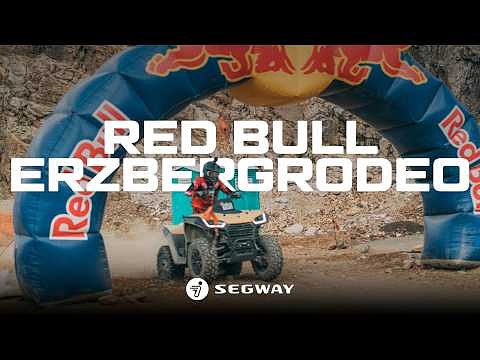
- 2026 Erzbergrodeo: Segway revived the ATV category after an 8-year absence, financing the 'Segway Quad Challenge'.
- AT10 Performance: The 999cc, 97-horsepower Segway AT10 successfully completed the race, piloted by riders with minimal prior experience.
- Global Team: Riders from the U.S., Germany, and Serbia participated, underscoring Segway's international strategy.
Experts would likely conclude that Segway's Erzbergrodeo gambit is a strategic reinvention, blending corporate ambition with cultural impact to reshape the off-road racing landscape.
Segway's Iron Giant Gambit: More Than a Race, A Corporate Reinvention
PLANO, TX – June 18, 2026 – On the surface, the story is a straightforward triumph. A global technology company, Segway Powersports, partnered with Red Bull to bring All-Terrain Vehicles (ATVs) back to the legendary Erzbergrodeo, the world's most punishing off-road race, after an eight-year absence. Their international team of riders, piloting the new Segway AT10, successfully conquered the Austrian 'Iron Giant.' It’s a compelling narrative of grit and engineering prowess. But a closer look reveals a far more intricate and strategic maneuver. This was not merely about winning a race; it was a public and forceful demonstration of corporate reinvention, a calculated play to embed a brand into the very DNA of a culture it seeks to lead.
The Ghost of Four Wheels Past
To understand the significance of Segway's achievement, one must first grasp the void it filled. ATVs are not new to the Erzbergrodeo. A quad classification was first introduced in 2005, but by 2018, the four-wheeled beasts had vanished from the mountain. A combination of waning manufacturer interest and a prolog course that grew increasingly hostile to quads led to the quiet discontinuation of the category. The Iron Giant, it seemed, had become the exclusive domain of two-wheeled enduro motorcycles.
The return of ATVs in 2026, therefore, was not a simple evolution but a deliberate resurrection. By sponsoring the new "Segway Quad Challenge," the company did more than just enter a race; it financed the creation of the platform on which it would compete. This move sidestepped the question of whether ATVs belonged at Erzberg and instead asserted their presence with corporate conviction. It was a forensic look at a gap in the market—and the cultural landscape—and a decisive move to fill it. For the global off-road community, it signaled that a new, serious player had not only arrived but was willing to invest in the structural integrity of the sport itself.
A Calculated Return to the Fray
Segway's history is one of pivots. From its origins as a revolutionary but niche personal transporter to its current identity under the Segway-Ninebot global conglomerate—a powerhouse in micro-mobility and robotics—the brand has constantly adapted. Its aggressive entry into the powersports arena is the latest, and perhaps most audacious, of these transformations. The Erzbergrodeo initiative is the cornerstone of this new identity.
Gabriel Cruz, Marketing Director of Segway Powersports U.S., articulated this mission with telling precision: "We didn't come to Erzberg to fit into off-road culture—we came to contribute to it." This is the language of a market-maker, not just a market participant. The statement reveals a strategy that transcends simple product marketing. It's about shaping the narrative, creating opportunities, and becoming an indispensable part of the ecosystem. By reviving a dormant racing class on one of the sport's biggest stages, the company has effectively become a patron of the very culture it wishes to capture.
This global ambition is further underscored by the international composition of the team, with riders from the United States, Germany, and Serbia. As Peter Pokorny, Marketing Director for Segway Powersports Germany, noted, it reflects a vision where international collaboration strengthens the brand's impact. This isn't just a German or American effort; it's a unified global front. In a world of fragmented markets, Segway is using the universal language of extreme sports to project a cohesive brand identity.
Baptism by Iron: The AT10's Trial
The technological centerpiece of this gambit was the Segway AT10. The Erzbergrodeo served as its ultimate baptism by fire, a real-world crucible far more convincing than any sterile test track or marketing brochure. The 999cc, 97-horsepower machine was piloted by a diverse team, including seasoned American racer Jacob Zuccone, who reportedly arrived in Austria with zero prior seat time on the vehicle. That he and the rest of the team successfully guided the AT10 to finishes on such unforgiving terrain speaks volumes about the machine's capability and, perhaps, its accessibility.
Herein lies another layer of the strategy. The AT10 is, tellingly, not yet available for purchase in the lucrative United States market, despite being offered globally. This makes the high-profile American involvement in the race—headlined by Zuccone and media figure Cain Smead of Dirt Wheels Magazine—a masterstroke of pre-marketing. It builds anticipation and validates the product in the most extreme way imaginable before it even hits U.S. showrooms. By conquering the Iron Giant, the AT10 arrives in the consumer consciousness not as an unknown quantity, but as a proven champion.
More Than a Race: Redefining the Playing Field
Segway's move is significant beyond its own corporate interests. It injects new energy and capital into a segment of off-road racing that had been left to stagnate. The successful reintroduction of ATVs at Erzberg could catalyze other race organizers and manufacturers, potentially sparking a renaissance for four-wheel hard enduro competition. It sets a new precedent for how a company can actively shape the evolution of a sport.
This act of revival and innovation at the 2026 Erzbergrodeo was not isolated. The same event saw electric motorcycles make their own historic mark, with multiple riders completing the race on nearly silent machines. The simultaneous success of a resurrected ATV class and a burgeoning electric class points to a broader trend: the diversification and technological disruption of traditional motorsports. Established systems are being challenged, and the very definition of off-road racing is expanding. Segway, a company built on electric mobility, has astutely positioned itself within this transformation by championing a traditional combustion category, demonstrating a nuanced understanding of the culture. By investing in the sport's heritage while its parent company pioneers its future, Segway is not just competing for market share; it is vying for a permanent place in the soul of the off-road world.