
- $21 million: Cost of over one million discounted or donated testing requisitions in 2025, up from $18 million in 2023.
- 2.1 percentage points: Improvement in workforce retention compared to 2024.
- 5 laboratories: Certified under ISO 14001:2015, meeting rigorous environmental standards.
Experts would likely conclude that Quest Diagnostics' 2025 ESG report demonstrates a strategic, measurable approach to corporate responsibility, linking social impact directly to long-term business resilience and industry leadership.
Quest Diagnostics' ESG Report: A New Benchmark for Healthcare?
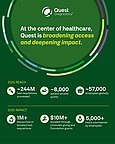
SECAUCUS, NJ – June 16, 2026 – Quest Diagnostics (NYSE: DGX), a titan in the U.S. diagnostic services market, today released its 2025 Corporate Responsibility Report, a detailed accounting of its progress on the environmental, social, and governance (ESG) fronts. The report, themed "At the Center of Healthcare," frames the company's efforts across four pillars: health access, employee engagement, governance, and environmental sustainability, marking progress against ambitious goals set back in 2021.
In a statement accompanying the release, Chairman, CEO, and President Jim Davis emphasized the role of Quest's nearly 57,000 employees. "Our care for the many communities we serve and live in shines through the actions we've taken to broaden healthcare access and improve our employee experience and environmental impact," he said. Davis highlighted investments in people and strengthened policies in areas like medical quality and AI as reflections of a "deep focus on responsible business practice."
While corporate responsibility reports are now standard fare for publicly traded companies, Quest's document warrants a closer look. It moves beyond platitudes to present a multi-year narrative of specific, measurable actions. For a company that serves one in three adult Americans annually, these initiatives have the potential to create significant ripples. But do they set a new standard for the industry? A deeper analysis of the report's claims reveals a methodical strategy to link corporate responsibility directly to long-term business resilience and market leadership.
Translating Dollars into Access: A Community Impact Analysis
A central claim in the 2025 report is the company's commitment to health access. Quest reports providing over one million discounted or donated testing requisitions, representing a cost of more than $21 million. This initiative is a cornerstone of its Quest for Health Equity (Q4HE) program, which also saw targeted investments in non-profits focused on healthcare and nutrition in underserved communities in Baltimore, Paterson, and Chicago.
These figures are not an anomaly but part of a consistent, escalating investment. In 2023, the company reported a similar program costing over $18 million for more than 950,000 requisitions. This steady increase in both volume and financial commitment demonstrates a sustained effort to leverage its core competency—diagnostic testing—to address systemic health inequities. For a diagnostic leader, providing access to its services is the most direct way to make an impact, moving beyond simple cash donations to deploy its primary assets for social good.
However, the true test of such programs lies in their tangible outcomes. While the financial inputs are clear, quantifying the direct impact on patient health in these specific communities remains a complex challenge that often extends beyond the scope of a corporate report. The success of Q4HE will ultimately be measured by long-term health improvements in these targeted areas, a metric that requires sustained partnership with local health organizations and academic researchers. Nonetheless, in a healthcare landscape defined by rising costs and access disparities, Quest's consistent, multi-million dollar investment positions it as a proactive partner in community health, bolstering its brand reputation and social license to operate.
Winning the War for Talent in a Turbulent Sector
Perhaps one of the most strategically significant achievements highlighted in the report is on the human capital front. Quest announced a 2.1 percentage point improvement in overall workforce retention compared to 2024 and an Employee Engagement score three points above a non-specified healthcare industry benchmark. In an industry plagued by burnout and high turnover, these metrics are more than just HR jargon; they are indicators of operational stability and a potential competitive advantage.
The broader healthcare sector has been grappling with a staffing crisis, with average annual turnover rates hovering between 19% and 23% in recent years. While Quest does not disclose its absolute turnover rate, a 2.1 percentage point improvement against such a challenging backdrop is a noteworthy achievement. It suggests the company's strategies for employee well-being and professional development are bearing fruit.
One tangible driver of this success appears to be the company's Employee Business Networks (EBNs). The report notes that these groups welcomed over 2,500 new employees, bringing total membership to over 11,000 across eleven networks. This represents significant growth from approximately 8,000 members reported in 2023. These networks provide a crucial infrastructure for fostering inclusion, mentorship, and a sense of belonging—key ingredients for retaining talent. For a company whose services depend on the precision and dedication of tens of thousands of technicians, phlebotomists, and scientists, a stable and engaged workforce is a critical asset that directly impacts quality and reliability.
Fortifying Governance: From AI Ethics to Environmental Crises
Quest’s report also signals a proactive stance on managing emerging risks, particularly in governance and environmental sustainability. The company announced the creation of a new senior vice president and chief quality and regulatory affairs officer role, a structural move designed to centralize and elevate oversight. More pointedly, it highlighted enhanced governance frameworks for both AI and cybersecurity.
This focus is timely. As artificial intelligence promises to revolutionize diagnostics, it also introduces complex ethical questions around data privacy, algorithmic bias, and accountability. By explicitly stating its intent to promote the "responsible use of AI," Quest is acknowledging these risks and signaling to regulators and patients that it is building guardrails for future innovation. While the report lacks specific details on its AI ethics framework, the public commitment aligns with best practices and sets a foundation for future transparency. Similarly, bolstering cybersecurity governance by aligning with standards like the NIST framework is not just a defensive posture but a necessary requirement for protecting the sensitive health data of millions of Americans.
On the environmental front, Quest has moved from pledges to proven systems. The achievement of its goal to certify five major laboratories under the ISO 14001:2015 standard—a rigorous international benchmark for environmental management—demonstrates a systematic, enterprise-wide approach to sustainability. This is further illustrated by the company's response to real-world environmental health crises. The report details support for testing individuals affected by the devastating 2025 Palisades fire in Los Angeles and citizens in a designated cancer cluster in Texas. This work directly connects Quest's diagnostic capabilities to urgent public health needs, powerfully demonstrating its role "at the center of healthcare" and turning its ESG commitments into tangible, impactful action.