
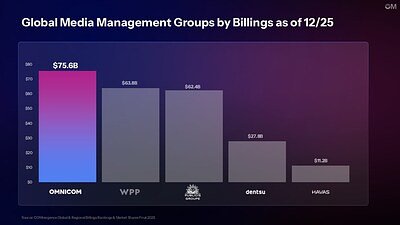
- $75.6 billion: Omnicom Media's total billings for 2025, commanding a 31% share of global media managed by major holding companies.
- $11.8 billion lead: Omnicom Media finishes 2025 $11.8 billion ahead of its nearest competitor, WPP.
- $900 million: Targeted cost-reduction synergies for 2026, aiming for $1.5 billion in annual savings by mid-2028.
Experts would likely conclude that Omnicom's unprecedented scale and strategic acquisitions have fundamentally reshaped the advertising industry, creating a dominant player with unmatched leverage in data, media buying, and technology.
Omnicom's New Reign: How a $75 Billion Titan Will Reshape Advertising
NEW YORK, NY – June 19, 2026 – The global advertising landscape has a new, undisputed titan. A report released this week by industry research firm COMvergence confirms that Omnicom Media, the integrated entity born from Omnicom’s blockbuster acquisition of rival IPG, is now the world’s largest media management organization. The numbers are staggering: total billings of $75.6 billion for 2025, commanding a 31% share of all global media managed by the major holding companies.
This isn't just a marginal victory; it's a seismic shift. The new behemoth finishes the year $11.8 billion ahead of its nearest competitor, WPP, and $13.2 billion ahead of Publicis. The ranking is the first official measurement of the combined power of Omnicom Media Group and IPG Mediabrands since the ink dried on the historic merger in late November 2025. This move effectively consolidates the industry's "Big Six" into a more top-heavy "Big Five," fundamentally altering the competitive dynamics that have defined advertising for a generation.
Beyond the global headline, Omnicom Media has also cemented its dominance in key regions, claiming the top spot in North America with $35.9 billion in billings and in the crucial U.S. market with $33.1 billion. This isn't just a story about getting bigger; it's the story of a calculated, high-stakes strategy to achieve a level of scale previously unseen in the industry. The question now is what Omnicom will do with this immense power.
The Architecture of a Behemoth
The creation of this media giant was no accident. It is the result of Omnicom’s ambitious $9 billion all-stock acquisition of Interpublic Group, a deal designed explicitly to create the world's leading marketing and communications company. The strategic rationale, as articulated by leadership during the acquisition, was to build an entity with unmatched leverage across data, media buying, creative services, and technology. The COMvergence report is the first tangible proof that the initial phase of that strategy—achieving unparalleled scale—has been a resounding success.
The financial underpinnings of the merger are equally aggressive. The company is targeting a staggering $900 million in cost-reduction synergies in 2026 alone, with a goal of reaching $1.5 billion in annual savings by mid-2028. These efficiencies are expected to come from the consolidation of back-office functions, IT systems, and real estate, creating a leaner operational core to support the massive client-facing structure. It’s a classic playbook for building a resilient, cash-generating enterprise, but one executed on an unprecedented scale.
This new reality marks a dramatic reversal of fortunes. Just a year prior, in 2024, WPP Media held the top position. Now, it finds itself looking up at a competitor with a double-digit billion-dollar lead in billings. The merger has not only reshaped Omnicom but has forced every other player on the field to re-evaluate its position and strategy in a world where one competitor controls nearly a third of the market.
The Scale Dividend: A Promise to Clients and Talent
In the official announcement, Omnicom Media CEO Florian Adamski was quick to frame this new scale not as an end in itself, but as a means to an end. "The significance of these rankings isn't simply that we're the largest—it's what that scale enables," he stated. "It gives us greater access to data, stronger partnerships... more opportunities to invest in innovation, and more leverage to create better business outcomes."
Early signs suggest major clients are buying into this vision. The 2025 rankings were bolstered by significant wins like Amazon, Paramount, and Volvo. More telling, however, is the momentum post-integration. In the first half of 2026, the company has already added $2.5 billion in new billings from giants like Delta, Dyson, and IBM. The decision by Dyson to keep its $500 million global media account, previously with IPG, within the new Omnicom Media structure is a powerful vote of confidence. Sources close to the decision cited the merged entity's superior technology, data capabilities, and global scalability as key factors. Similarly, winning IBM's highly sought-after $190 million global media account after a competitive pitch demonstrates that the promise of integrated power is resonating with the world's most sophisticated marketers.
However, Adamski also extended the promise of scale to the company's 40,000+ employees, suggesting it creates "more opportunities to build careers." This is where the narrative becomes more complex. The immense pressure to achieve cost synergies inevitably involves difficult decisions. Industry analysts have pointed to the operational overlap between the two former holding companies, with one consulting firm estimating that the integration could ultimately lead to a significant reduction in headcount. The challenge for Omnicom's leadership will be to balance the ruthless efficiency required by the merger's financial logic with the need to foster a cohesive culture that retains and motivates top talent. True permanence is built not just on balance sheets, but on the strength and stability of its people.
The Engine Room: Data, AI, and the Omni Platform
In the 21st century, scale without intelligence is simply dead weight. Omnicom’s strategy for sustained leadership appears to rest on its ability to infuse its massive operations with data-driven precision. Central to this effort is the Omni Intelligence Platform, the company's proprietary operating system designed to connect data, talent, and technology across its vast network.
This is where the true potential for value creation lies. By leveraging a unified data and analytics framework, Omnicom aims to move beyond the traditional benefits of media buying power—namely, pricing leverage—and offer clients more sophisticated advantages in targeting, personalization, and performance measurement. The firm is investing heavily in Artificial Intelligence to power this platform, seeking to automate insights and optimize campaigns in real-time. This focus on technology was a key factor in its recognition on Fast Company’s Most Innovative Companies 2026 list.
With its new market-defining scale, Omnicom Media has the resources to out-invest competitors in the technological arms race that now defines modern advertising. The successful integration of its legacy agencies—including top-ranked OMD, PHD, and the former IPG powerhouses UM and Initiative—into this single, AI-powered ecosystem will be the ultimate test of its strategy. If it succeeds, Omnicom will have done more than just become the biggest; it will have created a new model for what a media holding company can be.