
- 95% reduction in investigation time for network alerts or citizen complaints
- 78% of traffic professionals report overwhelming time spent analyzing performance measures
- Real-world testing in the City of Coquitlam demonstrated near-instantaneous root-cause analysis
Experts agree that Miovision's AI 'Copilot' Mateo represents a significant advancement in traffic management, automating tedious data analysis tasks and enabling engineers to focus on strategic urban mobility solutions while ensuring transparency and accountability through audit trails.
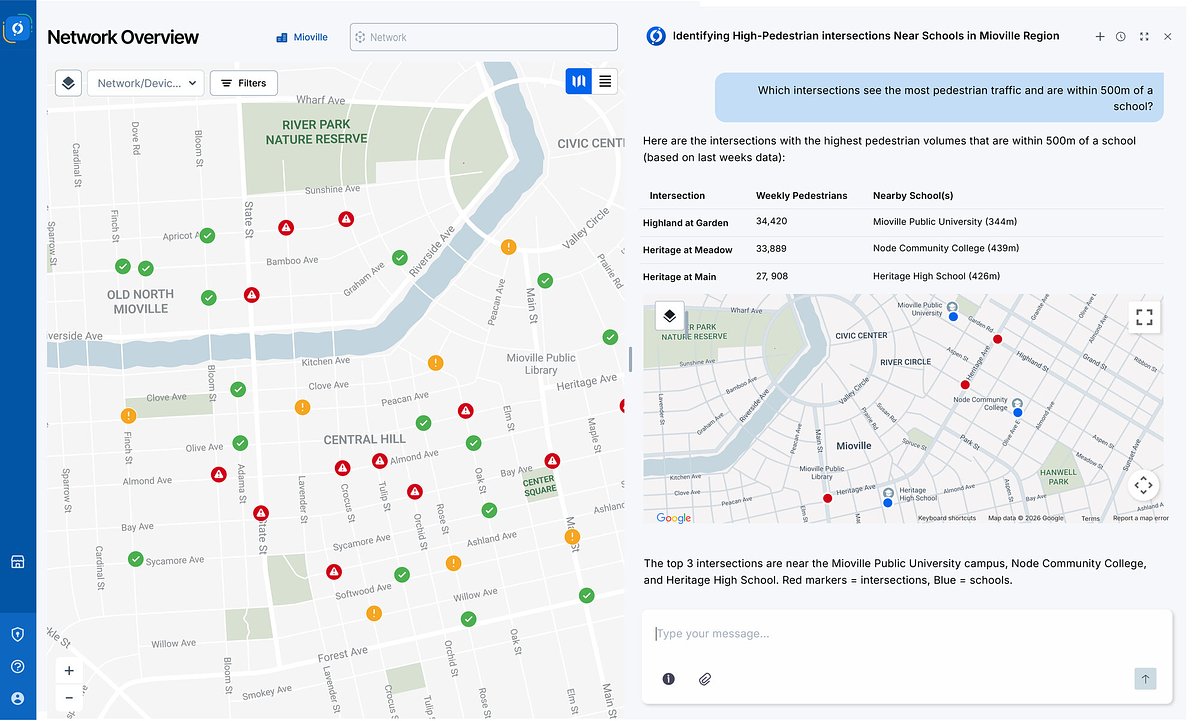
Miovision's AI 'Copilot' Promises to End Traffic Data Gridlock
KITCHENER, Ontario – April 07, 2026 – Traffic engineers, long buried under mountains of complex data, are being offered a new digital partner. Miovision, a global leader in intelligent mobility solutions, today announced the launch of Mateo™, a generative AI agent designed to act as a technical copilot for traffic professionals. The system promises to transform a process that often takes weeks of manual analysis into mere minutes of conversation, potentially revolutionizing how cities manage traffic flow, improve safety, and respond to incidents.
Mateo integrates directly into the company's Miovision One platform and allows traffic engineers to use natural language—simply asking questions in plain English—to diagnose network issues, analyze performance, and generate actionable insights. Instead of manually cross-referencing spreadsheets, sensor data, and video feeds, engineers can now ask the AI agent to investigate a citizen complaint or identify the root cause of congestion at a specific intersection.
"Traffic professionals have long spent hours sifting through mountains of data when they’d prefer to be tackling real mobility challenges,” said Kurtis McBride, CEO of Miovision, in the official announcement. “The Miovision GenAI Agent is the next step in our mission to transform ordinary intersections into intelligent systems that save time and empower traffic experts to work more proactively.”
From Data Drudgery to Strategic Design
The launch of Mateo addresses a critical and widely acknowledged pain point within the traffic management industry. A National Cooperative Highway Research Program Study found that 78% of traffic professionals report that modern performance measures, while valuable, require an overwhelming amount of time to analyze. This "hidden operational tax" sees highly skilled engineers spending the bulk of their days on administrative reporting and data wrangling rather than designing safer, more efficient road networks.
Mateo aims to eliminate this bottleneck. The company claims its AI agent can reduce the investigation time for network alerts or citizen complaints by up to 95 percent. By automating the tedious tasks of data collection, synthesis, and visualization, the platform is designed to free professionals to focus on higher-level strategic work—like optimizing signal timing for an entire corridor, planning for a major public event, or developing long-term strategies to meet Vision Zero safety goals. This shifts the role of the traffic engineer from a reactive data analyst to a proactive urban mobility architect.
A Conversational Partner for Urban Mobility
At its core, Mateo is more than a simple chatbot. It leverages a sophisticated reasoning engine powered by a Large Language Model (LLM) combined with a suite of agentic tools. This allows it to perform multi-step analysis, pulling information from siloed data sources like traffic sensors, hardware health monitors, and historical safety metrics.
"The technical breakthrough with the Miovision GenAI Agent lies in its ability to execute multi-step retrieval, reasoning, and data analysis to answer complex questions based on a city’s unique network data while following established traffic engineering standards," explained Brent Rogerson, Director of Solutions Engineering at Miovision. "This is what truly separates it from general-purpose GenAI and basic chatbots."
A key feature designed to build trust and ensure accountability is the agent's audit trail. Rogerson noted, "It also creates answers with an audit trail citing original data sources, ensuring high-confidence on how responses were made." This transparency is crucial for public infrastructure, as it allows engineers to verify the AI's conclusions and justify their decisions. The agent can generate cohesive visual charts, maps, and executive-ready summaries, enabling traffic departments to more easily demonstrate the return on investment for infrastructure projects to decision-makers and the public.
Real-World Results from the Road
Before its global launch, Mateo underwent extensive beta testing with municipal partners. The City of Coquitlam served as a primary testbed, providing real-world scenarios to refine the agent's capabilities. The feedback from this partnership validates many of the efficiency claims.
“At its most fundamental level, MATEO has saved us countless hours of complex data retrieval and analysis by leveraging generative AI and Miovision One," said Bernard Tung, a representative from the City of Coquitlam. "This efficiency alone makes the platform worthwhile, but its true value is in our ability to respond faster to complex queries and performance deficiencies."
Tung added that by synthesizing comprehensive results in real-time, the platform has become an "indispensable tool for maintaining a reliable traffic network." This real-world application demonstrates a tangible shift from weeks-long investigations to near-instantaneous root-cause analysis, a leap in operational efficiency that could be replicated in cities worldwide.
Navigating the Future of AI in Public Infrastructure
While many companies in the intelligent transportation system (ITS) sector utilize AI for functions like vehicle detection or signal optimization, Miovision's positioning of Mateo as a purpose-built generative AI agent for analysis and diagnostics appears to be a first for the industry. This move signals a broader trend of applying advanced AI not just to automate tasks, but to augment the cognitive workload of specialized professionals.
However, the deployment of such powerful AI in the public sphere raises important considerations. Ensuring data privacy through robust anonymization of traffic and movement data is paramount. Furthermore, the potential for algorithmic bias, where AI systems might inadvertently prioritize certain types of traffic or neighborhoods based on biased historical training data, must be actively mitigated. Miovision's approach of grounding responses in established engineering principles and providing an audit trail is a direct attempt to address these concerns, promoting transparency and human-in-the-loop oversight.
The introduction of tools like Mateo also reframes the conversation around job roles. Rather than replacing engineers, the goal is to empower them, transforming their function from data gatherers to strategic decision-makers who leverage AI as a powerful analytical tool. This will necessitate a focus on upskilling and adapting workflows within public works departments.
The Kitchener-based firm plans to continue expanding Mateo's capabilities, with applications for traffic planning and engineering expected later this year. This suggests a long-term vision for a single, connected platform where generative AI assists across the entire lifecycle of traffic management, from temporary data collection to long-range urban planning. As cities grow increasingly complex, such intelligent systems may become essential tools for creating safer, more efficient, and more responsive urban environments.