
- AI-powered features initially rolled out to Citymapper CLUB subscribers
- AI learns user preferences over time for personalized route recommendations
- AI summaries provide concise trade-offs between speed, cost, walking distance, and real-time service reliability
Experts would likely conclude that Citymapper's AI-powered personalization represents a significant advancement in urban navigation, offering commuters more intuitive and stress-free travel experiences while raising important data privacy considerations.
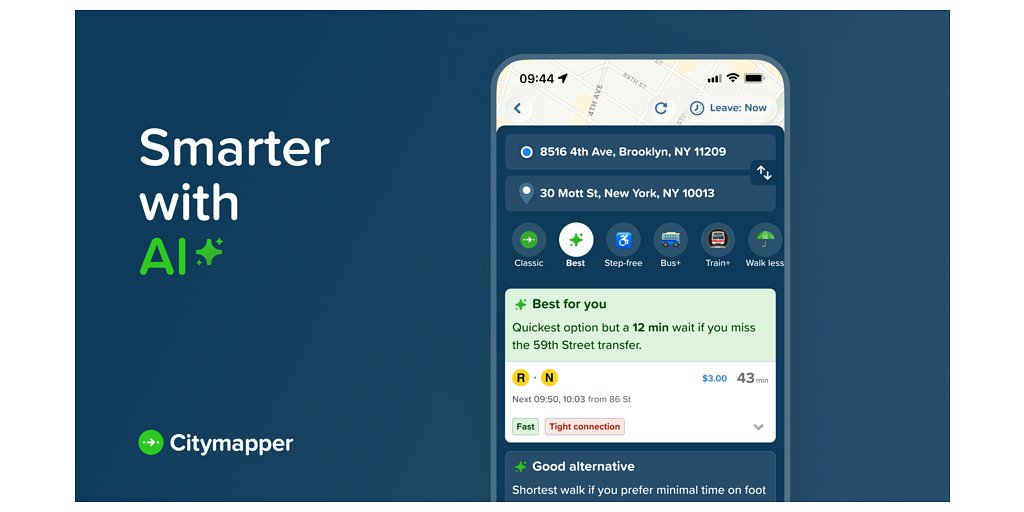
Citymapper's AI Learns Your Commute for a Personalized Trip
NEW YORK, NY – March 04, 2026 – The daily commute, often a rigid routine of navigating familiar yet frustrating transit options, is getting a dose of artificial intelligence. Citymapper, the popular urban navigation app, has officially launched a suite of AI-powered features designed to transform journey planning from a one-size-fits-all query into a personalized conversation.
The new functionality, initially rolled out to subscribers of its premium Citymapper CLUB service, aims to learn individual user preferences over time, offering route recommendations that go beyond simply being the fastest or cheapest. Parent company Via announced that the features, which will become available to all users in the coming weeks, represent a significant step toward a more intuitive and stress-free travel experience.
When planning a trip, users will now see AI-recommended options alongside standard results. More importantly, the app will provide an "AI summary" for each route, clearly articulating the trade-offs involved—weighing factors like speed, cost, walking distance, and even real-time service reliability.
"Our vision has always been to make urban travel stress-free," said Nithya Sowrarijan, Chief Product Officer of Via, in the announcement. "With the launch of these new features, Citymapper is moving beyond simple route-finding to a truly personalized travel companion. We're not just showing the multitude of public transit options available to you — we're guiding you towards the best journey for you."
Your Commute, Curated by AI
For years, transit apps have competed on the breadth of their data and the speed of their calculations. Citymapper's latest move suggests a new frontier: proactive personalization. The core of this new system is an AI engine that observes and learns from a user's historical travel choices.
If you consistently choose a route with a slightly longer walk to avoid a crowded subway line, the AI takes note. If you prioritize the absolute fastest journey, even if it means more transfers, that preference is logged. Over time, the app aims to anticipate your personal definition of an "optimal" route without you needing to manually filter the options each time. This contrasts with competitors like Google Maps or Moovit, where personalization often relies on user-defined settings—such as "prefer bus" or "fewer transfers"—rather than an adaptive learning process based on past behavior.
The AI summaries are designed to combat decision fatigue. Instead of presenting users with a wall of data—multiple lines, arrival times, and walking segments—the app will offer a concise, human-readable breakdown. A summary might read: "This route is 10 minutes faster but requires an extra transfer, while this other option is cheaper and has less walking." This transparency allows commuters to make informed choices that align with their priorities for that specific journey, whether they are rushing to a meeting or enjoying a leisurely day.
Powering the Future of Smart Cities
While the immediate benefits are targeted at the individual commuter, the implications of Citymapper's AI integration extend far beyond a single user's phone. The technology is a key component of parent company Via's broader mission to create dynamic, data-driven transportation networks for cities worldwide.
Via, which positions itself as the "technology backbone of a modern transportation network," partners with hundreds of cities and transit agencies to replace legacy systems and optimize operations. The granular, preference-based data generated by Citymapper's AI offers an unprecedented level of insight into how residents actually navigate their urban environments.
By analyzing aggregated and anonymized travel patterns, public transit agencies partnered with Via can gain a deeper understanding of commuter behavior. For example, if the AI identifies that thousands of users are consistently choosing a longer, multi-modal route to bypass a specific chokepoint in the system, that provides a powerful data point for city planners. It highlights a pain point that raw ridership numbers might miss, potentially informing decisions about service adjustments, new bus routes, or infrastructure investments. This moves beyond simply tracking where people are going, revealing why they make the choices they do.
This data-driven approach is central to the concept of the "smart city," where technology is leveraged to make urban services more efficient, responsive, and user-centric. By improving the passenger experience and making public transit more appealing, Via and Citymapper aim to increase ridership, which in turn helps cities reduce traffic congestion and lower carbon emissions.
The Price of Personalization
The promise of a perfectly tailored commute comes with an implicit trade-off, one that is becoming increasingly central to the digital age: data privacy. For an AI to "learn" your preferences, it must first "watch" your actions. This requires the collection and analysis of historical travel data, including routes taken, modes of transport chosen, and the times and frequencies of journeys.
Via's privacy policy outlines the collection of location and usage data to provide and improve its services, a standard practice for navigation apps. However, the move toward hyper-personalization based on long-term behavioral patterns puts a new emphasis on the sensitivity of this information. A detailed history of a person's movements can reveal a great deal about their life, from where they live and work to their social habits and personal appointments.
For Citymapper and Via, maintaining user trust will be paramount. This hinges on transparency about what data is being collected and how it is being used, as well as providing users with robust and easily accessible controls. Industry standards and regulations like GDPR mandate that users have the right to access and delete their data. It is expected that Citymapper will offer in-app settings allowing users to manage their privacy, potentially including an option to opt-out of the AI's learning features or clear their journey history.
The company's phased rollout, starting with its paying CLUB subscribers, provides a controlled environment to gather feedback not only on the feature's utility but also on user comfort levels with this new depth of data collection. The ultimate success of this ambitious AI-powered vision will depend not just on the cleverness of its algorithms, but on its ability to prove to millions of commuters that the convenience of a personalized journey is worth the price of the data required to create it.
Topics & Related
Software & SaaS
AI & Machine Learning
Artificial Intelligence
Regulation & Compliance
Generative AI
Machine Learning
Data-Driven Decision Making
Geopolitics & Trade
Acquisition
Revenue
Related Company Pulse