
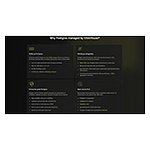
- 10x faster performance for disk-bound workloads compared to common cloud offerings
- 100x faster analytical queries when using the unified query layer
- Microsecond latency achieved through co-located NVMe storage and compute resources
Experts would likely conclude that ClickHouse's native Postgres integration represents a significant advancement in unifying transactional and analytical workloads, potentially simplifying AI-driven application development by eliminating traditional architectural complexities.
ClickHouse Unifies Data Stack with Native Postgres Service for AI
SAN FRANCISCO, CA – January 22, 2026 – ClickHouse, Inc., the company behind the high-speed analytical database, has announced a significant strategic expansion with the launch of a high-performance, enterprise-grade Postgres service. Developed in a key partnership with open-source cloud company Ubicloud, the new offering is natively integrated with ClickHouse's core analytical engine, creating a unified data stack designed to streamline the development of modern, real-time, and AI-driven applications.
This move signals a major step for the company, extending its reach from purely analytical workloads into the realm of transactional data processing. By combining the world’s most popular transactional database, Postgres, with its own formidable analytical capabilities, ClickHouse aims to solve a long-standing architectural headache for developers and data engineers, promising a single, cohesive foundation for applications that require both rapid transactions and deep, real-time analytics.
Bridging the Transactional-Analytical Divide
For decades, application architecture has been defined by a fundamental separation between two types of databases: Online Transaction Processing (OLTP) systems and Online Analytical Processing (OLAP) systems. OLTP databases, like PostgreSQL, are optimized for fast, frequent, small-scale transactions, such as processing an order or updating a user profile. In contrast, OLAP databases, like ClickHouse, are columnar stores built to execute complex queries across massive datasets at incredible speeds, powering dashboards, reports, and analytical models.
While effective, this separation creates significant complexity. Development teams are forced to manage two disparate systems, building and maintaining complex data pipelines (ETL/ELT processes) to move data from the transactional database to the analytical one. This introduces latency, increases operational overhead, and adds cognitive load for developers who must work across different systems and query languages.
The rise of AI and real-time applications has amplified these challenges. A modern AI-powered feature, for example, might need to instantly retrieve a user's latest data (an OLTP task) while simultaneously running a complex analytical query over billions of historical data points to inform a recommendation or prediction (an OLAP task). The friction between these two worlds can stifle innovation and slow down performance.
ClickHouse's new offering directly confronts this issue. “Postgres and ClickHouse have become foundational technologies for modern AI applications,” said Aaron Katz, CEO of ClickHouse, in the announcement. “With our native Postgres service, we’re unifying transactional and analytical workloads, so developers can build any type of application powered by AI on the best technical foundation.” The goal is to provide the best of both worlds without the traditional trade-offs, enabling a single, simplified architecture.
Under the Hood: A High-Performance Integration
The unified stack is more than just a bundling of two services; it is a deeply integrated system designed for performance and ease of use. The foundation is a high-performance managed Postgres service, provided through the partnership with Ubicloud. This service runs on high-throughput NVMe storage that is physically co-located with compute resources, a design choice that delivers microsecond latency and significantly higher I/O operations per second (IOPS) compared to common cloud offerings that rely on network-attached storage like Amazon's EBS. This architecture alone promises up to 10x faster performance for disk-bound workloads.
Data synchronization between the transactional and analytical layers is handled through native Change Data Capture (CDC). This technology, partly powered by ClickHouse's 2024 acquisition of Postgres-focused company PeerDB Inc., allows for the near-instantaneous replication of data from Postgres to ClickHouse. As transactions occur in the Postgres database, the changes are streamed to the ClickHouse analytical engine within seconds, ensuring that analytical queries are always running on fresh, up-to-date data.
The final piece of the puzzle is a unified query layer, enabled by a powerful Postgres extension called pg_clickhouse. This extension allows developers to query the ClickHouse database directly from their familiar Postgres environment. Analytical queries are transparently pushed down to ClickHouse, which executes them at speeds up to 100 times faster than a standard Postgres instance could achieve. This eliminates the need for developers to switch contexts or manage separate connections, effectively making Postgres the single pane of glass for both transactional and analytical operations.
An Alliance of Open-Source Champions
This initiative is not just a product launch but also a story of strategic open-source collaboration. ClickHouse's choice of partner, Ubicloud, is critical. Founded by the seasoned team that built the distributed PostgreSQL solution Citus Data (later acquired by Microsoft), Ubicloud brings world-class expertise in delivering high-performance, enterprise-grade Postgres. Their commitment to open-source principles and performance-driven engineering made them a natural fit.
“Postgres and ClickHouse complement each other naturally and are key for AI applications. Together, we’re delivering an integrated stack that removes complexity for teams,” stated Umur Cubukcu, Co-CEO and Co-Founder of Ubicloud. “We’re excited to join forces with ClickHouse at Ubicloud because this is how the open-source ecosystem wins: trusted teams building best-in-class products that work and grow together.”
This partnership underscores a growing trend in the software industry: combining best-of-breed open-source technologies to create solutions that are more powerful and flexible than monolithic, proprietary alternatives. By integrating two of the most respected open-source data technologies, the companies are providing a pathway for developers to build on a robust, community-supported foundation without vendor lock-in.
Market Impact and a Simplified Future
The strategic implications of this launch are substantial. It repositions ClickHouse from a specialized analytical database into a comprehensive data platform provider, directly competing with cloud giants and other converged database vendors. The move validates an existing pattern in the industry, where thousands of companies, including leaders like GitLab, Instacart, and Cloudflare, already use Postgres and ClickHouse in tandem. This new service simply formalizes and optimizes that popular combination.
The value proposition is resonating with customers who have been grappling with this integration challenge themselves. Noah Pryor, the CTO of Beehiv, a large ClickHouse customer, shared his enthusiasm for the launch. “We’re excited to see ClickHouse entering the Postgres ecosystem. At Beehiv, we rely heavily on both Postgres and ClickHouse to power our mission-critical, customer-facing applications,” he noted. “We’ve invested significant effort in integrating these technologies, so a tighter, more native integration between them would materially simplify our architecture.”
With a private preview now open for developer sign-ups, the industry will be watching closely to see how this unified stack performs in the wild. The launch represents a bold bet on a future where the lines between transactional and analytical workloads are blurred, offering a clear signal that the future of data platforms lies in integration, not isolation.