
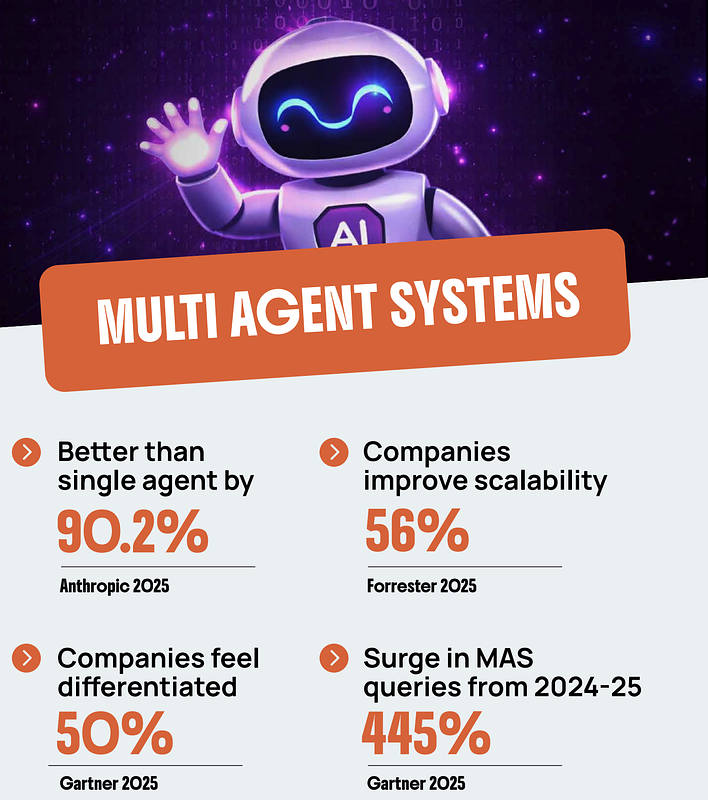
- 90% performance gain: Multi-agent AI systems outperform single AI models by over 90% on complex tasks (Anthropic).
- 1,445% surge: Enterprise interest in multi-agent systems grew by 1,445% between 2024-2025 (Gartner).
- 65% of CMOs: Believe AI will fundamentally change their role within two years (Gartner 2025).
Experts agree that autonomous AI agents will revolutionize marketing by 2026, shifting focus from campaigns to continuous, adaptive systems, though significant technical, ethical, and adoption challenges remain.
Marketing's AI Overlords: Agents, Not Campaigns, to Rule by 2026
MUMBAI, India – February 06, 2026 – The era of human-led marketing campaigns is drawing to a close, to be replaced by a new paradigm where autonomous artificial intelligence agents orchestrate everything from customer segmentation to final sales. This is the central, disruptive thesis of the Netcore Agentic Predictions 2026 report, a new analysis suggesting that 2026 is the inflection point where marketing moves from AI experimentation to full-scale agentic execution.
The report, released today by marketing technology firm Netcore Cloud, synthesizes research from industry giants like Gartner, Forrester, and McKinsey. It paints a near-future where marketing departments no longer build campaigns but instead manage swarms of intelligent agents that operate continuously, adapting in real time to customer needs and business goals. This shift, driven by concepts like multi-agent systems and 'Brand Twins,' promises to fundamentally reshape commerce, leadership roles, and the very definition of brand engagement.
The Rise of the AI Marketing Swarm
At the heart of this transformation is the move from isolated AI tools to sophisticated multi-agent systems (MAS). Unlike generative AI, which responds to prompts to create content, agentic AI involves autonomous agents that can strategize, act, and learn with minimal human intervention. A MAS functions like a highly efficient team, with a lead orchestrator delegating specialized tasks—such as content creation, audience segmentation, and performance optimization—to a fleet of subordinate agents.
The performance gains are staggering. Research from AI safety and research company Anthropic found that a multi-agent approach outperformed a single, powerful AI model by over 90% on complex research tasks. This leap in capability is driving rapid enterprise interest, with Gartner reporting a 1,445% surge in queries related to multi-agent systems between 2024 and 2025. According to Forrester research cited in the report, 56% of organizations already see improved scalability after adopting such approaches.
This new operating model replaces fragmented marketing technology stacks and the endless manual coordination they require. Instead of marketers piecing together data and launching discrete campaigns, self-optimizing AI engines will work around the clock, creating a continuous, adaptive dialogue with the market.
Winning Hearts, Minds, and Algorithms
This technological shift is a direct response to a deepening crisis in marketing: the collapse of human attention. With the average attention span now reportedly shorter than that of a goldfish and a HubSpot study indicating 73% of consumers merely skim content, the traditional model of mass outreach is failing. Brands are shouting into a void.
Netcore's report posits a solution it calls "Brand Twins"—always-on, brand-owned AI agents that act as digital doppelgangers for a brand's relationship with each individual consumer. A Brand Twin would continuously learn a user's intent, preferences, and behavior, not to bombard them with more messages, but to enable fewer, more relevant, and more valuable interactions. Marketing becomes quieter, more contextual, and built on a foundation of demonstrated understanding and trust.
This creates a new dual-audience reality for brands. Marketing must now appeal to two distinct entities: the human consumer and their AI agent gatekeepers. These agents, whether consumer-owned or platform-embedded, will filter choices, compare options, and even negotiate prices autonomously. As Gartner predicts AI agents will influence 20% of e-commerce transactions by 2030, brands face the challenge of creating messaging that is emotionally resonant for humans and logically compelling for the algorithms that serve them.
A New Mandate: From Campaign Creator to Chief AI & Profits Officer
The automation of execution is set to trigger a profound upstream shift in leadership accountability. As AI agents take over the tactical 'how' of marketing, the role of the Chief Marketing Officer (CMO) is poised for a radical redefinition. According to a 2025 Gartner survey, 65% of CMOs already believe AI will fundamentally change their role within two years.
Netcore's report forecasts the evolution of the CMO into a "Chief AI and Chief Profits Officer." The focus will move away from managing campaigns and teams toward orchestrating complex AI systems and owning measurable growth outcomes. "2025 was about proving that AI works. 2026 will be about proving that it delivers," said Rajesh Jain, Founder & MD of Netcore Cloud, in the press release. "As autonomous agents take over execution, marketing's real constraint is no longer technology—it's attention, outcomes, and accountability."
This transformation will ripple through the entire marketing profession. Routine tasks will be automated, but the need for strategic human oversight will intensify. Future-proof marketers will be those who can collaborate with AI, interpret its outputs, ask the right questions, and ensure its actions align with brand values and ethical standards. The most valuable skills will shift toward data analysis, prompt engineering, and a deep understanding of AI ethics and governance.
Reality Check: Bridging the Agentic Gap
Despite the revolutionary promise, the path to an agentic future is fraught with challenges. The marketing technology landscape is already a source of significant frustration. The Netcore report highlights that 55% of marketers are dissatisfied with their martech's cost-versus-value, and a staggering 99% underutilize their existing tech stack. This has led to a predicted industry-wide pivot toward outcome-based pricing, where vendors are paid for results like revenue and conversions, not software licenses.
Furthermore, experts warn of an "agentic reality gap." While exploration is rampant, many organizations are struggling to move pilots into production. Consulting firm Deloitte notes that only a small fraction of companies have successfully deployed agentic solutions, and Gartner has forecast that over 40% of agentic AI projects could be canceled by 2027 due to escalating costs, unclear business value, or legacy system incompatibility.
Beyond the technical and financial hurdles lies a minefield of ethical concerns. Autonomous agents trained on biased data can perpetuate discrimination, while their ability to collect and process personal information raises profound privacy questions. Establishing clear lines of accountability for the decisions made by non-human agents is a complex challenge that organizations must address to maintain consumer trust. For brands and marketers, the race is on not just to adopt this new agentic paradigm, but to master it responsibly before their competitors do.