
- Most overused phrase: 'Reaching out' appeared in 6,117 emails
- Top 3 phrases: 'Follow up' (5,755 emails) and 'Check in' (4,286 emails)
- AI involvement: Nearly 1 in 4 employees use AI tools to draft emails, perpetuating jargon
Experts suggest that corporate jargon persists due to a mix of politeness, social conditioning, and cognitive ease, but breaking free from these phrases can enhance clarity and professional impact.
Just 'Reaching Out'? Study Reveals Our Most Overused Email Habits
SANTA BARBARA, CA – January 21, 2026 – If you’ve ever hesitated before typing "I hope this email finds you well," you’re not alone. A new landmark study has quantified our collective reliance on email clichés, revealing that phrases once seen as polite formalities have become deeply ingrained, and even our AI assistants are picking up the habit.
The study, conducted by email deliverability company ZeroBounce, analyzed over one million real work emails and crowned "reaching out" as the most overused phrase in modern business communication. The findings paint a vivid picture of a professional world that, despite its focus on innovation and efficiency, remains tethered to a lexicon of vague, familiar buzzwords.
The Data Behind the Jargon
The comprehensive analysis provides a definitive ranking of the phrases professionals just can't quit. By examining a dataset of 1,000,967 emails sent between January 2024 and October 2025, the study moved beyond anecdotal complaints to offer concrete evidence of our most common linguistic crutches.
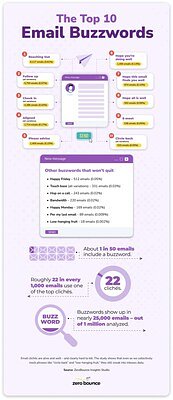
Topping the list, "reaching out" appeared in 6,117 emails. It was followed closely by variations of "follow up" (5,755 emails) and "check in" (4,286 emails). These phrases often serve as soft openings, buffering the true purpose of the message.
The top ten most prevalent buzzwords include:
1. Reaching out: 6,117 instances
2. Follow up: 5,755 instances
3. Check in: 4,286 instances
4. Aligned: 1,714 instances
5. Please advise: 1,459 instances
6. Hope you're doing well: 1,300 instances
7. Hope this email finds you well: 974 instances
8. Hope all is well: 592 instances
9. E-meet: 536 instances
10. Circle back: 533 instances
Notably, the various "hope" greetings collectively appeared in nearly 3,000 emails, underscoring a widespread tendency to begin correspondence with a polite, if formulaic, pleasantry. Even the much-maligned phrase "per my last email," a passive-aggressive classic, made an appearance in 89 emails, proving that even widely mocked jargon has a long shelf life. Other familiar terms like "touch base," "hop on a call," and "bandwidth" also featured prominently, confirming their status as staples of the corporate vocabulary.
The Psychology of 'Circling Back'
The persistence of these phrases offers a fascinating glimpse into workplace psychology. Experts suggest that the use of such jargon isn't merely a bad habit but is rooted in a complex mix of politeness, social conditioning, and a fundamental fear of being perceived as too direct. In many corporate cultures, directness can be misinterpreted as aggression or impatience.
Linguistic hedges—phrases that soften a statement or request—are a key component of this phenomenon. Openings like "Hope you're doing well" or "Just checking in" act as buffers, easing the sender and receiver into the core message. They signal a desire to maintain a positive relationship before making a demand on the recipient's time or resources. Similarly, a phrase like "please advise" can be a polite way to request guidance, but it can also function as a subtle way to transfer responsibility, effectively saying, "This is your problem now."
This linguistic padding is also a product of cognitive ease. In a fast-paced environment where professionals send and receive dozens or even hundreds of emails a day, falling back on familiar formulas requires less mental energy than crafting a fresh, original message each time. Jargon becomes a form of shorthand, a way to signal intent without having to spell it out. For members of a specific team or industry, it can even foster a sense of in-group identity. However, when used with external partners or clients, this same language can become a barrier, creating confusion and sounding exclusionary rather than professional.
The AI Mirror: How Bots Learned Our Bad Habits
Perhaps the most surprising revelation from the study is the role of artificial intelligence in this cycle. With nearly one in four employees now using AI tools to help draft emails, one might expect a move toward clearer, more efficient language. Instead, the opposite appears to be happening: AI is learning and perpetuating our reliance on clichés.
"The same buzzwords keep sneaking back into our inboxes – and even AI has picked up on our bad habits," says ZeroBounce CEO Liviu Tanase. "The bots are 'reaching out' and 'circling back.' We laugh at corporate jargon, but we keep using it, and we've trained machines to sound just like us."
This occurs because AI language models are trained on vast datasets of existing human text, including billions of emails. If those emails are filled with phrases like "let's align" and "touch base," the AI will learn that this is the standard for professional communication. When prompted to write a business email, it reproduces the patterns it has observed most frequently, effectively holding up a mirror to our own linguistic tendencies. The result is a homogenization of language, where both human- and AI-generated emails begin to sound indistinguishable and equally generic.
This dynamic presents a new challenge for the future of workplace communication. While AI offers unprecedented efficiency, its uncritical adoption can lead to a loss of authenticity and personal voice. The risk is that instead of elevating our communication, we may be outsourcing it to systems that simply echo the blandest, most overused parts of our professional dialect.
Standing Out in a Crowded Inbox
While the study highlights a widespread problem, it also points toward a clear opportunity. In a sea of generic messages, an email that is clear, direct, and free of clichés can have a significant impact. According to ZeroBounce Chief Marketing Officer Anne Ghaltchi, "The findings reveal an opportunity for people to stand out at work and in business. Emails that skip the clichés tend to sound more confident and persuasive."
Breaking free from the jargon trap requires conscious effort. The first step is awareness—recognizing the crutch phrases in one's own writing. Instead of "reaching out," state the purpose of the email directly: "I'm writing to ask about the Q4 report." Instead of the vague "please advise," ask a specific question: "What would be the best next step for this project?"
This approach respects the reader's time by getting straight to the point. It also conveys confidence and clarity of thought, qualities that are highly valued in any professional setting. By replacing tired buzzwords with strong verbs and specific nouns, a message becomes more memorable and its intent becomes unmistakable.
Ultimately, effective communication is about connection and clarity. While politeness is important, it doesn't have to come at the expense of authenticity. As professionals navigate an increasingly digital and automated world, the ability to communicate with a clear, human voice is not just a stylistic choice—it is a powerful tool for building trust and making a genuine impact.