
- 99.9999999% uptime: The BEAM virtual machine, originally designed for telecom, achieves 'nine nines' of uptime, translating to just milliseconds of downtime per year. - Minority of organizations: Only a minority of organizations successfully scale AI beyond the experimental stage, according to a 2025 McKinsey report. - Gartner prediction: A significant percentage of agentic AI projects will fail due to reliability issues, per Gartner.
Experts agree that the future of production AI lies in leveraging proven, battle-tested technologies like the BEAM virtual machine and Elixir, which offer unparalleled reliability and fault tolerance for enterprise-grade AI systems.
Why a 40-Year-Old Telecom Technology Is the Future of Production AI
WILMINGTON, Del. – May 14, 2026 – As artificial intelligence transitions from experimental labs to the front lines of business, a persistent and costly problem is emerging: production fragility. AI systems that perform flawlessly in development often crumble under the unpredictable pressures of real-world use. In response, AI-native marketing platform Marketeam.ai is championing an unconventional solution, drawing on decades of battle-hardened engineering from the telecommunications industry.
Through a series of technical presentations at major European software conferences, the company has pulled back the curtain on its architecture, built on Elixir, Phoenix, and the BEAM virtual machine. Their message is clear: the key to building the next generation of reliable, enterprise-grade AI doesn't lie in the newest, flashiest tools, but in the proven principles of concurrency, fault tolerance, and distributed systems that the BEAM has embodied for decades.
The Widening Chasm Between AI Promise and Production Reality
The gap between AI pilots and scalable, production-ready systems has become a primary bottleneck for enterprise adoption. Industry analysts paint a stark picture. Gartner, for instance, predicts that a significant percentage of agentic AI projects will fail due to reliability issues. This isn't just about code crashing; it's a more insidious problem of silent failures, where AI produces plausible but incorrect results, and performance drifts over time without obvious alerts. The result is a crisis of confidence that keeps promising AI initiatives perpetually stuck in a pilot phase.
Key challenges cited by industry leaders include managing long-running autonomous processes, ensuring concurrent state is handled correctly, and building systems that can gracefully tolerate faults without cascading failures. Traditional software infrastructure, often designed for stateless request-response cycles, struggles to cope with the demands of stateful, long-lived, and often non-deterministic AI agents. According to a 2025 McKinsey report, only a minority of organizations successfully scale AI beyond the experimental stage, frequently because the foundational infrastructure chosen for the pilot cannot support the demands of production.
This is the complex, high-stakes environment where Marketeam.ai is making its mark, not by inventing a new paradigm from scratch, but by applying a mature one to a new problem domain.
A Blueprint for Reliability from an Unlikely Source
At the heart of Marketeam's strategy is the BEAM, the Erlang virtual machine developed by Ericsson in the 1980s to run the world's telephone switches. The design brief for BEAM was extreme reliability; it needed to handle millions of concurrent connections and operate with "nine nines" of uptime (99.9999999%), which translates to just milliseconds of downtime per year. It achieves this through lightweight, isolated processes and a "let it crash" philosophy, where supervisors automatically restart failed components without bringing down the entire system.
Elixir, the modern language Marketeam uses, brings a friendly, productive syntax to the raw power of the BEAM. This combination has proven ideal for solving the core challenges of production AI. Coby Benveniste, Co-Founder and VP of Engineering at Marketeam, articulated this philosophy in a recent statement.
"When we started, we kept hitting the same problems everyone hits when they run AI in production: processes crashing, cascading failures, one slow task taking everything else down with it," said Benveniste. "Eventually, we realized that so much of this has already been solved. The BEAM has been handling process isolation and fault tolerance in telecom systems since the eighties, and we just pointed it at a different problem. Most of our reliability isn't clever engineering on our part, it's Elixir and the BEAM doing what they were already designed to do."
This perspective reframes infrastructure reliability not as a late-stage optimization but as a foundational strategic constraint for any serious AI product.
From Architectural Theory to Production-Tested Patterns
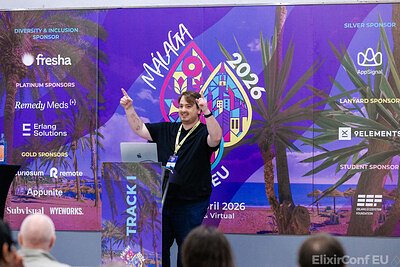
Marketeam has not just adopted this philosophy but is actively contributing its findings back to the engineering community. At recent conferences like CodeBEAM Europe 2025 and ElixirConf EU 2026, the company's engineers unveiled three specific, production-tested patterns that directly address common AI development pain points.
First, Benveniste's presentation, Beyond GenServers: Declarative AI Flows with gen_statem, tackled the orchestration of complex AI agents. Instead of using generic server processes, Marketeam advocates for using explicit state machines (gen_statem). This approach makes the agent's behavior more declarative, predictable, and easier to debug, materially improving the operational reliability of long-running reasoning and action loops common in autonomous AI.
Second, the company addressed the unique performance challenges of real-time applications built with Phoenix LiveView. In a talk titled A Murder of LiveViews, Benveniste challenged the common metric of raw concurrent connections as a poor indicator of health. Instead, Marketeam proposed focusing on metrics like render churn and event latency, which more accurately predict how systems fail at scale. To support this, the company open-sourced its LiveLoad framework, a tool that uses headless browsers to simulate thousands of coordinated users, allowing teams to surface real-world bottlenecks before they impact customers.
Finally, Software Engineer Ido Leshkowitz presented Lit Up LiveView, a solution for a growing challenge in the LiveView community: how to add rich client-side interactivity without resorting to heavy JavaScript frameworks like React or Vue. The talk demonstrated a lightweight pattern for integrating browser-native Web Components using the Lit library, preserving LiveView's simple server-rendered model while enhancing the user experience.
Charting a Different Path in the AI Arms Race
Taken together, these contributions position Marketeam among a small but influential group of companies forging a distinct path in AI system design. While much of the industry focuses on Python-based MLOps platforms and massive, monolithic infrastructure, Marketeam's approach is a masterclass in using the right tool for the job—even if that tool isn't the most hyped.
Their work suggests a future where the AI stack is more diverse. While Python will likely remain dominant for model training and data science, the critical task of deploying, orchestrating, and maintaining these models in production-grade, fault-tolerant systems may fall to other ecosystems. Frameworks like Elixir and the BEAM, with their inherent strengths in concurrency and resilience, are uniquely positioned to own this crucial layer of the AI stack.
By open-sourcing tools like LiveLoad and sharing their architectural patterns, Marketeam is not just building its own platform; it's providing a blueprint for others to follow. Their work serves as a powerful case study that as AI becomes an integral part of our business and infrastructure, the conversation must evolve from simply what AI can do, to how it can be done reliably, scalably, and with the operational resilience the modern world demands.