
- 6,200 customers: Workable's MCP Server impacts its entire customer base.
- 55% reduction in time-to-hire: Projected efficiency gain from AI orchestration.
- 68% cut in administrative costs: Forrester research on AI-driven automation savings.
Experts view agentic AI in HR as a transformative tool that augments human roles by automating repetitive tasks, while emphasizing the need for strict security and ethical governance to maintain trust and compliance.
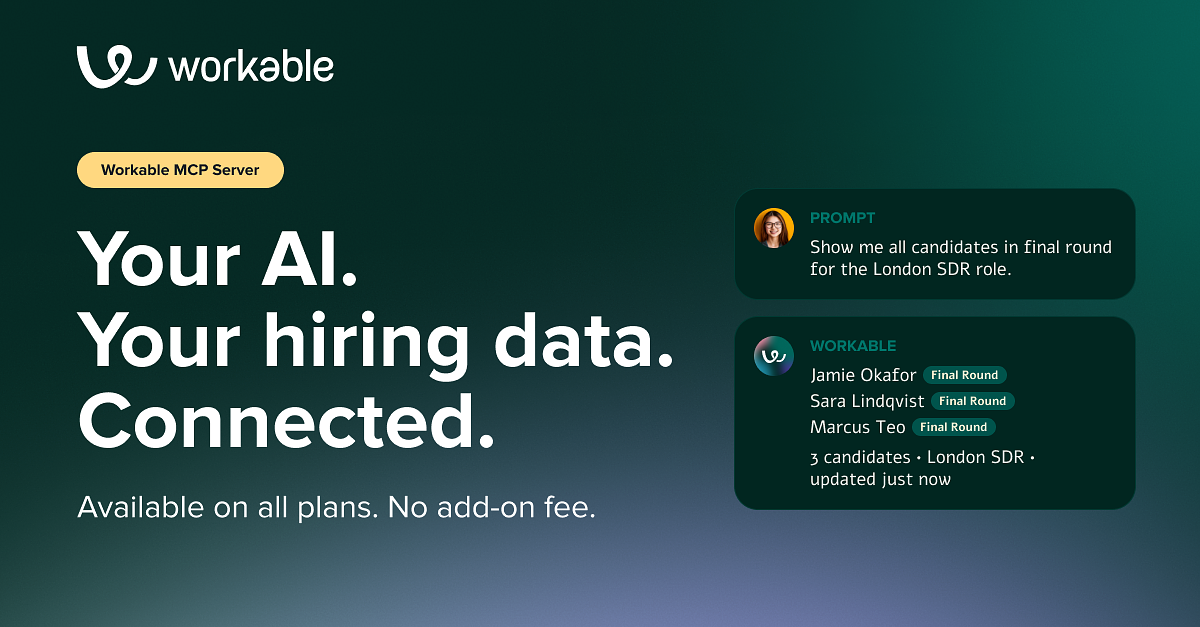
Workable's MCP Server Gives Agentic AI the Keys to HR Data
BOSTON, MA – May 13, 2026 – Recruiting and HR software provider Workable today announced the launch of its MCP Server, a move that enables AI assistants like Claude and ChatGPT to directly access and manipulate live company data. The integration signals a pivotal shift in enterprise software, moving beyond simple AI-powered suggestions to equipping AI with the agency to perform complex tasks directly within core business systems.
The new feature, built on the open-standard Model Context Protocol (MCP), gives conversational AI tools direct read and write access to a company's entire Workable database. This includes everything from job postings and candidate pipelines to employee time-off records and calendar events. For HR professionals, this promises to transform routine administrative work into a simple conversation, turning complex data queries and multi-step processes into tasks that can be delegated to an AI assistant.
The Universal Connector: MCP Goes Mainstream
Workable's announcement is significant not just for its 6,200 customers but for its adoption of the Model Context Protocol, a framework rapidly becoming the industry's default for connecting AI to the outside world. Originally developed by AI safety and research company Anthropic in late 2024, MCP was designed to solve the "N x M" integration problem, where every new AI model required a custom connection to every external tool.
Described by some as a "USB-C port for AI," the open standard provides a universal interface that allows AI models to interact with external data sources and execute functions. The protocol's adoption has been swift and decisive. OpenAI integrated MCP support for ChatGPT in 2025, followed by Microsoft shipping MCP servers for its GitHub, Azure, and Microsoft 365 ecosystems. By early 2026, Google had added MCP support to its Gemini API, and a recent survey of Chief Technology Officers found that two-thirds now consider MCP their default standard for AI agent integration.
By embracing this standard, Workable is betting on an open, interconnected future for AI rather than a closed, proprietary ecosystem. The move allows its platform to be immediately compatible with a growing number of powerful AI assistants, providing the integration at no additional cost across all subscription plans. Setup is designed to be simple, requiring a quick authentication process without developer involvement or the management of complex API keys.
From AI Assistant to AI Agent: Redefining HR Efficiency
The true impact of Workable's MCP Server lies in its ability to enable "agentic AI" within the HR workflow. This represents a significant evolution from the generative AI tools that have recently become popular. While generative AI excels at creating content like job descriptions or emails, agentic AI is designed to autonomously think, plan, and execute multi-step processes to achieve a specific goal.
Instead of merely generating a list of candidates, an HR manager can now ask a conversational AI, "Which candidates for the Senior Developer role have been in the interview stage for over five days and don't have a follow-up scheduled?" The AI agent can query Workable's live data, identify the relevant candidates, cross-reference their status with calendar data, and potentially even draft follow-up emails for the recruiter to approve and send.
This capability promises dramatic efficiency gains. Industry research projects that this level of AI orchestration can slash time-to-hire by up to 55%, reducing recruitment cycles from months to weeks. Forrester research suggests AI-driven automation can cut related administrative costs by 68%. For a company with over 1,000 employees, the operational savings from a fully integrated AI recruitment solution can reach millions annually. Workable is providing 38 distinct tools out of the box, covering workflows from sourcing and screening to managing employee time-off requests, turning the AI into a versatile, always-on team member.
The Crucial Questions of Security and Trust
Granting an AI direct read and write access to a company's most sensitive employee data—from performance reviews to salary information—inevitably raises critical questions about security, privacy, and ethical governance. An AI agent with such power could, if not properly controlled, perpetuate hidden biases or expose confidential information.
Workable's primary safeguard is a strict permission-scoping model. The company states that the MCP Server respects each user's existing access permissions within the platform. When a user authenticates their AI assistant, that session inherits their specific role and permissions. The AI can only see and act on the data that the human user is already authorized to access. This design ensures that a recruiter cannot use the AI to view confidential payroll data, and a manager cannot access the performance reviews of employees outside their own team.
This approach is a necessary foundation for complying with stringent data privacy regulations like Europe's GDPR and California's CPRA. These laws mandate strict controls on automated decision-making, requiring transparency, data minimization, and often a "human in the loop" for significant decisions like hiring or termination. As one data privacy expert noted, "The key is to build systems with auditable, human-centric oversight. The AI can do the legwork, but the final accountability must rest with a person." Organizations implementing these tools will need to conduct thorough data protection impact assessments and establish clear internal policies to govern their use, ensuring that the quest for efficiency does not compromise fairness and trust.
Augmenting the Human Element of HR
While the specter of automation often brings fears of job displacement, the prevailing view among industry experts is that agentic AI will augment, rather than replace, the HR professional. By automating the high-volume, repetitive tasks that consume much of a recruiter's or HR manager's day, these tools free up human capital for more strategic, high-value work.
With AI handling the initial screening of thousands of resumes, scheduling interviews, and tracking pipeline metrics, human recruiters can focus on building relationships with top candidates, negotiating complex offers, and acting as strategic talent advisors to the business. Similarly, when AI can instantly answer routine policy questions and process time-off requests, HR managers can devote more energy to employee development, conflict resolution, and cultivating a strong company culture.
Projections support this vision of a collaborative future. One recent report estimated a 327% growth in the adoption of AI agents by 2027, with 80% of CHROs expecting most workforces to feature people and AI agents working together within five years. The introduction of tools like Workable's MCP Server marks a concrete step toward this reality, fundamentally reshaping the role of the HR department from a primarily administrative function to a strategic driver of business success.