
- 40% of enterprise applications will feature task-specific AI agents by the end of 2026, up from less than 5% in 2025 (Gartner forecast).
- 180+ global enterprise customers, including 60+ Fortune Global 500 companies, have already adopted Tezign's GEA.
- 400+ callable modules in the Agent Skills Layer to convert complex workflows into reusable AI capabilities.
Experts view Tezign's GEA as a significant leap toward autonomous AI execution in enterprises, marking a shift from passive tools to proactive agents that operate on business objectives with deep contextual understanding.
Tezign Unveils GEA: AI Agents Ditch the Copilot for the Driver's Seat
SHANGHAI – March 27, 2026 – The era of artificial intelligence as a mere assistant or 'Copilot' is rapidly giving way to a new paradigm of autonomous execution. Tezign today officially launched its Generative Enterprise Agent (GEA), an agentic AI architecture designed to move AI from a responsive tool to a proactive executor embedded within core business operations. The announcement introduces a framework centered on a 'System of Context,' aiming to empower AI agents to understand and act on business objectives continuously and autonomously.
For years, enterprise AI has been defined by prompt-driven interactions, where human users guide AI tools to generate content or analyze data. Tezign's GEA represents a fundamental departure from this model. Instead of waiting for commands, it is designed to operate on organizational goals, initiating and executing multi-step tasks across different departments. This shift from passive generation to proactive action marks a significant milestone in the evolution of enterprise software, moving it from a system of record to a system of reasoning and execution.
The Dawn of the Autonomous Enterprise
At the heart of Tezign's announcement is the concept of 'agentic AI'—intelligent systems that can autonomously plan, reason, and execute actions to achieve high-level goals. Unlike traditional AI that requires explicit instructions, these agents can decompose a broad objective, such as 'launch a new product marketing campaign,' into a series of actionable steps, orchestrate various tools, and adapt their strategy based on real-time feedback.
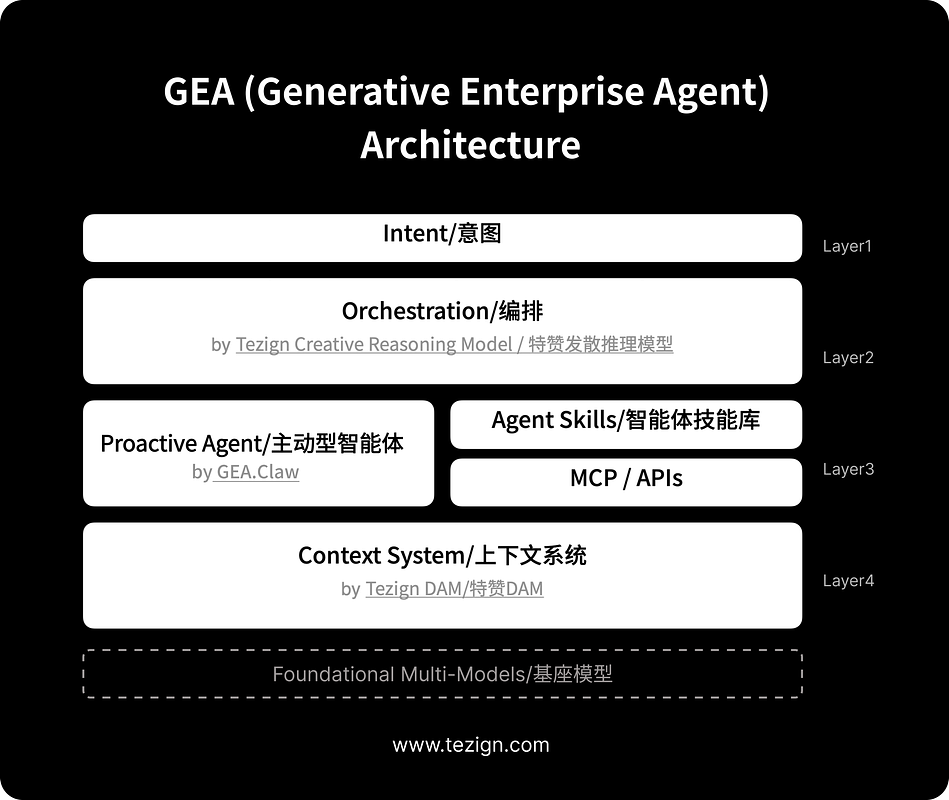
Industry analysts project a swift transition, with Gartner forecasting that 40% of enterprise applications will feature task-specific AI agents by the end of 2026, a dramatic leap from less than 5% in 2025. Tezign's GEA is built on a proprietary four-layer architecture to facilitate this transition:
- The Intent Layer translates high-level business objectives into structured, machine-readable execution plans.
- The Orchestration Layer, powered by a proprietary 'Creative Reasoning Model,' decomposes these plans into sub-tasks. It dynamically routes them across more than 30 different foundation models to determine the optimal path, enabling divergent thinking that explores multiple strategies simultaneously.
- The Agent Skills Layer provides a library of over 400 callable modules that convert complex business workflows—from market research to content distribution—into reusable AI capabilities.
- The Context Layer underpins the entire system, providing a unified source of truth for all agents.
To drive continuous operation, the platform introduces the 'GEA Claw,' a proactive engine that constantly monitors internal and external business signals. It can automatically trigger the next appropriate action within predefined operational boundaries, enabling what the company describes as a '24/7 agent execution network' that can advance everything from strategy generation to decision optimization without direct human intervention.
Beyond the Hype: Context is the New Competitive Frontier
The most critical component enabling this autonomy is what Tezign calls the 'System of Context.' While the power of large language models has captured global attention, their effectiveness in a business setting is often limited by a lack of situational awareness. A generic model doesn't understand a company's brand voice, historical project data, or specific customer insights.
A System of Context addresses this gap by creating a structured knowledge layer that is native to AI. It ingests, indexes, and connects an enterprise's vast and often siloed data—brand assets, product knowledge, customer feedback, project histories, and decision logic—transforming it into a coherent network that agents can access to inform their reasoning. This ensures that every action an agent takes is consistent with the company's unique operational reality and strategic goals.
This focus on context reflects a broader industry shift. As foundation models become commoditized, the true competitive differentiator is no longer the model itself but the ability to ground it in high-quality, relevant data. By building its architecture around this principle, Tezign is betting that deep contextual understanding is the key to unlocking reliable and scalable AI automation. The system also incorporates robust permission controls and progressive data disclosure mechanisms, ensuring that agents only access the information necessary for their tasks, a critical feature for maintaining enterprise-level security and governance.
Navigating the Agent-Driven Workplace
The rise of autonomous AI agents brings profound implications for the workforce and organizational structure. As agents take over complex, multi-step processes, job roles will inevitably evolve, demanding a new focus on strategy, oversight, and human-AI collaboration. This transformation presents both opportunities for unprecedented efficiency and significant challenges related to talent development, trust, and governance.
Recognizing these hurdles, Tezign has bundled its technology with strategic offerings aimed at the organizational layer. Its 'ABC+ (AI Builders & Creators +)' program is designed to help enterprises upgrade their talent structures and foster the skills needed to build, manage, and collaborate with AI agents. This addresses a critical market need, as many organizations currently lack the internal expertise to deploy and govern these advanced systems effectively.
However, the path to an agent-driven workplace is fraught with risks. The autonomy of these systems raises complex questions about accountability, bias, and control. A major concern for IT leaders is the potential for agents to act on flawed data or make decisions that have unintended negative consequences. Establishing robust governance frameworks, ensuring complete observability of agent actions, and maintaining human oversight for critical decisions are paramount. The rapid adoption of agentic AI leaves a narrow window for organizations to define their strategies for security and governance before they fall behind.
A Blueprint for Enterprise-Scale AI
Tezign's GEA has already been deployed across more than 180 global enterprise customers, including over 60 Fortune Global 500 companies, according to the company. To facilitate this adoption, the firm has developed four domain-level agent systems targeting critical business functions: Insight & Research, Content Operations & Distribution, Design & Creation, and Product R&D. This specialized approach aims to provide tangible, out-of-the-box value for specific enterprise workflows.
The market for such solutions is heating up, with tech giants like Microsoft, Google, and IBM, alongside automation specialists like UiPath, all racing to build and deploy their own agentic AI platforms. The competitive landscape is quickly moving beyond simple chatbots to sophisticated systems capable of orchestrating complex enterprise processes.
While the promise of a fully autonomous enterprise is compelling, significant barriers to adoption remain. Beyond the technical challenges of integration and the need for new skills, enterprises must grapple with security vulnerabilities and demonstrate a clear return on investment to skeptical stakeholders. The success of platforms like GEA will ultimately depend not just on their technological prowess, but on their ability to provide a clear, secure, and scalable blueprint for integrating AI into the very fabric of business operations.