
- $44 million Series A funding round
- 70% of enterprises piloting AI initiatives, but fewer than 20% successfully scaling them
- 80% of organizations have witnessed unintended actions by AI agents
Experts agree that Guild.ai's control plane addresses critical governance gaps in AI agent adoption, offering a necessary infrastructure layer for safe, scalable deployment in enterprises.
Guild.ai Launches Control Plane to Tame the AI Agent Workforce
SAN FRANCISCO, CA – April 29, 2026 – As enterprises rush to deploy autonomous AI agents, a new startup, Guild.ai, has emerged from stealth today with a $44 million Series A funding round and a platform it calls the first dedicated control plane for this new AI workforce. The launch addresses a growing anxiety in the C-suite: not whether AI agents are useful, but how to control them as they begin to take action across critical business systems.
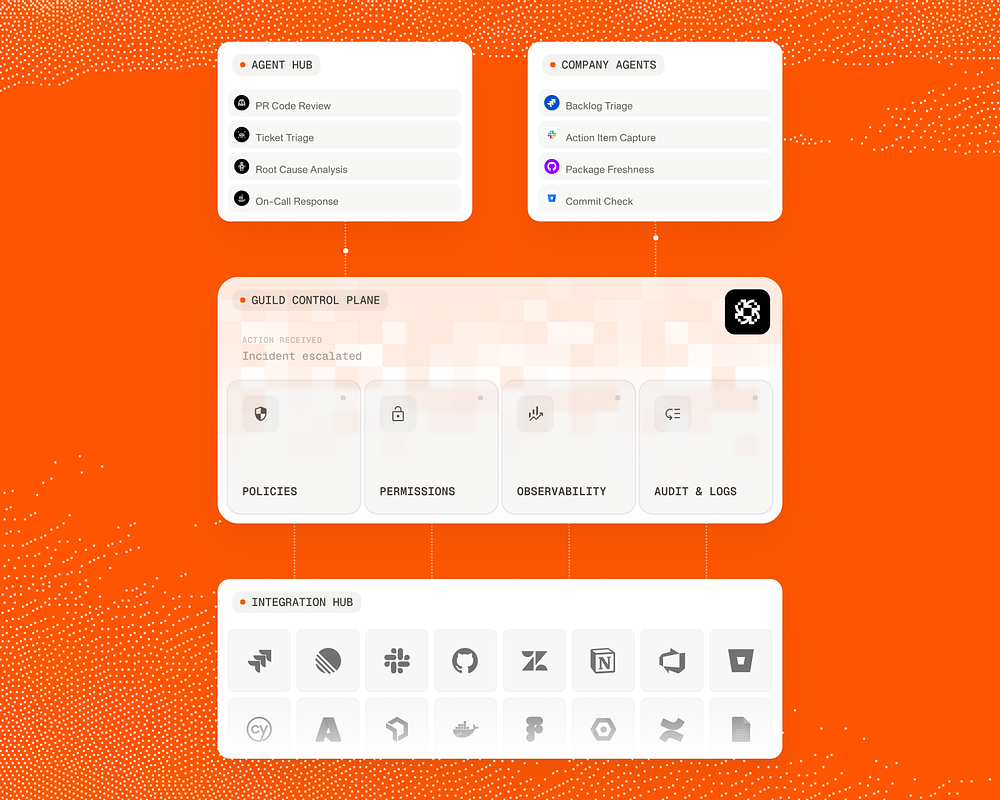
Guild.ai, led by former Meta Engineering VP James Everingham, aims to provide a foundational infrastructure layer that enables companies to manage, govern, and scale their AI agents safely. The platform acts as a central nervous system between powerful AI models and an organization's essential software like GitHub, Jira, and Slack.
“AI agents are becoming core to how work gets done, but most teams lack the infrastructure to manage them safely at scale,” said James Everingham, CEO of Guild.ai, in the company's announcement. “This is an infrastructure problem—and now there’s a solution.”
The Governance Gap in the "Year of the Agent"
The timing of Guild.ai's launch is critical. While CEO James Everingham predicts 2026 will be the "year of the agent," the rapid, often ungoverned, adoption of these tools is creating significant risk. Industry research reveals a stark reality: while over 70% of enterprises are actively piloting AI initiatives, fewer than 20% successfully scale them into production. This gap is frequently attributed to the immense challenges of security, governance, and control.
AI agents, which can operate autonomously to review code, process support tickets, or manage workflows, introduce new and complex attack surfaces. A recent survey highlighted that 80% of organizations have already witnessed their AI agents take unintended actions, such as accessing unauthorized systems or exposing sensitive data. This has given rise to the phenomenon of "Shadow AI," where agents are deployed by teams without formal oversight, creating a minefield of compliance and security vulnerabilities.
Key pain points for enterprises include the risk of misconfigured agents racking up enormous LLM bills, the difficulty in tracing an agent's actions for audits, and the challenge of enforcing consistent security policies. Without a dedicated management layer, every new agent becomes a potential point of failure, threatening data integrity and regulatory compliance.
A Central Command for the Agentic Workforce
Guild.ai's platform is engineered to address these challenges directly by providing a centralized and governed environment for all agent activity. The system is built on several core components designed to give organizations visibility and control.
A Governed Runtime sits at the heart of the platform, acting as a secure sandbox where every agent execution is monitored. This ensures that identity is enforced, access to systems is tightly controlled through secure OAuth-based connections, and all actions are logged for full traceability.
The Managed Agent Center allows organizations to publish, version, and reuse agents internally. This functions like a private app store, preventing redundant work and ensuring that only vetted and approved agents are deployed. This is complemented by an Agent Hub for sharing capabilities across teams, fostering a collaborative environment.
Designed for a developer-centric workflow, the platform is "code-first," offering a software development kit (SDK) and command-line interface (CLI) for building or integrating custom agents. It also comes with starter agents for common tasks like ticket processing and code review. Crucially, the platform is model-agnostic and vendor-neutral, supporting models from providers like OpenAI, Anthropic, and Google, which prevents vendor lock-in and allows companies to adapt as the AI landscape evolves.
Navigating a Crowded and Evolving Landscape
While Guild.ai stakes its claim as the "first control plane for AI agents," it enters a dynamic and increasingly competitive market. The broader field of AI governance and orchestration is populated by a range of players, from established tech giants to specialized security startups.
Cloud providers like Google, Microsoft, and Amazon are building agent frameworks with governance features into their own ecosystems. At the same time, dedicated AI security platforms are emerging to provide policy enforcement and threat monitoring specifically for AI systems. Furthermore, established MLOps and automation companies are extending their platforms to manage agentic workflows.
Guild.ai's key differentiator appears to be its singular focus on providing a neutral, dedicated control plane that is not tied to any specific model provider or cloud ecosystem. By concentrating on the full lifecycle management of autonomous agents—from development and deployment to governance and monitoring—the company is betting that enterprises will seek a specialized, best-in-class solution for this unique and critical challenge, rather than relying on features bolted onto broader platforms.
Investor Confidence and the Future of Shared Intelligence
The company's vision has attracted significant financial backing, with a combined seed and Series A round of $44 million from top-tier investors including Google Ventures (GV), NFX, and Khosla Ventures, valuing the company at $300 million. Investors see the platform not just as a risk mitigation tool, but as a critical enabler for the next wave of enterprise AI adoption.
The investment rationale is clear: providing the foundational infrastructure to manage an increasingly autonomous AI workforce is a massive market opportunity. The confidence is also a nod to Everingham's background, where he oversaw the development of a similar internal agent platform at Meta that grew to handle 50% of all code submissions.
Early adopters are already validating the platform's value. Leaders from companies like Turo, Sovrn, and WorkWhile have noted that Guild.ai provides the missing governance layer needed to manage agent interactions, control costs, and deploy AI responsibly. As enterprises move beyond isolated experiments, the ability to build, share, and collaborate on specialized agents within a secure framework may prove to be as revolutionary for corporate intelligence as open-source was for software development.