
- 52% of IT practitioners report persistent visibility gaps and fragmented observability across their systems. - Median annual observability spend exceeds $800,000 per enterprise, with some spending over $10 million annually with a single vendor. - AI workloads experience double-digit failure rates in three out of four enterprises.
Experts agree that legacy APM tools are inadequate for modern, AI-driven IT environments, and a system-level approach is necessary to address visibility gaps and operational inefficiencies.
Virtana Challenges APM Titans with AI-Native Observability Platform
PALO ALTO, CA – March 10, 2026 – Virtana today launched a new AI-native Application Observability platform, making a bold declaration that the era of legacy Application Performance Monitoring (APM) is over. The company asserts that traditional tools, which focus primarily on application code, are no longer sufficient for the complex, distributed, and AI-driven IT environments that power modern enterprises.
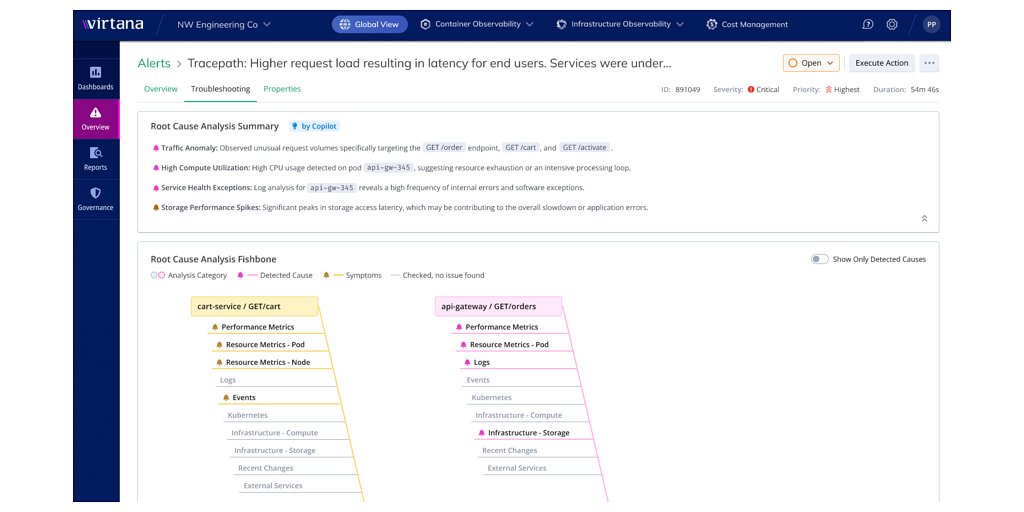
Virtana's new offering aims to redefine the very concept of an application, treating it not as isolated software but as a complete system. The platform is designed to automatically trace performance failures from the application layer down through the entire technology stack—including services, infrastructure, networks, storage, and AI workloads—to identify the true root cause without requiring the manual correlation and guesswork that plague many IT operations teams.
This launch positions Virtana directly against observability giants like Datadog, Splunk, and New Relic, arguing that a fundamentally new architecture is required to manage the scale and complexity of today's systems. The company claims its system-aware approach provides the evidence-backed answers that have eluded enterprises, even as their spending on monitoring tools has skyrocketed.
An Industry Drowning in Data, Thirsty for Insight
The backdrop for Virtana's announcement is a growing crisis in IT operations. A recent Virtana research report, “AI Is Breaking Human-Managed Operations,” paints a stark picture of the problem. The study reveals that 52% of IT practitioners report persistent visibility gaps and fragmented observability across their systems. This is happening despite significant financial investment, with Gartner reporting a median annual observability spend exceeding $800,000 per enterprise, and a subset spending over $10 million annually with a single vendor.
The report highlights a critical disconnect: while many executives feel their platforms are ready for AI, the practitioners on the ground disagree, citing fragmented systems unfit for the speed and scale of machine-driven operations. The problem is compounded by the introduction of AI workloads, which, according to the research, are already experiencing double-digit failure rates in three out of four enterprises. At scale, this translates to thousands of failed jobs daily, leading to wasted compute capacity, cascading delays, and escalating operational risk.
Legacy APM tools, built for a simpler, monolithic world, often exacerbate the issue. They can identify symptoms like a slow transaction but frequently fail to pinpoint the underlying constraint when it resides in storage behavior, network paths, Kubernetes resource pressure, or GPU contention. This leaves teams to manually hunt for clues across dozens of disconnected tools, a process that is slow, inefficient, and often inconclusive.
Redefining the Application as a System
Virtana's core argument is that the definition of an “application” has irrevocably changed. “Mission-critical applications such as airline reservation systems, payment processing systems, health care delivery systems, and emergency dispatch are no longer just code, but complex systems spanning software, services, infrastructure, and AI workloads,” said Paul Appleby, CEO of Virtana, in a statement. “At this scale and complexity, legacy APM focused on code and human-only operations is no longer a credible way to understand how applications behave.”
To address this, the company has built its platform on two key technical foundations: a System Dependency Graph and agentic AI. The System Dependency Graph continuously maps the intricate relationships between every component in a hybrid IT environment—from applications and microservices to Kubernetes clusters, storage arrays, and network routers. This creates a dynamic, system-level context that traditional tools lack.
Layered on top is an AI-native engine that uses this graph for automated reasoning and investigation. When an issue arises, Virtana’s platform can trace it across the entire system, correlating signals from traces, logs, and infrastructure telemetry to move beyond symptoms. “Legacy observability was built for a world where applications were just code,” said Amitkumar Rathi, Chief Product Officer at Virtana. “We built Virtana to see the entire system and correlate traces, logs, topology, and infrastructure telemetry into one operational context, allowing engineers and AI agents to act on it instead of chasing symptoms across disconnected signals.”
The Arms Race for Autonomous Operations
The move toward AI-driven, autonomous operations is an industry-wide phenomenon, creating a fiercely competitive market. The global AIOps market is projected to surge from just over $5 billion in 2024 to more than $44 billion by 2034, signaling a massive technological shift. Major players like Datadog, New Relic, and Splunk have all made significant investments in adding AI and machine learning capabilities to their platforms, including generative AI assistants and automated anomaly detection.
Virtana aims to differentiate itself by claiming its platform is not just AI-enhanced but “AI-native”—purpose-built from the ground up for this new paradigm. The company’s approach is centered on enabling both human operators and autonomous AI agents to identify the true limiting dependency with a unified data foundation. This allows for natural language analysis through compatible AI assistants like ChatGPT, Claude, and Gemini, grounding their responses in real-time operational context.
This system-level visibility is validated by partners like NWN, a technology solutions provider. “Modern applications are distributed systems, and performance constraints frequently originate in infrastructure, network, or platform layers that traditional APM was never designed to see,” noted Doug Syer, Chief Engineer for AI Monitoring and Observability at NWN. He added that Virtana’s offering provides the “true system-level visibility” needed to move directly from symptoms to evidence-backed root cause.
By unifying application telemetry with full-stack observability, the platform promises to fundamentally change incident response. Instead of cross-team debates over fragmented data from disparate tools, teams are presented with a single, evidence-based narrative of what went wrong and why. This not only accelerates triage and minimizes downtime but also frees up highly skilled engineers to focus on innovation rather than firefighting. As enterprises continue to grapple with the immense complexity of modern IT, the ability to see and understand the entire system may become the most critical capability of all.
Topics & Related
Software & SaaS
AI & Machine Learning
Generative AI
Automation
ChatGPT
Claude
Revenue
Related Company Pulse