
- 21% average activity participation: Assisted living residents attend only 21% of offered activities, with 15% attending none. - 30% socially isolated: Nearly 30% of adults over 50 feel socially isolated, up since the pandemic. - 50% higher dementia risk: Social isolation is linked to a roughly 50% increased risk of dementia.
Experts would likely conclude that this initiative represents a significant advancement in measuring and addressing senior isolation, potentially transforming it from an overlooked issue into a core clinical priority.
From Headcounts to Heartbeats: Tech's New Push Against Senior Isolation
CENTENNIAL, Colo. – June 15, 2026 – In the meticulously managed world of senior living, one of the most dangerous threats is also one of the quietest: social isolation. While communities track meals, medications, and activities with precision, the slow fade of a resident into loneliness often goes unmeasured until the damage—cognitive decline, depression, increased mortality—is already done. For decades, the primary metric for engagement has been a simple headcount at group activities, a flawed system that research shows can miss a significant portion of the resident population.
Now, a new initiative is seeking to replace the clipboard with intelligence. Tech company Quiltt, in a strategic alliance with the National Association of Activity Professionals (NAAP) and renowned gerontology expert Dr. Rob Winningham, has introduced what it calls the industry’s first framework for “Resident Engagement Intelligence.” It’s a move that signals a potential paradigm shift, aiming to transform engagement from a checklist of amenities into a core, measurable component of clinical care.
The Failure of the Calendar
The fundamental problem, according to Quiltt, is that the senior living industry has been looking in the wrong place. By focusing on the calendar—how many events are offered and how many people show up—communities risk overlooking the individual. Research published in Activities, Adaptation & Aging paints a stark picture, finding that assisted living residents attended, on average, just 21 percent of offered activities. More alarmingly, 15 percent attended no programmed activities at all in a given week. These are the residents most at risk of becoming invisible.
This isn't just a social failing; it's a public health crisis hiding in plain sight. A 2024 study revealed that nearly 30% of adults over 50 feel socially isolated, a number that has risen since the pandemic. The consequences are severe, with social isolation linked to a roughly 50% increased risk of dementia and other serious health conditions. The challenge for providers is that traditional software has been a “system of record,” adept at logging what happened, but ill-equipped to serve as a “system of awareness” that signals what needs to happen next.
“For nearly a decade I have worked alongside the activity and life enrichment professionals who are the heart of senior living. They have always known their work changes lives,” said Mathew Guilfoyle, COO of Quiltt, who developed the framework. “What they have not had is a framework that proves it.”
A New Language of Connection
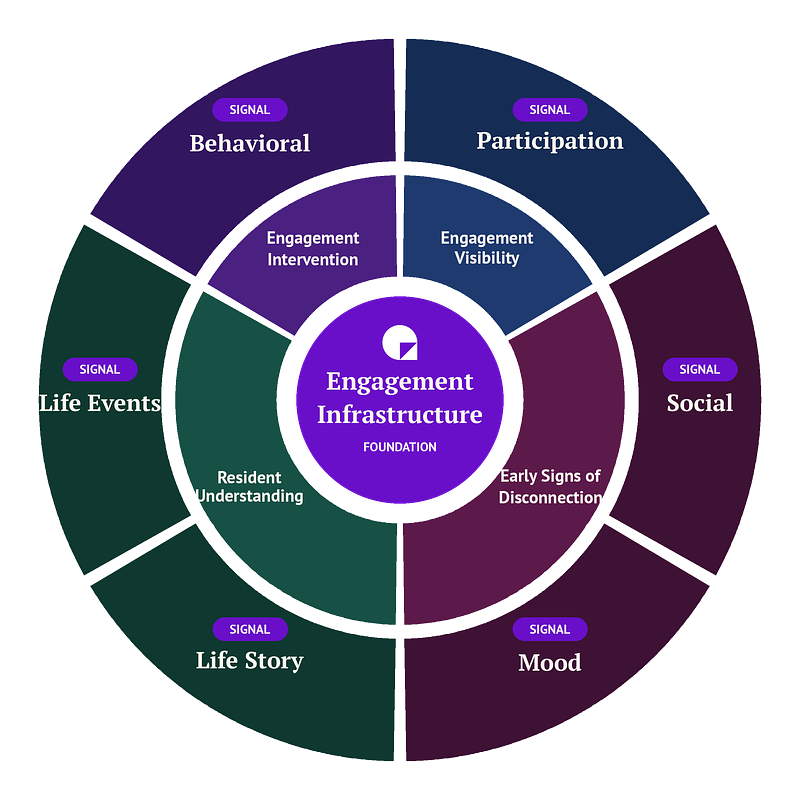
Quiltt's proposed solution is a multi-layered framework designed to give care teams a more profound understanding of each resident. It moves beyond participation to create a holistic view, built on five core dimensions: Engagement Visibility, Resident Understanding, Early Signs of Disconnection, Engagement Intervention, and Engagement Infrastructure.
Feeding into this structure are six distinct “Engagement Intelligence Signals” that are already present in communities but are rarely captured systematically:
- Participation: Tracking trends and, more importantly, sudden drops in attendance.
- Social: Mapping connection patterns and observing if a resident’s social circle is shrinking.
- Mood: Noting subtle shifts in emotional well-being over time.
- Life Story: Understanding a resident’s personal history, identity, and core interests.
- Life Events: Recognizing significant anniversaries, losses, or personal milestones.
- Behavioral: Observing actions and expressions that signal engagement or withdrawal.
The inclusion of “Life Story” and “Life Events” is a deliberate move to differentiate this from generic wellness scoring. It requires staff to know residents as people, not just as occupants of a room. “This newly established resident engagement intelligence framework goes beyond simply measuring attendance and looks at the systems in place related to how we learn about and respond to residents’ individual and unique needs,” noted Dr. Rob Winningham, whose work in brain health and gerontology lends significant academic weight to the initiative.
Validating a Vital Profession
Perhaps one of the most significant impacts of this framework will be felt by the life enrichment professionals themselves. Often viewed as event planners providing a “nice-to-have” amenity, these staff members are on the front lines of resident well-being. This new framework gives them a standardized, data-backed language to demonstrate their impact, elevating their work to the level of a clinical discipline.
“This framework and benchmark represent a defining step forward for the activity profession, shifting engagement from something we do to something we can clearly demonstrate, measure, and elevate,” said Alisa Tagg, Association Director for NAAP. By linking the deeply personal work of knowing a resident’s story to measurable health and wellness outcomes, the framework provides the tools to prove what many have long known anecdotally: engagement is care.
This validation is critical in an industry facing workforce shortages and budgetary pressures. By demonstrating a clear return on investment—in the form of improved resident health, lower staff turnover, and increased family satisfaction—life enrichment departments can make a stronger case for resources and recognition as an essential part of the care continuum.
The Business of Belonging
Quiltt, a company under the Alpine Media Technology umbrella, is not entering this field by accident. Its parent company has a long history of building robust communication platforms for other industries, such as ski resorts, before pivoting its flexible technology to address needs in senior care and other verticals. This background provides a powerful technological foundation for Quiltt's Resident Engagement Intelligence System (REIS).
In a crowded market of senior living software providers—many of whom offer activity calendars and communication tools—Quiltt is attempting to define and own a new category. The strategy is clear: address a critical, high-stakes problem that existing solutions only partially solve. The launch is accompanied by a free online benchmark tool, a savvy marketing move that allows any community to get a quick diagnosis of their engagement operations, simultaneously generating leads and establishing the framework's terminology as a new industry standard.
By positioning its REIS platform as the engine for this new intelligence, Quiltt is making a calculated bet that the industry is ready to invest in moving beyond the status quo. The goal is to make its system indispensable not just for activity directors, but for executive directors and clinical leaders who are ultimately responsible for resident outcomes and the financial health of the community. It represents a sophisticated approach to a deeply human problem, leveraging data not to replace human touch, but to direct it where it's needed most.