
- Record Imports: The US imported 51,840 tons of canned tomatoes from Italy in 2025, valued at $96 million.
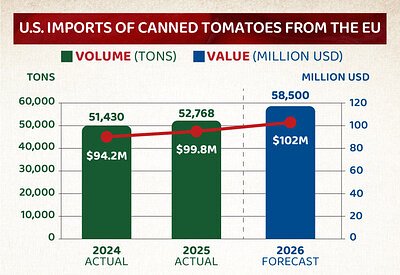
- Projected Growth: European tomato imports to the US are expected to reach 58,500 tons by the end of 2026.
- Consumer Perception: 54% of American consumers associate 'Made in Italy' with superior taste, and 49% with high-quality raw ingredients.
Experts would likely conclude that the success of European canned tomatoes in the US market is driven by a combination of premium quality, strategic marketing, and shifting consumer preferences, though trade policy risks could disrupt this growth.
Europe's Red Gold Rush: How Canned Tomatoes Became a Business Battleground
NEW YORK, NY – June 05, 2026 – The American pantry is turning increasingly red, and the hue is distinctly Italian. In 2025, the United States imported a record-breaking 51,840 tons of canned tomatoes from Italy, a market valued at nearly $96 million. This surge represents more than a simple grocery trend; it’s the culmination of a sophisticated, multi-year campaign that highlights the evolving dynamics of global trade, consumer psychology, and the potent economic power of a well-told story.
This isn't a grassroots phenomenon. The rising tide of European tomato imports, projected to swell to 58,500 tons by the end of this year, is being meticulously engineered. At the heart of this strategy is the 'Greatest Tomatoes from Europe' campaign, an initiative by ANICAV (the Italian Association of Canned Vegetable Industries) and co-funded by the European Union. By successfully positioning their product not as a mere commodity but as an emblem of quality, health, and culinary tradition, European producers have effectively conquered a significant slice of the American kitchen. This red gold rush offers a compelling case study in how to build a premium market for a seemingly ordinary product.
Beyond the Pantry Staple: Decoding the Demand
The foundation of this import boom lies in a fundamental shift in American consumer behavior. The modern shopper and professional chef are no longer content with just any canned tomato. They are seeking authenticity, superior flavor profiles, and traceable, high-quality ingredients. European, and particularly Italian, producers have successfully tapped into this demand.
"American consumers and food professionals are showing growing enthusiasm for Italian and European canned tomatoes, with demand in the US continuing to rise year after year," said Giovanni De Angelis, ANICAV's General Director. He attributes this to the product's "premium quality, rich taste and natural nutritional benefits." This message is resonating. In a market flooded with choices, the promise of tomatoes harvested and preserved at their peak, rich in health-boosting lycopene, provides a powerful differentiator.
This trend extends beyond the home kitchen. The recovery of the foodservice industry post-pandemic has seen restaurants and institutional buyers return to the market with a renewed focus on quality and consistency. For chefs crafting authentic Italian-American cuisine, the specific taste and texture of a San Marzano or a rich passata from Italy are non-negotiable. This professional demand creates a powerful pull-through effect, influencing retail trends as home cooks seek to replicate restaurant-quality meals. The versatility of the product line—from whole peeled and chopped to intensely flavored concentrates—ensures that European tomatoes can seamlessly integrate into any culinary setting, from a high-end restaurant to a busy family's weeknight dinner.
A Masterclass in Marketing: The 'Made in Italy' Advantage
While quality is the product, savvy marketing is the engine driving these record sales. The 'Greatest Tomatoes from Europe' campaign is a masterclass in soft power, focusing on education and storytelling rather than hard-sell tactics. By promoting the safety standards, sustainability of traditional European agriculture, and the rich heritage behind the harvest, the campaign elevates the product from a simple ingredient to a cultural artifact. This strategy leverages the immense brand equity of "Made in Italy," which American consumers associate with superior taste (54%) and high-quality raw ingredients (49%), according to industry surveys.
The campaign's success demonstrates the value of coordinated, EU-backed promotional efforts, especially in a fragmented industry. While Italy is a global titan in tomato processing, its industry comprises thousands of enterprises. A unified campaign provides the scale and reach necessary to penetrate a competitive market like the US, creating a halo effect that benefits producers large and small. It's a strategic investment in building long-term brand value, ensuring that the perception of premium quality is constantly reinforced in the consumer's mind.
The Global Crate: Competition and Trade Headwinds
The success of European exporters has not gone unnoticed. While Italy dominates the global trade of canned tomatoes, supplying nearly three-quarters of the world's exports, the US market is a fiercely competitive arena. Domestic producers, primarily based in California, are facing intense pressure from these high-quality, well-marketed imports. Furthermore, other countries like Chile and Turkey are vying for a larger share of the US market, though they currently lag far behind Italy's import value.
However, the most significant threat to this trans-Atlantic tomato trade is not competition, but policy. The looming specter of new US tariffs on European goods casts a long shadow over the industry's future. A proposed 20% tariff on EU-origin goods, which took effect in April 2025, could potentially escalate import duties on Italian processed tomatoes to a staggering 42%. Such a move would drastically alter the competitive landscape, eroding the price competitiveness that has allowed these products to become staples.
For importers and distributors, this uncertainty creates significant risk. For consumers, it could mean a sharp increase in the price of a beloved pantry item. For Italian producers, it threatens to undo years of strategic market development. The battle for the American tomato aisle is increasingly being fought not in grocery stores, but in the halls of trade regulators.
The Future in a Can: Projections and Evolving Tastes
Despite potential trade disputes, the underlying market fundamentals remain strong. The global canned tomato market, valued at $11.8 billion in 2025, is projected to grow to nearly $17 billion by 2031. North America, with its $3.1 billion industry, is a critical driver of this growth. The demand for convenience and shelf-stable products is a permanent feature of the modern food landscape.
The future of the market will likely be defined by further segmentation. The fastest-growing product lines are those that cater to specific health and lifestyle preferences: organic, no-added-sugar, BPA-free, and glass-packaged options are growing at a faster clip than their conventional counterparts. European producers who can innovate and cater to these niche but expanding demands will be best positioned for future success. The story of the humble canned tomato has become an unexpectedly complex narrative of international business, demonstrating that even in the most traditional industries, innovation in marketing and a deep understanding of consumer trends are the keys to global growth.