
- $270M Prize Pool: Global esports tournament prize pools surged past $270 million in 2025, a 15.5% increase from the previous year.
- Top 3 Nations: Saudi Arabia ($39.66M), China ($34.82M), and the United States ($23.12M) collectively hosted nearly half of all prize money.
- Global Divide: The remaining seven countries in the top ten accounted for just over $47 million in prize money, highlighting a stark financial disparity.
Experts warn that the concentration of prize money in a few nations raises concerns about long-term sustainability and accessibility in esports, though alternative models like Romania and Germany demonstrate viable paths for growth without massive funding.
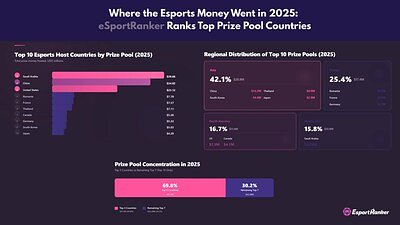
Esports' New Power Map: How Three Nations Control the $270M Prize Pool
STOCKHOLM, SWEDEN – March 16, 2026 – The global esports industry celebrated a landmark year in 2025, with total tournament prize pools surging past $270 million, marking a robust 15.5% increase from the previous year. However, a new analysis from eSportRanker, based on data from over 10,500 tournaments, reveals a complex and potentially fraught story beneath the surface of this impressive growth. While the financial rewards in competitive gaming have never been higher, the money is increasingly concentrated in the hands of a few global superpowers. This consolidation of financial power creates a stark divide that raises critical questions about the industry's long-term sustainability and the future of global competition.
The New Kings of Competitive Gaming
The 2025 figures paint a clear picture of a top-heavy landscape. Saudi Arabia, China, and the United States collectively hosted nearly half of all prize money awarded across the world's top ten esports nations. Their dominance is not accidental but the result of distinct, powerful strategies that are reshaping the global gaming arena.
Leading the charge is Saudi Arabia, which claimed the top spot by hosting an astounding $39.66 million in prize pools. This meteoric rise is almost entirely fueled by sovereign state investment. The nation's Public Investment Fund (PIF), a core component of its Vision 2030 plan to diversify the economy away from oil, has funneled billions into the gaming sector through its Savvy Games Group. This investment has manifested in events like the Esports World Cup in Riyadh, a massive circuit featuring top-tier competitions for games like Dota 2 and Mobile Legends: Bang Bang. While this strategy has rapidly made the kingdom a central hub for esports, it has also drawn criticism from human rights organizations, who label the massive spending as an act of "sportswashing" to deflect from the nation's human rights record.
Close behind, China secured its second-place position with $34.82 million, driven by a different but equally potent model: the publisher-controlled ecosystem. Tech giant Tencent, developer of the mobile blockbuster Honor of Kings, has cultivated a powerful domestic league system. The King Pro League (KPL) Grand Finals in 2025 alone boasted a prize pool nearing $10 million, with the final event selling out Beijing's 91,000-seat "Bird's Nest" stadium. This model provides stability and recurring prize money but concentrates power in the hands of a single corporate entity, shaping the competitive landscape around its own titles.
The United States, placing third with $23.12 million, represents a more traditional and diversified market. Its ecosystem is a mix of publisher-run leagues, third-party tournament organizers, and a wide variety of game genres, reflecting a more decentralized but still powerful presence in the global scene.
A Widening Chasm in the Global Arena
Beyond this dominant trio, the financial landscape falls off a cliff. The remaining seven countries in the top ten—a list that includes France, Canada, and South Korea—collectively accounted for just over $47 million in prize money. This figure, barely exceeding Saudi Arabia's total alone, starkly illustrates the growing chasm between the haves and have-nots in the world of esports hosting.
This concentration of capital raises serious questions about the overall health and accessibility of the industry. While the 15.5% growth in prize pools aligns with positive trends in viewership—which is projected to approach 900 million users globally—and sponsorship revenue, it suggests that the benefits are not being distributed evenly. For teams, players, and organizers in regions outside these three power centers, the path to professional success is becoming steeper.
The challenge is that the massive, state-funded prize pools of the Esports World Cup or the publisher-backed purses of the KPL create a high-stakes environment that smaller, independent tournaments cannot hope to match. This can lead to a talent drain, as the best players naturally gravitate toward the biggest paydays, potentially starving smaller regional scenes of the top-tier competition needed to thrive and develop new talent. The risk is an ecosystem that becomes less of a global community and more of a closed shop, accessible only to those with immense state or corporate backing.
Forging Alternative Paths to the Top
Despite the daunting dominance of the top three, the eSportRanker data offers a glimmer of hope and a blueprint for an alternative path to success. Countries like Romania ($7.79 million) and Germany ($5.22 million) have secured spots in the top ten not by hosting a single, multi-million-dollar flagship event, but through consistency and strategic planning.
Their model relies on becoming reliable hubs for a steady stream of international events throughout the year. By building a reputation for excellent event infrastructure and fostering a strong local fan base, these nations attract a diverse portfolio of tournaments across various games. This approach builds a more resilient and sustainable local ecosystem that is not dependent on a single source of massive funding. It cultivates grassroots talent, supports local production crews and organizers, and creates a durable foundation for long-term growth.
This strategy highlights the importance of a multi-faceted approach for aspiring esports nations. Success does not solely depend on outspending competitors. It can also be achieved through smart public-private partnerships, integrating esports into educational programs, and fostering a supportive regulatory environment. For the broader health of the global esports ecosystem, the continued success of these alternative models is crucial. They demonstrate that while money can buy a seat at the top table, it is not the only way to earn one. The future of competitive gaming may well be defined by the tension between these competing philosophies of growth.