
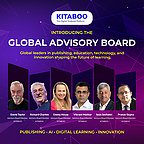
- Global Advisory Board: KITABOO has assembled a board of 6 industry veterans with deep expertise in publishing, technology, and EdTech.
- Platform Ambition: KITABOO ONE aims to integrate content creation, distribution, licensing, and monetization into a single ecosystem.
- AI Integration: The company is focusing on AI, immersive technologies, and accessibility as defining frontiers of modern education.
Experts would likely conclude that KITABOO's strategic move to assemble a high-profile advisory board signals a serious bid to reshape the digital learning landscape, combining decades of industry expertise with cutting-edge technology to create a comprehensive, ethically governed platform for global education.
EdTech's New Brain Trust: KITABOO's Play for the Future of Learning
MUMBAI, India – June 08, 2026 – In a move that reverberates beyond a standard corporate announcement, Indian digital learning firm KITABOO has unveiled a Global Advisory Board composed of some of the most influential figures in modern publishing and technology. While press releases about new boards are common, this one signals something more significant: a calculated maneuver to assemble the architects of the past half-century of content to build the infrastructure for the next.
The roster reads like a who's who of the industries that digital disruption first upended and now seeks to redefine. By bringing these veterans into its inner circle, the Mumbai-based company is making a bold statement about its ambition to not just participate in the future of education but to set its very terms.
The Architects of a New Era
To understand the strategic weight of this board, one must look beyond the titles to the careers. The members are not just advisors; they are living repositories of institutional knowledge on how content is created, distributed, and valued. Richard Charkin, for instance, is a titan of the publishing world, having held senior leadership roles at giants like Bloomsbury, Macmillan, and Oxford University Press. His experience is a chronicle of the industry’s turbulent transition from print to digital, making his insights invaluable for a company aiming to guide that journey for others.
Then there is David Taylor, the strategist who, as a Senior Vice President at Ingram Content Group, led the global expansion of Lightning Source. He was instrumental in building the physical infrastructure for print-on-demand, a technology that revolutionized the book trade by breaking the constraints of traditional print runs. His involvement suggests KITABOO is focused on solving the complex logistical and infrastructural challenges of global content distribution, a core mission of its KITABOO ONE platform.
The board is rounded out by figures like Emma House, an expert in navigating the intricate web of international publishing markets and digital rights; Vikrant Mathur, whose company Impelsys has long provided technology solutions to publishers; and Sesh Seshadri, a veteran of the EdTech sector with deep experience in scaling digital learning initiatives. Together with KITABOO's own founder, Pranav Gupta, this group represents a formidable concentration of expertise spanning the entire content lifecycle—from creation and policy to technology and global distribution.
A Bid to Control the Digital Bookshelf
This assembly of talent is not merely for show. It underpins a strategy to create a comprehensive, end-to-end ecosystem for digital learning. KITABOO provides the tools for publishers and institutions to create interactive, accessible digital content. Its sibling platform, KITABOO ONE, is designed to handle the crucial next steps: distribution, licensing, and monetization. By integrating these functions, the company is positioning itself as a one-stop-shop in a fragmented market of learning management systems, content creation tools, and separate distribution platforms.
The strategic rationale is clear. As educational and corporate learning shifts irrevocably online, the real power lies not just in having content, but in controlling the platform that delivers, analyzes, and secures it. The newly formed board is tasked with guiding this vision. As the company’s leadership stated, "The future of learning will belong to organizations that can successfully combine technology, pedagogy, accessibility, and scalable content innovation." The board, they added, represents decades of experience across these exact domains, making their guidance instrumental for the company's next phase of growth.
This move enables the firm to offer publishers a compelling proposition: a guided transition into the digital future, overseen by the very people who shaped their industry. For educational institutions, it promises a platform built on deep pedagogical and technological expertise, aiming to move beyond static PDFs and into genuinely interactive and personalized learning experiences.
The AI Question: Navigating Promise and Peril
Central to KITABOO’s mission is the integration of artificial intelligence, immersive technologies, and enhanced accessibility. These are not just buzzwords but the defining frontiers of modern education. The promise is immense: AI-powered platforms can deliver personalized learning paths for students, automate assessments for educators, and generate analytics that provide unprecedented insight into learning effectiveness. Immersive technologies like AR and VR can make complex subjects tangible and engaging.
However, these technologies are a double-edged sword. The deployment of AI in education raises profound ethical questions about data privacy, algorithmic bias, and the potential for technology to create new forms of inequality. A platform that recommends content must be audited for bias, and the data it collects on student performance must be protected and used responsibly. This is where the board’s collective wisdom becomes critical.
Their role will be less about accelerating technology adoption for its own sake and more about providing the governance and strategic foresight to deploy it ethically and effectively. The challenge is to build systems that augment, rather than replace, human educators and to ensure that the pursuit of personalized learning does not lead to isolated, algorithm-driven echo chambers. The inclusion of seasoned leaders who have navigated multiple technological and market shifts provides a crucial counterbalance to the tech-first mentality that often dominates Silicon Valley, grounding the company's ambitions in the practical realities of the publishing and education worlds.
A Global Gambit for Knowledge Infrastructure
Perhaps the most telling aspect of this announcement is its geography. An Indian technology company is consolidating expertise from London, New York, and other global hubs to build a platform with worldwide ambitions. This reflects a broader geopolitical shift where leadership in critical technology sectors is no longer the exclusive domain of a few Western nations. Control over the infrastructure of knowledge is a significant form of influence, and this move positions the Mumbai-based firm as a serious contender in shaping the global digital learning landscape.
By assembling a board with deep experience in establishing transformative infrastructure and navigating global markets, KITABOO is signaling its intent to build a resilient, competitive, and truly international system. This is more than just a company expanding its reach; it is a strategic play to become a foundational layer in how knowledge is delivered and consumed in the 21st century.