
- DEUTLI's methodology validated by Google’s Gemini team prompt engineering guidelines
- DEUTLI's open
.deutformat aims to create a 'preset economy' for AI-generated art - DEUTLI v1 available now, with DEUTLI v2 visual editor in development
Experts would likely conclude that DEUTLI's structured, parametric approach to AI prompt control represents a significant step toward professionalizing and standardizing creative AI workflows, addressing long-standing challenges in consistency and reproducibility.
DEUTLI Aims to Tame AI Chaos with Parametric Prompt Control
FRIBOURG, SWITZERLAND – April 16, 2026 – As generative artificial intelligence continues its rapid integration into creative workflows, a Swiss startup is tackling one of the technology's most persistent challenges: the frustrating unpredictability of text-to-image models. DEUTLI, an ecosystem for managing AI prompts, announced today that its core methodology has been validated by recent prompt engineering guidelines from Google’s Gemini team, a claim that positions the company as a potential standard-bearer for a more precise and controllable era of AI creation.
The company argues that the current paradigm, which relies on users typing natural language into a text box, is fundamentally flawed. This "blank canvas" approach often leads to a frustrating cycle of trial and error, as the stochastic nature of human language clashes with the mathematical logic of AI models. DEUTLI’s announcement points to guidelines for Google’s Nano Banana model, which emphasize the importance of strictly clustering semantic tokens—like Subject, Composition, and Style—to achieve predictable results. While public records from Google do not show a direct, official endorsement of DEUTLI, the company interprets this alignment of principles as a powerful verification of its architectural approach, which moves beyond simple text input to offer a structured, parametric interface for creators.
The Problem with Prompts
The explosive growth of generative AI has been a double-edged sword for the creative industry. While adoption is widespread, with studies showing a vast majority of creative professionals now using AI tools, a significant hurdle remains in bridging the gap between artistic intent and AI output. The core of the issue lies in the ambiguity of natural language. A single prompt can yield wildly different results across multiple generations, making consistency and fine-tuned control feel more like a matter of luck than skill.
This challenge has given rise to the field of "prompt engineering," an art form in itself dedicated to coaxing desired outputs from AI models. However, this often involves crafting convoluted strings of text, a process one industry analyst described as "wandering through an unstructured, snowy field of random words." For professionals who rely on precision and reproducibility—such as graphic designers, architects, and product visualizers—this lack of deterministic control is a major bottleneck. The market is saturated with tools that promise to enhance creativity, but many still leave users struggling to command the AI with the same level of authority they have with traditional software like Photoshop or AutoCAD.
This gap between the user's vision and the machine's interpretation is what DEUTLI aims to close. The company’s philosophy suggests that the solution isn't just about writing better prompts, but fundamentally changing how we communicate with generative models.
A Shift from Linguistic to Parametric Control
DEUTLI's solution is to transition control from the linguistic plane to a parametric one. Instead of relying on the nuanced and often-unreliable interpretation of "prompt-English," the system provides users with a structured framework based on established principles of visual composition. The company uses a professional camera analogy to explain its approach, structuring the AI's visual attention through two key spatial parameters: field of view and depth of field.
By allowing users to precisely define the subject-to-background ratio and other geometric properties at the engine level, DEUTLI asserts it can achieve deterministic control over scene composition. This method bypasses the ambiguity of descriptive words, offering a more direct, mathematical command over the AI's latent space. It’s a system designed to guide users "seamlessly along a precisely groomed track," providing deep detailing of the technical aspects of the image.
"Our methods of controlling viewer attention are based on an understanding of the 500-year history of visual arts development," emphasizes Yuriy Sydorenko, the founder of DEUTLI, in the company's press release. "We are not reinventing the wheel, but rather integrating the best practices created by recognized masters into image generation." This grounding in art history, combined with a rigorous technical framework, represents a novel attempt to professionalize the act of AI creation.
Building an Open Ecosystem
Perhaps the most strategic element of DEUTLI's approach is its commitment to an open ecosystem. A key differentiator is the development of the .deut sidecar format, an open standard designed to function as "the digital negative for generative metadata." This format captures the complete creative DNA of a generated image—every parameter, setting, and adjustment—in a structured, non-destructive way.
This focus on an open, portable format stands in stark contrast to the closed, proprietary systems of most major generative AI platforms. By creating a universal standard for prompt data, DEUTLI hopes to foster a "preset economy." In this vision, creators could build, share, and even sell complex parameter sets, much like presets and plugins are traded in the worlds of digital photography and audio production. Such a marketplace could democratize access to sophisticated techniques and accelerate innovation across the industry.
The .deut format is designed for interoperability, with the company noting its ability to support deep recursive parsing for popular open-source tools like ComfyUI and Automatic1111. This suggests a strategy focused on integrating with and enhancing existing professional workflows rather than demanding users switch to an entirely new, isolated platform. By building a foundational layer for structured prompt data, DEUTLI is positioning itself not just as a tool, but as a potential infrastructure provider for the next generation of creative AI applications.
The Road Ahead: From v1 to 'Snap It In'
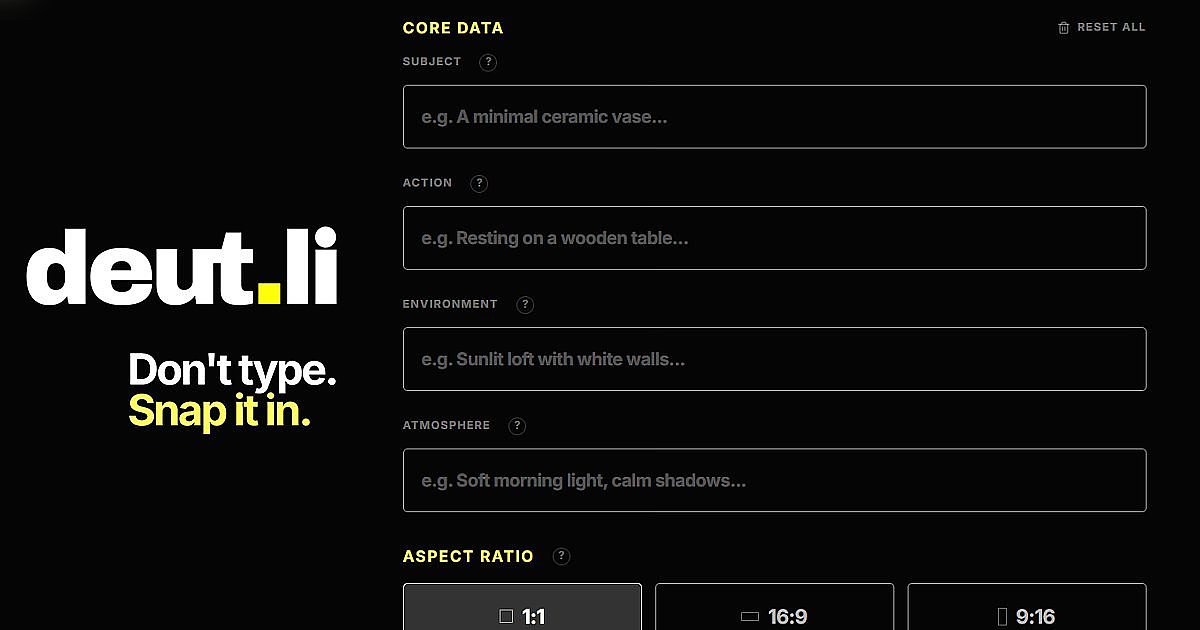
DEUTLI's vision is being rolled out in phases. The company's algorithmic prompt enhancement system, DEUTLI v1, is available today. However, the more ambitious part of the plan lies in the active development of DEUTLI v2, a comprehensive visual editor that fully embodies the company's core concept: "Don't type. Snap it in."
This motto hints at a future interface where prompt creation is a modular, visual process. Instead of typing a long sentence, a user might select a "subject" component, snap in a "wide-angle lens" parameter, adjust a slider for "depth of field," and choose a "Baroque" style from a library of presets. This would transform prompt engineering from a textual puzzle into a more intuitive, tactile experience, making sophisticated control accessible to a broader range of creators.
While the full visual editor remains in development, components of the v2 ecosystem are already emerging. The company has released DEUTLI Extractor V2, an open-source, offline-capable tool that can extract and parse generative metadata from existing AI art tools. This utility, built for professional workflows and even air-gapped environments, demonstrates a tangible commitment to the open .deut standard and provides a practical tool for creators today. By delivering functional pieces of its long-term vision, DEUTLI is building momentum toward a future where creative control over AI is no longer a matter of finding the right words, but of having the right parameters.