
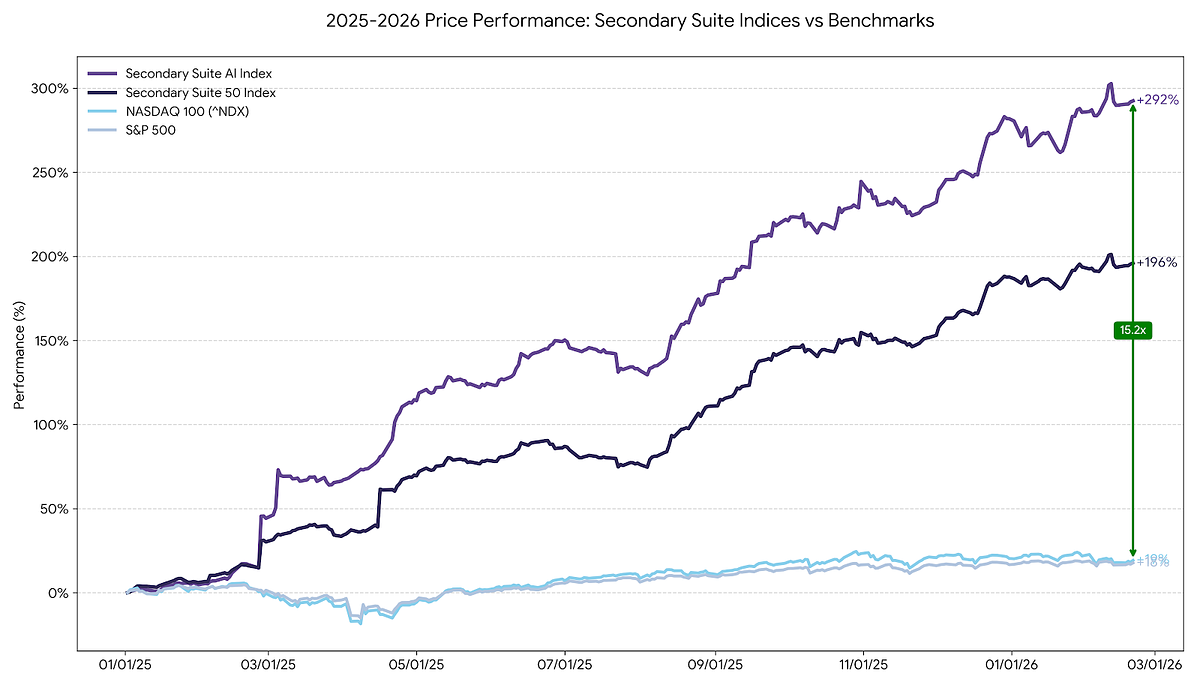
- Private Tech Index Surge: 196% growth over 14 months, outpacing Nasdaq 100 and S&P 500 by 10x
- AI Sector Growth: Top 20 private AI companies saw 292% valuation increase
- SpaceX-xAI Merger: Combined valuation of $1.25 trillion, largest private merger ever
Experts agree that the explosive growth in private tech valuations, particularly in AI and SpaceX, signals a structural shift in capital markets, with wealth creation increasingly concentrated in private ecosystems before IPOs.
Private Tech Soars 200%, Leaving Public Markets in the Dust
TEL AVIV, Israel – February 25, 2026 – A dramatic divergence is splitting the financial world in two, with a red-hot private technology market leaving public stock exchanges far behind. New data reveals that an index tracking the 50 most actively traded private technology companies has skyrocketed 196% over the past 14 months, a performance that outstrips gains in the Nasdaq 100 and S&P 500 by a factor of nearly ten.
The findings, based on over $5 billion in executed secondary transactions, come from Secondary Suite, a new operational platform providing unprecedented visibility into the traditionally opaque world of private share trading. The report highlights a powerful structural shift in capital markets: immense value is being created and traded long before companies ever consider an Initial Public Offering (IPO), leaving most public market investors on the sidelines.
This isn't just a minor outperformance; it's a chasm. The Secondary Suite 50 Index, which reflects real-world transactions for stakes in the world's most sought-after private firms, paints a picture of a bull market hidden from public view. This surge suggests that the most explosive growth in today's economy, particularly in cutting-edge sectors, is happening within a closed ecosystem accessible primarily to institutional funds and accredited investors.
The Twin Engines of Growth: AI and SpaceX
Two powerful forces are fueling this extraordinary private market rally: the artificial intelligence gold rush and the astronomical valuation of SpaceX. According to Secondary Suite's data, the top 20 private AI companies it tracks saw their valuations grow by an average of 292% over the same 14-month period.
This explosive growth reflects a broader trend. In 2025 alone, Silicon Valley's private AI startups reportedly raised a record-shattering $150 billion, with a significant portion of capital concentrating in mega-rounds for industry leaders like OpenAI and Anthropic. As AI becomes deeply integrated into the global economy, investors are scrambling for direct exposure, which remains almost exclusively within private markets. The most innovative, AI-native companies have yet to list on public exchanges, meaning their hyper-growth phase is enriching a select group of early backers.
The second major driver is SpaceX. The aerospace giant’s recent all-stock merger with Elon Musk’s artificial intelligence venture, xAI, created a private behemoth with a combined valuation exceeding $1.25 trillion. The deal, which valued SpaceX at $1 trillion and xAI at $250 billion, is seen as the largest private merger ever completed. Secondary transactions for shares in the newly combined entity are reportedly being executed at a premium to even that staggering figure, signaling sustained and intense institutional demand. This single company’s trajectory accounts for a significant portion of the private market’s outperformance, underscoring how transformative, category-defining companies are generating wealth outside public oversight.
Bringing Light to the Shadows
For years, the private secondary market—where employees and early investors sell their shares to other private buyers—operated in the shadows. It was a fragmented, informal network characterized by opacity, inefficiency, and a lack of reliable pricing data. This is the challenge that a new wave of financial technology platforms aims to solve.
Secondary Suite, which is now used by over 100 institutional participants, functions as a centralized operational system. It aggregates bid-ask indications, completed transaction data, and pricing signals from across the ecosystem, providing what it calls “panoramic visibility” into more than 2,500 private tech companies. It joins a growing field of competitors like Nasdaq Private Market, Forge Global, and Hiive, all vying to build the essential infrastructure for this burgeoning asset class.
These platforms are not public exchanges but professional-grade tools for funds, brokers, and investment banks to manage transactions and gain market intelligence. “Secondary Suite was built to consolidate data, enhance pricing transparency and enable professional participants to operate based on verified market intelligence rather than informal signals,” said Ofek Cohany, the company’s Chief Architect, in a statement.
This professionalization is critical. As companies stay private for a decade or longer—a significant increase from the past—the need for liquidity among early employees and investors grows. These platforms provide a structured, data-driven venue for that liquidity, turning illiquid private stock into a more manageable asset and enabling more accurate price discovery long before an IPO.
A New Era for Investors and Regulators
The widening gap between private and public market returns is forcing a broad reevaluation among investors and regulators alike. For institutional portfolio managers, exposure to private markets is shifting from a niche alternative to a core strategic imperative. Chief investment officers at major funds have noted that ignoring this arena means missing out on a primary engine of modern wealth creation.
This shift is also catching the attention of policymakers. The U.S. Congress and the SEC have taken steps to cautiously broaden access. Legislation passed in 2025 aims to expand the definition of an “accredited investor” beyond simple wealth thresholds to include individuals with relevant professional expertise. Concurrently, regulators have cleared the way for certain regulated funds, such as closed-end funds, to offer retail investors access to private market strategies, albeit with guardrails.
However, this expansion comes with concerns. Regulators globally are increasing their scrutiny of the non-bank financial sector, wary of systemic risks that could be brewing in these less-transparent markets. The very opacity that once defined private equity is now a source of regulatory anxiety, prompting calls for greater disclosure and oversight to protect a new, broader class of investors and ensure financial stability.
As capital continues to flow into private ecosystems and technology continues to redefine the global economy, the divergence between the private and public spheres is set to become one of the most defining financial stories of this decade. The question for investors is no longer if they should access these markets, but how they can do so effectively and prudently in a rapidly evolving landscape.