
- 300,000+ mass-production vehicles equipped with DeepRoute.ai's Urban NOA solution
- 1.3 billion kilometers of real-world operation logged in the past year
- 1,000+ kilometers target for Miles Per Critical Intervention (MPCI) by end of 2026
Experts would likely conclude that DeepRoute.ai's shift to a unified Foundation Model architecture represents a significant leap forward in autonomous driving technology, addressing critical safety and scalability challenges through a more cohesive AI infrastructure.
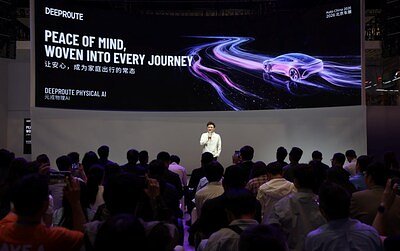
DeepRoute.ai Unveils 'Physical AI' to Power Future of Driving
BEIJING, CHINA – April 29, 2026 – At the bustling Auto China 2026 exhibition, intelligent driving firm DeepRoute.ai articulated a vision that extends far beyond the dashboard, aiming to position its technology as the fundamental AI infrastructure for the physical world. During a press conference, CEO Maxwell Zhou and newly appointed Chief Scientist Chong Ruan detailed a strategic pivot towards a large-scale “Foundation Model” architecture, a move they argue is essential for delivering truly safe and scalable autonomous driving.
Zhou, who co-founded the company in 2019, framed the mission in deeply personal terms, recounting a traffic accident he witnessed in 2016. "At that time, I wondered whether we could use AI technology to save more lives," he shared. This ambition now underpins a grander vision. "I hope that in the future, the company will become the AI infrastructure of the physical world, serving as a foundational capability that sustains real-world operations, much like telecommunications and electricity."
This declaration sets the stage for the company's push into what it terms “Physical AI”—intelligent systems that perceive, reason, and interact with the real world. The announcements suggest a concerted effort to move beyond incremental improvements and fundamentally reshape the technological stack powering autonomous vehicles.
A New Foundation for Intelligent Driving
The technical centerpiece of DeepRoute.ai's strategy is its new Foundation Model, a concept detailed in the first public keynote by Chief Scientist Chong Ruan. Ruan, a former Head of R&D at AI firm DeepSeek, argued that the industry's previous reliance on smaller, specialized models has hit a wall, particularly as autonomous systems move into mass production.
"These systems still exhibit performance fluctuations in complex, edge-case scenarios, and a reliable foundation of trust in the driving experience has yet to be established," Ruan explained. The older approach, which often stitched together numerous discrete models for perception, prediction, and planning, could lead to cognitive gaps and unpredictable behavior.
In contrast, DeepRoute.ai's Foundation Model unifies driving decision-making, scene understanding, and behavior evaluation within a single, massive neural network architecture. By leveraging a greater scale of model parameters, higher quality data, and a dramatically accelerated development cycle, the company aims to build a more cohesive and capable AI driver. This unified approach is designed to provide the system with a more holistic understanding of its environment, enabling it to better handle the long tail of rare and complex driving scenarios.
The most tangible benefit of this new framework is a staggering increase in efficiency. The company reported that the iteration cycle of its data-driven closed-loop—the process of collecting data, training the model, and deploying an update—has been slashed from roughly five days to just 12 hours. This acceleration provides a significant competitive advantage, allowing for rapid learning and system refinement at a pace previously unimaginable.
From Lab to Mass Market: Scaling Safety and Adoption
While the technology is forward-looking, DeepRoute.ai's strategy is firmly grounded in real-world deployment and data. The company announced that the number of mass-production vehicles equipped with its Urban NOA (Navigate on Autopilot) solution has already surpassed 300,000 units. This growing fleet acts as a massive data collection engine, forming a virtuous cycle the company calls the “Data Flywheel.”
Over the past year alone, vehicles running the company's systems have logged over 1.3 billion kilometers of real-world operation. This immense dataset not only validates the system's current performance but also provides the critical fuel needed to continuously train and optimize the new Foundation Model. This strategy of leveraging mass-market partnerships with automakers like Smart, and collaborations with tech giants like Qualcomm, is central to its plan for scaled evolution.
With this foundation in place, DeepRoute.ai has set aggressive targets for the end of 2026. The company aims to have its advanced intelligent driving system deployed in over one million vehicles. More critically, it plans to improve its safety and reliability metrics dramatically. CEO Maxwell Zhou acknowledged that the current industry standard for Miles Per Critical Intervention (MPCI) in urban settings is still low, often measured in the tens of kilometers. The company's goal is to increase its MPCI to over 1,000 kilometers—a fifty-fold or greater improvement that would represent a significant leap in system trustworthiness.
Alongside safety, the company is targeting user engagement, aiming for an active daily use rate of over 50%. This focus signals a shift from treating advanced driving systems as a novelty feature to positioning them as a reliable and frequently used co-pilot, a key step in building consumer trust and demonstrating tangible value.
The Grand Vision: AI as a Foundational Utility
Beyond the immediate goals of scaling production and improving safety, DeepRoute.ai's presentation consistently returned to a broader, more philosophical question: what is AI ultimately for? This was the theme of an “AI Talk” panel hosted at the event, which brought together a diverse group of thinkers, including a Fudan University professor, an Alibaba Cloud executive, and Hugo Award-winning author Hao Jingfang.
The discussion moved beyond product features to debate the societal impact of Physical AI, the boundaries of large models, and the ultimate purpose of this powerful technology. This framing aligns with Zhou’s long-term vision of AI as a public utility. This ambition is not just about building a better car but about creating a foundational layer of intelligence that can make the physical world safer and more efficient.
This AI-native philosophy is also reshaping the company from within. Ruan noted that the influence of the Foundation Model extends beyond the product itself. “From internal knowledge base Q&A and automated code generation to cross-departmental collaboration and autonomous experimental analysis, AI is reshaping our R&D and management workflows,” he stated.
As a glimpse into this future, the company previewed a Cabin-Driving Integration Agent, designed not as a simple voice assistant but as an “AI Brain” for the vehicle, capable of understanding user needs and proactively responding to complex situations. This integration of the driving system with the in-cabin experience represents a tangible step toward a more holistic and intelligent vehicle, pushing the boundaries of what is possible as the worlds of digital intelligence and physical mobility continue to converge.