
- 30% faster sales: Listings promoted with agent-to-agent email flyers went under contract 30% faster than local market medians.
- 77% success rate: 77% of 'stale' listings (on market longer than local median) were under contract within 3 weeks after flyer campaigns.
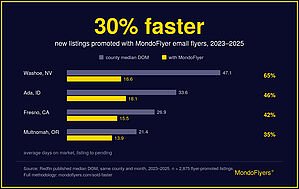
- 65% speed boost in slow markets: In Washoe County, NV, flyer-promoted listings went pending 65% faster than the county median.
Experts would likely conclude that targeted digital outreach to agents offers a measurable advantage in slowing real estate markets, particularly for listings that have lost momentum.
Data Reveals a Speed Advantage in a Slowing Real Estate Market
ANAHEIM, CA – June 18, 2026 – In an industry where time is quite literally money, a newly published study offers a data-driven look at accelerating property sales. MondoFlyers, a digital marketing service for real estate professionals, has released a three-year analysis indicating that listings promoted with agent-to-agent email flyers went under contract an average of 30% faster than their local market medians. The findings arrive as agents and investors search for a reliable edge in a market characterized by fluctuating interest rates and normalizing inventory levels.
While many marketing platforms make bold claims, this report stands out for its detailed methodology and its surprising core insight: the tool’s effectiveness appears to grow as a market cools. For professionals navigating an environment where every Day on Market (DOM) erodes a seller’s leverage, this data suggests that targeted digital outreach to fellow agents may be evolving from a helpful tool to an essential strategy.
Deconstructing the Data
The study, which ran from 2023 through 2025, analyzed the performance of 2,875 listings across 10 counties in five western states. To establish a performance benchmark, each property's time on market was compared against Redfin's published median DOM for the same county and month. This use of a consistent, third-party data source provides a layer of objectivity often missing from internal marketing reports.
The company was notably transparent about its methods and results. "We named the ten counties, the sample size, and the third-party DOM data source with four tables itemizing per-county results," stated Jem Ballou, MBA, the Customer Experience Manager at MondoFlyers. This commitment to transparency extended to acknowledging where the service had no discernible impact. In four particularly "hot" markets where the median DOM was already under 18 days, the flyers showed no significant difference—a detail the firm openly included in its report.
Ballou emphasized the need for methodological rigor in an industry saturated with unsubstantiated claims. "Agents deserve current research with disclosed methods, not decade-old market claims without published methodology," she said. The company is also careful to frame its findings correctly, labeling them as "real-world correlation numbers, but not causal proof." This distinction is critical; while the data shows a strong relationship between using the service and faster sales, it does not definitively prove one caused the other. However, for agents making strategic decisions, a 30% correlation over a large, multi-year sample is a powerful indicator.
The Counter-Cyclical Advantage
Perhaps the most compelling finding for investors and seasoned agents is the one that runs counter to conventional wisdom. The performance gap between flyer-promoted listings and the county median didn't shrink in slower markets—it widened. Parker Wynn, Owner of MondoFlyers, explained the dynamic: "The shorter-DOM benefit of MondoFlyers actually widened as markets slowed. Where county medians stretched out as rates and inventory shifted, flyer-promoted listings kept going pending at roughly the same speed."
This suggests that as the general pool of buyers thins and properties linger, the value of direct, targeted exposure to a network of active agents increases exponentially. Wynn’s conclusion is direct: "The slower the market, the more the extra exposure matters."
The data on "stale" listings—properties that had already been on the market longer than the local median—provides concrete evidence for this claim. The study identified 345 such listings, which had been languishing for an average of 68 days before a flyer campaign was initiated. After the email blast, the results were dramatic: 53% went pending within two weeks, and an astonishing 77% were under contract within three weeks. This points to the tool’s potential not just as a launch strategy, but as a powerful intervention for listings that have lost momentum.
In Washoe County, Nevada, one of the slower markets studied, the effect was particularly pronounced. Flyer-promoted listings there went pending in an average of just 16.6 days, a staggering 65% faster than the county's median of 47.1 days.
The Network Effect in the Digital Age
Behind these statistics is a simple but powerful mechanism: leveraging the collective sphere of influence of the entire agent community. An email blast doesn't just reach a few dozen or hundred agents; it taps into a network of professionals who are actively working with pre-qualified buyers. The platform’s success hinges on facilitating this inter-agent collaboration with modern technology.
One unique feature that underscores this collaborative spirit is the ability for a recipient agent to request an unbranded version of the flyer. They can then forward the listing directly to their own clients without appearing to promote another agent’s brand. This subtle but crucial function transforms a competitor into a collaborator, expanding a single listing’s reach into countless private buyer pools.
Technology and data transparency are the pillars supporting this network. The service, which has distributed over 100 million flyers since 2012, relies on what it calls the industry's largest daily-updated agent lists. Its email templates are designed to be responsive, self-adjusting for readability on any device—a critical detail in an industry where agents operate primarily from their phones. Furthermore, every campaign comes with a transparent 7-metric report, including verified open rates, which the company states averaged a 54% total impression rate in the final year of the study.
Differentiating in the PropTech Arena
Of course, MondoFlyers is not the only player in the agent-to-agent marketing space. Competitors like ZipYourFlyer have been in the market for years, also claiming to accelerate sales. The key differentiator, and the red flag for agents to watch for, often lies in the transparency and verifiability of those claims. While some competitors may boast higher open rates, the question for discerning professionals is how those metrics are measured and reported.
The MondoFlyers study provides a blueprint for what agents should demand: clearly defined methodology, third-party benchmarks, and an honest assessment of limitations. The platform operates on a self-serve model, where agents can instantly create flyers by pulling MLS data, giving them control over the final product. This contrasts with other services that may offload the design process, a trade-off between convenience and control.
Ultimately, the study’s findings suggest that in an increasingly complex real estate environment, success is a function of both strategy and the tools used to execute it. As markets continue to shift, the ability to generate targeted exposure and leverage the broader agent network through verifiable, data-backed platforms is becoming a significant competitive advantage.