
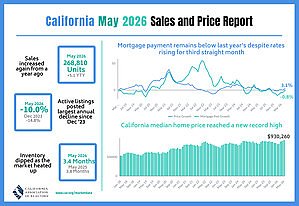
- Record Median Home Price: $930,260 in May 2026, driven by luxury segment sales.
- Luxury Sales Surge: Homes priced $1M–$2M up 8.2%, and those above $2M up 8.5% year-over-year.
- Affordability Crisis: Only 18% of California households could afford a median-priced home as of April 2026.
Experts would likely conclude that California's housing market is experiencing a dangerous bifurcation, with luxury sales propping up record prices while middle-class affordability and supply constraints worsen.
California’s Two-Tier Housing Market: A Record Price on a Fractured Foundation
SACRAMENTO, CA – June 17, 2026 – California's housing market has once again defied expectations, posting a new record-high median home price of $930,260 in May. Data released today by the CALIFORNIA ASSOCIATION OF REALTORS® (C.A.R.) shows a market where year-over-year sales are up for the second straight month, painting a surface-level picture of robust health. Yet, beneath this glittering headline lies a fractured reality: a market increasingly cleaved into two distinct tiers, where soaring prices are fueled by the wealthy while a choked supply and persistent affordability crisis lock out the middle class.
While total sales of existing single-family homes rose 5.1% from a year ago, the figure that truly defines the current market is the composition of those sales. The record median price isn't a reflection of uniform appreciation across the board; it's a direct consequence of a dramatic shift in market activity toward the highest end of the spectrum. This divergence reveals the hidden currents shaping not just the state's real estate landscape, but its broader economic and social fabric.
The Anatomy of a Record
The engine driving California’s median price into uncharted territory is the luxury segment. According to the latest C.A.R. report, sales of homes priced between $1 million and $2 million surged by 8.2% compared to last year. Even more strikingly, sales of properties above $2 million soared by 8.5%. This activity at the top end has become so concentrated that million-dollar-plus homes now account for a record 38.5% of all transactions in the state.
In stark contrast, sales in the more accessible $500,000 to $1 million range—the segment where most middle-income families hope to find a foothold—declined by 3.4%. This bifurcation is the central paradox of the 2026 market. The statewide median, a simple statistical midpoint, is being pulled upward by the sheer weight of high-value transactions, masking the stagnation and struggle occurring in the market's core.
This skew is so pronounced that it creates a divergence among market trackers. While C.A.R.'s data, which focuses on existing single-family homes, places the median at over $930,000, other analytics firms like Redfin and Zillow, which may include different property types, report lower statewide medians. The discrepancy highlights how the intense competition for luxury properties is creating a distorted public perception of overall market health.
"Strong equity market performance over the past two months supported higher-end housing demand," noted C.A.R. Senior Vice President and Chief Economist Jordan Levine. This influx of capital into the top tier intensifies competition and funnels resources away from the market's middle and lower rungs, exacerbating an already severe affordability crisis where, as of April, only 18% of California households could afford to purchase a median-priced home.
The Great Supply Constriction
The second fundamental force shaping this market is a profound and persistent lack of supply. Active listings in May fell below year-ago levels for the fourth consecutive month. The Unsold Inventory Index (UII), a measure of how long it would take to sell all available homes at the current sales pace, fell 10.5% from last year to just 3.4 months, indicating a tight seller's market.
The primary culprit is the well-documented 'lock-in effect.' A vast number of current homeowners are sitting on mortgages with interest rates of 3% or lower. With the average 30-year fixed rate hovering at 6.44% in May, there is a powerful financial disincentive to sell and enter the market for a new home. These homeowners are effectively wearing golden handcuffs, unable or unwilling to trade a low monthly payment for a much higher one, even if their housing needs have changed.
This dynamic has throttled the normal churn of the market, keeping would-be inventory on the sidelines. "Housing supply has remained constrained in recent months as the lock-in effect continued to put many would-be sellers on the sidelines, intensifying competition and placing upward pressure on home prices," Levine explained.
While C.A.R. President Tamara Suminski sees the recent easing of mortgage rates from their peaks as an "encouraging development," the reality is that rates have not fallen as quickly as many had forecast. This stubbornness, tied to broader economic and geopolitical uncertainty, ensures the lock-in effect will remain a dominant market feature, constricting supply through the peak summer buying season.
A State of Contrasts
Looking beyond the statewide median reveals a patchwork of deeply fragmented local markets. California is not one housing market, but dozens, each responding to unique economic pressures. The C.A.R. report shows the Central Coast leading all regions with a blistering 21.4% year-over-year increase in sales. The San Francisco Bay Area also posted a solid 5.5% gain.
In contrast, the massive Southern California region saw sales dip by 0.4%, essentially flatlining. County-level data shows even more extreme divergence. Glenn County, in the Central Valley, recorded a 54.5% surge in sales, while Trinity County in the Far North plummeted by 72.7%. While C.A.R. cautions that such dramatic swings in smaller counties can be attributed to low transaction volumes, they underscore the immense regional variation.
In the Bay Area, San Francisco saw its median price jump an astounding 22.2% year-over-year to $2.2 million, with homes selling in a median of just 25 days. In Southern California, Orange County's median price climbed 5.1% to nearly $1.5 million. This granular data confirms the statewide trend: wealth-driven, high-cost coastal areas are seeing intense activity, while other regions face different realities.
The market is functioning in an uneasy equilibrium. Despite the low overall sales volume—which has remained below the 300,000-unit benchmark for 44 straight months—the intense competition for what little inventory exists is fierce. Homes are selling in a median of just 22 days, unchanged from a year ago, and the statewide sales-price-to-list-price ratio stands at a perfect 100.0%, indicating that buyers have virtually no negotiating power. As the summer buying season continues, the California housing market remains a case study in economic divergence, where record highs for some are built upon the affordability crisis for many, a precarious balance sustained by a fundamental lack of homes.