
- 95% of enterprise AI projects fail to deliver measurable ROI
- Less than 2% of AI projects have deployed agents at full scale
- 88% of leaders regret not investing in foundational content and data infrastructure before deploying agentic AI
Experts would likely conclude that Contentstack's Agentic Experience Platform (AXP) addresses critical architectural gaps in enterprise AI execution, offering a unified framework to bridge the divide between AI ambition and operational reality.
Contentstack's Blueprint to Fix Enterprise AI's Execution Problem
AUSTIN, TX – June 09, 2026 – As enterprises pour billions into artificial intelligence, a troubling reality has emerged from behind the hype: the vast majority of AI projects are failing. Stalled pilots, nonexistent ROI, and a growing tangle of disconnected systems have created what Contentstack is calling the "AI execution gap." Today, the company is betting its future on the solution, launching its Agentic Experience Platform (AXP), a new architecture designed not just to add AI features, but to fix the broken foundations that prevent AI from delivering on its promise.
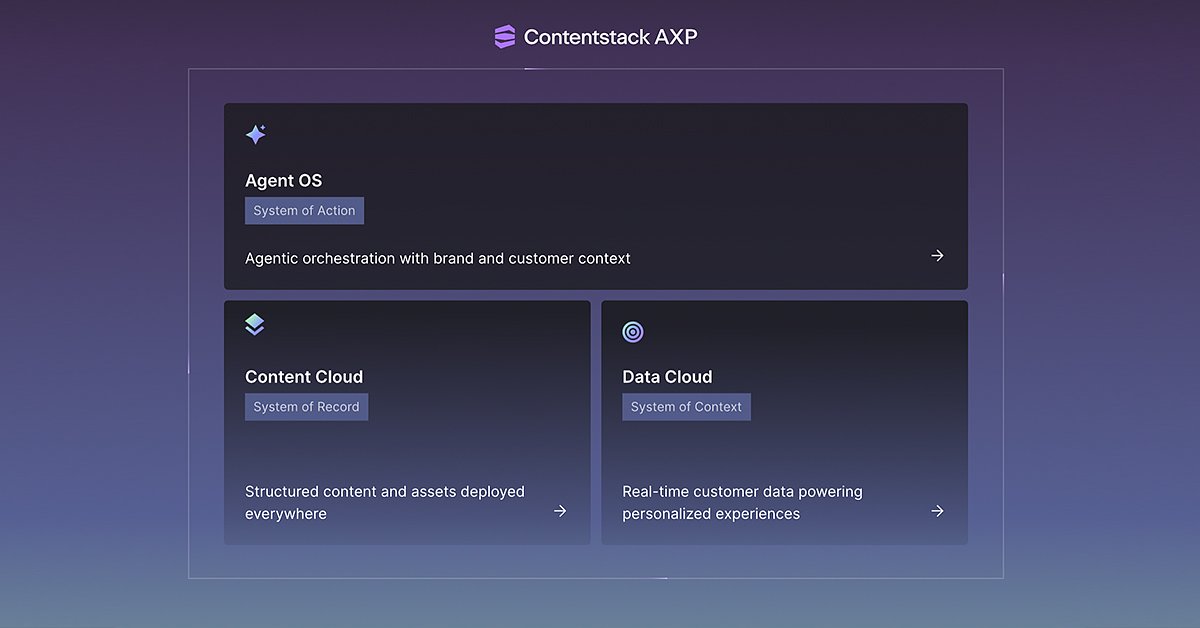
The announcement marks a significant pivot for the independent CMS pioneer, moving decisively from its headless content roots into the ambitious territory of AI orchestration. The platform, comprising an autonomous "Agent OS," a customer data "Data Cloud," and a brand governance "Content Cloud," aims to provide the unified framework that many organizations now realize they lack.
The Architecture of Action
For the past year, generative AI has dominated boardroom conversations, but industry analysts note a palpable shift. According to Gartner's 2025 Hype Cycle, generative AI has already entered the "Trough of Disillusionment" as executives grapple with poor returns and governance nightmares. Now, "agentic AI"—systems capable of autonomous reasoning, planning, and action—is cresting the "Peak of Inflated Expectations."
The danger is that enterprises will repeat the same mistakes. Research reveals a staggering 95% of enterprise AI projects fail to deliver measurable ROI, while less than 2% have deployed agents at full scale. The core issue isn't the AI itself, but the environment it's dropped into.
"Every enterprise leader I talk to has a version of the same story: great AI tools, sitting on top of disconnected foundations, producing pilots that never scale," said Neha Sampat, CEO of Contentstack, in today's announcement. "That's not an AI problem. That's an architecture problem. We built Agent OS to solve it."
Contentstack's own forthcoming research underscores the pain point, finding that 88% of leaders wish they had invested in foundational content and data infrastructure before deploying agentic AI. This widespread regret highlights a market that has learned a hard lesson: layering intelligent systems onto a fragmented, ungoverned tech stack is a recipe for failure.
A Unified Blueprint for AI
Contentstack’s AXP is its answer to this architectural crisis. The platform is built on the premise that for AI to act intelligently and safely on a company's behalf, it requires three tightly integrated systems working in concert.
First is the Content Cloud, a system for governance that provides the brand guardrails. This includes a headless CMS and a "Brand Kit" to ensure that no matter what an AI agent creates or does, it remains consistent with the company's voice and values.
Second is the Data Cloud, the system for context. Powered by a Customer Data Platform (Lytics) and a personalization engine, it unifies customer behavior and intent signals, ensuring the AI knows precisely who it is talking to.
Finally, there is Agent OS, the architecture of action. This is the workforce of AI agents designed to execute tasks, armed with the full context of the company's content and customer data.
"AI that generates content without knowing your customer is guessing. AI that knows your customer but runs without content governance will erode your brand," Sampat explained. Separately, these systems are incomplete. Together, Contentstack argues, they close the gap between AI ambition and operational reality.
Early adopters are providing the first glimpses of this theory in practice. “Accuracy of hotel data is critical for us,” said Jack Simkins, Digital Product Manager at Golfbreaks. An autonomous fact-checking agent built on Agent OS now cross-references data in the background, flagging discrepancies for the team. “We’re able to protect our customers’ trust without the manual overhead that was becoming unsustainable.”
Navigating a Crowded and Skeptical Market
Contentstack is not alone in identifying this opportunity. The race to build the operating system for enterprise AI is well underway. Just this past April, software giant Adobe announced its own agentic layer, CX Enterprise, designed to orchestrate actions across its massive Experience Cloud. Other players, from established DXP providers to nimble startups, are all staking a claim in the agentic future.
However, Contentstack is positioning its AXP not as another monolithic suite, but as an orchestration layer designed to connect and coordinate the systems a company already has. This integration-first approach could prove to be a key differentiator for enterprises wary of another costly and disruptive rip-and-replace project.
The company's vision aligns with where analysts see the market heading. “Intelligent content is going to go beyond the boundaries and limitations of content as we know it today," noted Chuck Gahun, Principal Analyst at Forrester, in a recent webinar. He predicts the rise of "agentic content systems—grounded in structure, governance, modularity, and human-machine collaboration"—as the standard for the next era of engagement.
This focus on governance is a critical selling point. “Our clients want autonomous AI capabilities, but they cannot compromise on security or brand alignment,” confirmed Meng Hak, Contentstack Practice Director at implementation partner XCentium. “Contentstack’s architecture solves this by embedding strict governance directly into the agent layer.”
From Pilot to Production
Technology, however, is only half the battle. One of the most significant hurdles to AI adoption is organizational, not technical. Contentstack's research found that for 42% of organizations, the lack of a clear internal owner has directly delayed their agentic AI initiatives.
To address this, the company is launching Agent Accelerator, a services-led program designed to shepherd organizations from concept to operational reality. It’s a tacit admission that selling complex AI technology requires a heavy dose of change management. The program aims to help teams establish guardrails, identify high-impact use cases, and build the internal operating models necessary to scale.
Contentstack claims to have proven the model internally, citing a web performance dashboard project that reduced manual data-gathering effort by 95%—turning a 45-minute task into a process completed in seconds.
“Enterprise teams are done with vague AI promises," said Christine Masters, Senior AI Solutions Strategist at Contentstack. "They need the right roadmap, guardrails, and operating model to put AI to work inside real daily functions.”