
- 300+ authorized patents held by SALIAI, spanning China and the U.S.
- 5 National Patent Excellence Awards for its cellular research innovations
- GMP-compliant manufacturing facility with ISO and CNAS certifications
Experts view SALIAI as a significant player in biotech innovation, particularly in cellular research, but emphasize that its global leadership claims will require rigorous scientific validation and regulatory approvals to be fully realized.
China's SALIAI Hailed as Biotech Pioneer, Eyes Global Stage
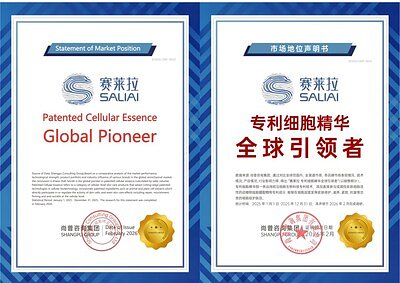
GUANGZHOU, China – March 02, 2026 – A recent market position statement has propelled Guangzhou SALIAI Stem Cell Science and Technology Co., Ltd. into the international spotlight, labeling the Chinese firm a "Global Pioneer in Patented Cellular Essence." The designation, issued by the China-based research and advisory firm Shangpu Group, recognizes SALIAI's technological standing after a purported global market study. This accolade highlights not only the company's ambitions but also the broader ascent of China's biotechnology sector on the world stage.
Founded in 2009 and headquartered at Guangzhou International Bio Island, SALIAI has been a significant player in China's domestic biotech scene for over 16 years. It was the first stem cell-focused company to be quoted on the country's NEEQ market. The new recognition from Shangpu Group, however, seeks to elevate its status from a national champion to a global leader. Yet, the statement comes with a crucial clarification from Shangpu itself, noting that the designation "does not constitute a regulatory classification, certification, or government endorsement," framing it as a market assessment rather than a scientific or governmental validation.
This distinction is critical in an industry where scientific rigor and regulatory approval are paramount. While the 'Global Pioneer' title offers a powerful marketing tool for SALIAI as it pursues international expansion, it also invites closer scrutiny of its claims, its technology, and its position within a fiercely competitive global market.
The Science Behind the Status
At the core of SALIAI's pioneer claim is an extensive intellectual property portfolio and a deep focus on cellular research. The company reports holding more than 300 authorized patents, with technologies granted in both China and the United States. Its innovations in umbilical cord-derived extracts and exosome-associated processes have earned it five National Patent Excellence Awards, positioning it as a leader in creating and protecting its technological assets.
Led by Founder Dr. Chen Haijia and Chief Scientist Academician Su Guohui, SALIAI has developed sophisticated processes designed to harness the power of cellular materials. A key technology is its proprietary freeze-drying process, which preserves cellular extracts at a frigid minus 40 degrees Celsius. This method, combined with nano-scale delivery systems, is intended to ensure the stability and topical efficacy of its ingredients in cosmetic applications. The company operates from a GMP-compliant manufacturing facility that boasts both ISO and CNAS certifications, underscoring its commitment to quality control.
These scientific endeavors are not merely academic. They are the foundation for a growing line of commercial products marketed within China's booming cosmetics sector. Its SYDRAW Intelligent Polypeptide Lyophilized Powder and Bio Island Anti-Wrinkle and Firming Essence Set have already achieved provincial recognition as "Guangdong Premium Cosmetics," translating laboratory research into tangible consumer goods.
Bridging Beauty and Regenerative Medicine
SALIAI is executing an ambitious dual-track strategy, leveraging its cellular technology platform to compete in two distinct yet converging markets: high-end cosmeceuticals and investigational regenerative medicine. This approach places it in a complex and crowded field, competing against a wide array of global players.
In the cosmeceutical space, SALIAI is up against brands like CALECIM® Professional, which uses stem cells from red deer cord lining, and SkinMedica, known for its growth factor-rich TNS Recovery Complex. These companies have already established the market for science-backed, high-efficacy skincare. SALIAI's success will depend on its ability to differentiate its umbilical cord-derived technology and prove its superiority in a market saturated with advanced ingredients.
Simultaneously, the company's investigational programs in regenerative medicine put it in the same arena as major biotech firms like Bayer's BlueRock Therapeutics, which is developing stem cell therapies for Parkinson's disease, and numerous other companies focused on cell-based treatments. SALIAI has announced research collaborations with medical institutions to explore stem cell approaches for conditions like knee osteoarthritis. While this signals a serious commitment to therapeutic development, details on these clinical programs—such as trial phases, patient enrollment, and preliminary outcomes—are not yet widely available in public registries. This lack of transparency makes it difficult for outside observers to independently assess the progress of its medical research.
Navigating a Complex Regulatory World
SALIAI's vision to "Make health and beauty within reach" on a global scale hinges on its ability to navigate the labyrinthine regulatory frameworks governing cellular products. The path from a research lab to an approved product is fraught with challenges that vary significantly from one country to another.
In its home market, China has been rapidly evolving its regulatory approach. The country operates a dual-track system for cell therapies, with the National Medical Products Administration (NMPA) treating them as drugs requiring rigorous trials and the National Health Commission (NHC) overseeing their use as a medical technology. New rules set to take effect in May 2026 aim to streamline this process, but the landscape remains complex. For its cosmetic products, SALIAI must comply with China's stringent Cosmetic Supervision and Administration Regulation (CSAR).
As SALIAI pushes for international expansion, it will face the formidable scrutiny of agencies like the U.S. Food and Drug Administration (FDA) and the European Medicines Agency (EMA). The FDA regulates stem cell products as drugs or biologics if they are more than minimally manipulated or used for non-homologous purposes, requiring a lengthy and expensive Investigational New Drug (IND) approval process. Similarly, the EMA classifies these products as Advanced Therapy Medicinal Products (ATMPs), which are subject to a centralized and highly demanding assessment of quality, safety, and efficacy. The 'Global Pioneer' designation may open doors to investors, but it offers no shortcuts through these rigorous regulatory gates.
To support its growth, SALIAI is implementing digital systems for manufacturing and quality control and is establishing a Stem Cell Innovation Association in the Guangdong-Hong Kong-Macao Greater Bay Area to foster collaboration. These initiatives demonstrate a strategic approach to scaling its operations. Ultimately, the company's journey from a national high-tech enterprise to a true global leader will be determined not by market position statements, but by its ability to produce robust clinical data and successfully navigate the world's most demanding scientific and regulatory pathways.