
- 2.3 trillion behavioral signals collected by Measure Protocol, growing by 200 million monthly. - 83% of Google searches within 5 minutes of ChatGPT use are for verification, not discovery. - Platform tracks activity across 29 primary platforms and 7,900 retail/travel properties.
Experts would likely conclude that Measure Predict offers a groundbreaking solution to the data fragmentation crisis in consumer behavior analysis, though its long-term impact will depend on adoption and real-world validation.
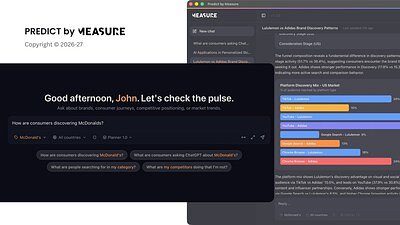
Beyond the Click: A New Map for the Lost 2026 Consumer
LONDON and NEW YORK – June 04, 2026 – For the better part of a decade, the world of commercial strategy has been grappling with a paradox: we are drowning in data, yet thirsting for clarity. The digital breadcrumbs we once followed to understand consumer intent have been swept away by a tide of privacy regulation and platform autonomy. The old maps are useless. For brands trying to navigate the 2026 consumer landscape, it often feels like they’re flying blind.
Today, a London and New York-based behavioral data company, Measure Protocol, announced a potential new compass. With the launch of Measure Predict, it is making a bold claim: that it can finally illuminate the true, unvarnished journey of the modern consumer, from the first flicker of intent on TikTok to the final purchase on Amazon. It’s a claim that, if true, could represent a fundamental shift in how we understand the 'why behind the buy'.
The Cracks in the Crystal Ball
It’s no secret that the marketing measurement stack is, as Measure Protocol’s press release bluntly puts it, “structurally broken.” The deprecation of third-party cookies was just the beginning. Apple’s App Tracking Transparency (ATT) framework, which requires apps to ask for permission to track users, has seen opt-in rates hover around 45%. This means more than half of iOS users are ghosts in the machine. Add in the broader trend of privacy-conscious browsing, and an estimated 30% of all mobile users are now effectively untrackable by traditional means.
This isn’t just a technical headache for ad-tech engineers; it's an existential crisis for strategists and CMOs. How do you justify a multi-million dollar campaign when you can’t reliably connect it to a sale? How do you innovate when the signals that once guided product development have gone dark? We've been forced to fall back on proxies, panels, and post-purchase surveys—tools that capture what consumers say they did, a notoriously unreliable substitute for what they actually did.
This data fragmentation has created a fractured, incomplete mosaic of the consumer. We see a search on Google, a video view on YouTube, and a purchase on a retail site, but the threads connecting them have been severed. We are left to guess, to model, to infer—but we don't know.
A New Blueprint Built on Trust
Measure Predict proposes a radical departure from this broken model. Instead of trying to piece together illicitly gathered data scraps, its entire foundation is built on one of the world's largest pools of 'zero-party' data. This isn't inferred or scraped data; it's behavioral information that consumers have explicitly and willingly shared in exchange for compensation, all under a privacy-first framework compliant with GDPR and CCPA.
For over five years—a timeline that predates both the cookie apocalypse and the rise of generative AI—Measure has been building a permissioned data lake that now holds a staggering 2.3 trillion behavioral signals. This continuous, unbroken time series, growing by over 200 million new data points every month, is the bedrock of the new platform. It’s a dataset of such scale and quality that it already underpins analytics work at Google, Meta, and Netflix, and serves as the foundation for Project Lantern, the ambitious cross-platform TV measurement initiative led by the UK’s largest broadcasters.
“Insights teams have been forced to choose between fast-but-shallow and rigorous-but-slow for far too long,” says Owen Hanks, CEO of Measure Protocol. He argues that Predict offers a third way. “This is the first time a CMO can ask a question of complete cross-platform behavioral data... and get an answer back in the time it takes to read a Slack message.”
Unlocking the Invisible Journey
The platform's most compelling promise is its ability to map the complete behavioral arc across the digital ecosystem, including inside the 'walled gardens' where so much of modern life happens. Predict links activity at the individual level across 29 primary platforms—from Facebook and TikTok to ChatGPT and Amazon—and over 7,900 retail and travel properties.
This is the holy grail for modern marketers. John Martin, Measure Protocol’s Chief Product Officer, lays out the scenario perfectly: “When someone searches on Google, watches a TikTok, asks ChatGPT for a comparison, and ends up on an Amazon product page, those events are linked to the same five-year history of behavior.”
This capability unearths insights that are simply impossible to find with other methods. For instance, Measure's data reveals that 83% of Google searches made within five minutes of a ChatGPT conversation are for verification, not discovery. This small but powerful fact fundamentally reframes how a brand should think about the interplay between generative AI and traditional search. It suggests a consumer who is more informed, more skeptical, and using a whole new set of tools to validate their decisions. Finally, we can see the previously invisible journey between platforms and understand where decisions are truly being made.
From Passive Data to Agentic Intelligence
Perhaps the most forward-looking aspect of Predict is its 'agentic' character. This isn't just a static dashboard or a database awaiting a query. The platform is designed to act as an autonomous analyst, actively surfacing patterns, flagging behavioral shifts, and identifying anomalies without waiting to be asked. It’s a move from passive data retrieval to proactive, AI-driven intelligence generation.
This agentic layer is coupled with an open architecture. Rather than forcing teams into yet another proprietary interface, Predict is designed as an 'intelligence infrastructure layer'. It connects directly into a company’s existing data platforms and business intelligence environments via command-line interface (CLI) or Model Context Protocol (MCP). This pragmatic approach recognizes that the value isn't in a new dashboard, but in embedding real-time behavioral intelligence directly into the workflows where decisions are made.
For CMOs, strategists, and insights leaders, this combination of speed, depth, and proactivity changes the game. It collapses the distance between a complex business question and a verifiable, behavior-based answer. As Hanks puts it, it provides access to intelligence that was “once locked behind a six-week project plan and six-figure invoice.” In a landscape defined by unprecedented speed and complexity, having a direct line to the ground truth of consumer behavior may be the only sustainable competitive advantage left.