
- 100 properties: Banyan Group celebrates its 100th property milestone, spanning 13 brands across 24 countries.
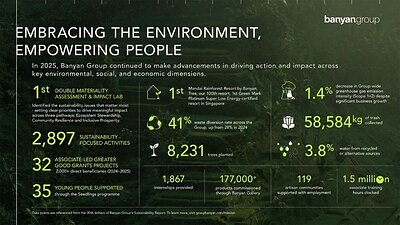
- 41% waste diversion rate: A significant increase from 28% the previous year, demonstrating progress in sustainability.
- 1.4% reduction in GHG emission intensity: Despite welcoming 4.7 million guests in 2025.
Experts view Banyan Group's strategic shift towards double materiality assessment and integrated sustainability pathways as a critical step in authentic ESG integration, positioning the company as a leader in scalable sustainable luxury.
Banyan Group at 100: Can Sustainable Luxury Scale Globally?
SINGAPORE – April 22, 2026 – As Banyan Group celebrates the opening of its 100th property, the global hospitality company has also marked two decades of sustainability reporting with the release of a report that signals a significant strategic pivot. The 2025 report, titled From One Vision to 100 Possibilities, details a new framework designed to embed environmental and social governance into the core of its business, challenging the conventional wisdom that rapid expansion must come at an ecological cost.
For over thirty years, the Group has operated under the ethos of “Embracing the Environment, Empowering People,” a vision that began with the ambitious restoration of an abandoned tin mine in Phuket. Today, that vision spans 13 brands across 24 countries. The central question now facing the company, and the industry watching it, is whether this ethos can be scaled with the same discipline as its balance sheet.
“The significance of reaching 100 properties lies not in the number itself but in what it represents,” said Ho Kwon Ping, Founder and Executive Chairman of Banyan Group, in a statement. “Long-term business success is inseparable from the wellbeing of the destinations in which we operate... Sustainability is not peripheral to business performance. It is part of how long-term value is protected and created.”
A Disciplined Shift from Programs to Strategy
The 2025 report distinguishes itself by detailing the Group’s first-ever double materiality assessment, a sophisticated approach to sustainability that moves beyond isolated, program-led initiatives. This methodology, aligned with emerging global standards like Europe’s ESRS, evaluates not only the financial risks and opportunities sustainability issues pose to the company but also the company's own impact on the environment and society.
This shift from a single to a double-sided view has informed a more integrated, enterprise-wide strategy. The findings from the assessment have been distilled into three new “Impact Pathways” that will guide future actions:
- Ecosystem Stewardship: To design, operate, and source in ways that protect nature and manage resources responsibly.
- Community Resilience: To strengthen the wellbeing, cultural vibrancy, and long-term resilience of host communities.
- Inclusive Prosperity: To create opportunities through associates, guest experiences, and governance that build trust.
This structured approach aims to translate aspirational goals into measurable business objectives, a move that experts suggest is critical for authentic ESG integration and avoiding accusations of “greenwashing.”
Measuring Impact: Growth Amidst Reductions
Despite significant business growth in 2025, which saw the Group welcome 4.7 million guests, Banyan Group reported notable environmental improvements. Group-wide greenhouse gas (GHG) emission intensity (Scope 1 & 2) fell by 1.4%, and waste generation decreased by a substantial 13%. Perhaps most impressively, the waste diversion rate—the percentage of waste kept out of landfills—rose to 41%, a sharp increase from 28% in the previous year.
In the competitive landscape of global hospitality, these numbers hold their own. While giants like Marriott and Accor have set ambitious long-term net-zero targets, Banyan Group's year-over-year progress demonstrates tangible results from its operational focus. For comparison, Marriott aims to reduce waste to landfill by 45% by 2025, and Accor has a target to cut food waste by 60% by 2030. Banyan Group's 41% waste diversion rate and its own target of 42% emissions reduction by 2030 (from a 2022 baseline) place it firmly within the cohort of industry leaders actively tackling their environmental footprint.
Redefining Luxury Through Regenerative Design
Banyan Group's 100th property milestone is not just a number but a showcase for its philosophy in practice. The latest additions to its portfolio exemplify a move towards regenerative tourism—an approach that seeks to leave a destination better than it was found.
The 100th property itself, the Mandai Rainforest Resort by Banyan Tree in Singapore, is the first hotel in the country to receive the prestigious BCA Green Mark Super Low Energy (Platinum) Award, setting a new benchmark for sustainable hospitality in a dense urban market.
In Vietnam, the Garrya Mù Cang Chải resort is a marvel of ecological design. Following the natural contours of rice terraces, it utilizes locally sourced bamboo as its primary structural material, creating what is billed as the world's largest bamboo-structured resort while minimizing land disturbance and embodied carbon. Meanwhile, the Banyan Tree Zhuhai Phoenix Bay in China integrates the region’s Lingnan water town traditions and intangible cultural heritage, such as Sanzao bamboo weaving, directly into its contemporary design.
These projects illustrate a vision of luxury that is deeply intertwined with place, culture, and ecology, offering guests more than just a five-star experience but a connection to the destination itself.
Empowering People: From Artisans to Associates
The Group’s commitment extends deeply into the social fabric of its locations. Through the Banyan Global Foundation, its philanthropic arm, 32 associate-led “Greater Good Grants” projects were activated in 2025, directly benefiting over 2,000 people in local communities, from students and farmers to inmates in rehabilitative training programs.
“Our role extends beyond responsible operations to ensuring that tourism contributes meaningfully to community wellbeing, cultural heritage and the long-term resilience of the places we share,” stated Claire Chiang, Co-Founder of Banyan Group and Chairperson of the Banyan Global Foundation.
This commitment is perhaps most visible in the Banyan Gallery, a social enterprise platform that has evolved from a small shop in 1996 to a global network. In 2025 alone, the Gallery commissioned over 177,000 products, providing stable income for artisans from more than 20 traditional craft communities and helping preserve heritage skills like Thai Bencharong ceramics and ancient Japanese papermaking. The platform now works with 339 artisan groups and 240 social enterprises, creating a tangible economic link between the Group's guests and local creators.
This focus on human capital also applies internally, with the company delivering over 1.5 million training hours to its nearly 15,000 associates in 2025, contributing to an increase in its Associate Wellbeing Index.
Looking ahead, the company plans to build on this new strategic foundation. An inaugural “Sustainability Impact Lab” has already translated the double materiality assessment into over 40 concrete action areas for 2026. “When sustainability is embedded as a business driver rather than a standalone initiative, it accelerates innovation, strengthens operational resilience and delivers measurable value,” said Dr. Mark Watson, the Group’s Director of Sustainability and Impact. Near-term priorities include creating a unified environmental management system and embedding sustainability deeper into the supply chain, ensuring the vision from the top is executed on the ground across all 100 properties and beyond.
Topics & Related
Venture Capital
Cloud & Infrastructure
AI & Machine Learning
Digital Transformation
Net Zero
Circular Economy
Corporate Finance
Revenue
Net Income
Related Company Pulse