
- 2050: Taiwan aims to achieve net-zero carbon emissions by this year.
- 1400W: Next-generation AI accelerators have thermal design power exceeding this wattage, pushing cooling limits.
- 50%: Cooling accounts for nearly half of the power draw in data centers.
Experts view this Franco-Taiwanese partnership as a strategic leap forward for Taiwan's dual goals of decarbonization and AI-driven industrial innovation, leveraging cutting-edge simulation technology to solve critical engineering challenges.
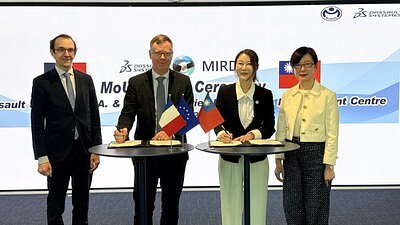
Taiwan Forges AI and Green Future with French Tech Partnership
KAOHSIUNG, Taiwan – April 16, 2026 – In a significant move to secure its position at the forefront of global technology, Taiwan's Metal Industries Research & Development Centre (MIRDC) has entered into a landmark partnership with French industrial software giant Dassault Systèmes. The Memorandum of Understanding (MOU), signed on April 15, aims to accelerate Taiwan's dual ambitions of achieving net-zero carbon emissions and leading the next wave of AI-driven industrial transformation.
The agreement, witnessed by Ambassador Pei-Chih HAO of the Taipei Representative Office in France, pairs MIRDC's deep expertise in materials science with Dassault Systèmes' world-leading 'Virtual Twin' simulation technology. This collaboration will initially target two of the most critical and challenging sectors in modern industry: the development of safe, high-pressure hydrogen energy components and the creation of ultra-efficient thermal management systems for power-hungry AI servers.
A Strategic Alliance for a Dual Transformation
This partnership is more than a simple technology exchange; it represents a cornerstone of Taiwan's national strategy. The island is aggressively pursuing ambitious goals to decarbonize its economy by 2050, with hydrogen identified as a key pillar in its "Five Strategies for Net Zero Transformation." Simultaneously, Taiwan is leveraging its formidable R&D and manufacturing base to become a global hub for AI development. This Franco-Taiwanese alliance directly serves both strategic imperatives.
The collaboration provides Taiwanese industries with a crucial competitive edge. By gaining access to Dassault Systèmes' 3DEXPERIENCE platform, local firms can leapfrog traditional, time-consuming R&D cycles. This digital-first approach allows for the simulation and validation of complex designs in a virtual environment, drastically reducing the need for costly and often hazardous physical prototypes. For a nation aiming to innovate rapidly in high-stakes fields like green energy and high-performance computing, this capability is transformative.
MIRDC has already laid extensive groundwork. The Centre has been fostering a domestic hydrogen ecosystem through its "Hydrogen Combustion Industrial Application and High-pressure Transmission and Storage Technology Alliance" and international collaborations with institutions like Japan's Kyushu University and Dutch and Canadian technology firms. This new pact with Dassault Systèmes builds upon that foundation, providing the advanced digital tools needed to solve the toughest material science challenges in the hydrogen value chain.
The Digital Edge: Revolutionizing Critical Technologies
The core of the partnership lies in the application of 'Virtual Twin' technology to solve complex engineering problems that are currently bottlenecks to progress. This technology creates a highly precise, physics-based digital replica of a product, process, or system, allowing engineers to test, analyze, and optimize it under a vast range of conditions.
In the realm of high-pressure hydrogen, safety and durability are paramount. Hydrogen, while a clean fuel, can cause embrittlement and fatigue in the metals used for storage tanks and pipelines. Using the 3DEXPERIENCE platform, MIRDC will integrate its material analysis models—some co-developed with the French research institute CETIM—to simulate the long-term effects of high-pressure hydrogen on various materials. This virtual lifetime analysis will enable the development of safer, more durable, and more reliable components, accelerating the safe rollout of hydrogen infrastructure across Taiwan and potentially the world.
Equally pressing is the thermal challenge posed by the AI revolution. The demand for high-performance computing (HPC) is exploding, but so is the energy consumption of data centers, with cooling accounting for nearly half of their power draw. Next-generation AI accelerators, with thermal design power (TDP) exceeding 1400W, are pushing traditional air-cooling methods to their absolute limit. The MIRDC-Dassault Systèmes collaboration will tackle this head-on. By combining MIRDC's expertise in thermal systems, evidenced by its AI-driven "ThermoMind" combustion system, with Dassault's simulation prowess, the partners aim to design and validate next-generation thermal management solutions, such as direct liquid and immersion cooling systems. These virtual simulations will help optimize energy efficiency and performance, ensuring that the growth of AI is sustainable.
Bolstering Taiwan's Global Supply Chain Resilience
This initiative is poised to have a profound economic impact, strengthening Taiwan's indispensable role in the global technology supply chain. For decades, Taiwan has been a world leader in manufacturing and component supply. This partnership signals a strategic evolution—from a maker of parts to an innovator of the core technologies that will define future industries.
MIRDC Chairwoman Chia-Ru LIU stated that the collaboration not only validates the Centre's R&D capabilities on a global stage but also empowers Taiwanese manufacturers to innovate using the world's most advanced AI tools. The benefits are expected to cascade through multiple sectors. Manufacturers in Taiwan's hydrogen supply chain will be able to produce globally competitive, high-safety-rated products. The island's powerful original design manufacturers (ODMs) and data center operators will gain access to cutting-edge thermal solutions, enabling them to build more powerful and efficient AI infrastructure.
By embedding AI-driven simulation and design into its industrial fabric, Taiwan is building a more resilient and competitive economic ecosystem. The knowledge and methodologies developed through this partnership will guide domestic players—from raw material suppliers to system module integrators—in making the leap to AI-driven transformation. This strategic investment in digital R&D capabilities is designed not just to meet current industrial demands but to establish the momentum for the next wave of economic growth, securing Taiwan's position as a critical innovator for years to come.