
- 84% of packaging leaders plan to adopt smart packaging in 1-3 years, but only 1% have fully implemented it today.
- The global intelligent packaging market is projected to grow from $18 billion (2024) to $31 billion by 2033.
- 77% of packaging leaders expect their operations to advance sustainability goals in the next 1-3 years.
Experts agree that while the packaging industry is highly motivated to adopt smart and sustainable technologies, significant barriers—including high costs, IT integration challenges, and regulatory uncertainties—are slowing widespread implementation, requiring strategic, long-term planning to bridge the gap between ambition and action.
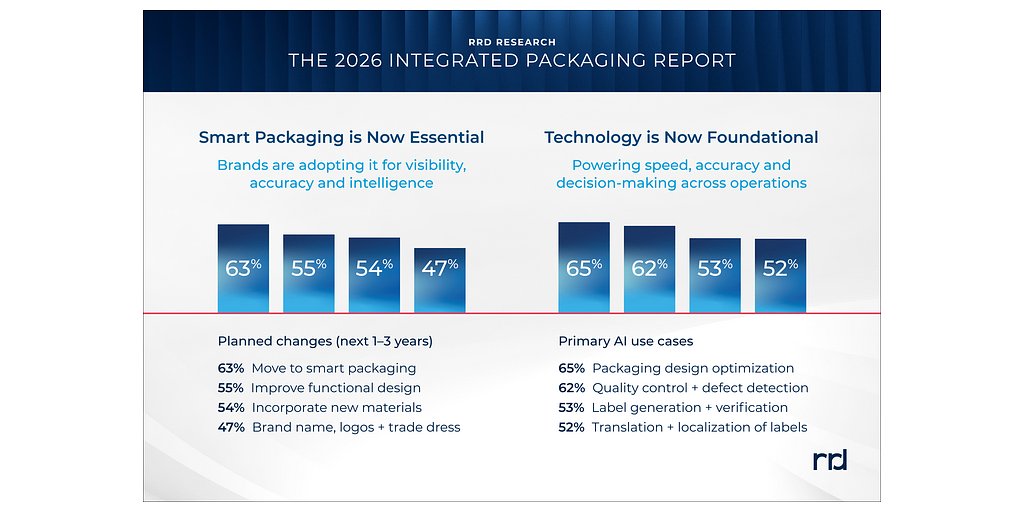
Smart Packaging's Great Divide: Ambition Outpaces Action
CHICAGO, IL – January 27, 2026 – A major new report reveals a stark paradox at the heart of the global packaging industry: while awareness and intent to adopt smart, connected technologies are at an all-time high, actual implementation lags dramatically behind. A survey of 400 industry leaders by RRD shows that while the future of packaging is envisioned as a data-rich, interconnected ecosystem, the path to that future is proving slower and more complex than anticipated.
This implementation gap exists even as the industry doubles down on sustainability as a core business driver, creating a complex landscape where companies must simultaneously navigate a technological revolution and an environmental mandate.
The Implementation Paradox
The findings from RRD’s 2026 Integrated Packaging Report paint a picture of an industry on the cusp of transformation, yet hesitant to take the final leap. An overwhelming 84% of packaging, label, and supply chain leaders surveyed plan to transition to smart packaging—which integrates technologies like RFID labels, QR codes, and IoT sensors—within the next one to three years. However, a mere 1% claim to have fully implemented such solutions today.
This disconnect is not for lack of market potential. The global intelligent packaging market was valued at over $18 billion in 2024 and is projected to surge past $31 billion by 2033. The RFID segment, crucial for supply chain tracking, is growing even faster. Yet, progress is stalled by significant hurdles. For half of the companies not planning an imminent adoption, the primary barrier is the perceived complexity of integrating these new systems with existing IT and operational infrastructure.
Beyond IT challenges, industry experts point to other systemic barriers. High initial investment costs, a lack of uniform regulatory standards across regions, and persistent data security concerns create a challenging environment for widespread adoption. Many intelligent packaging solutions are still in early development, lacking the long-term, proven success stories needed to build a compelling business case for the significant upfront investment required.
E-commerce Accelerates the Digital Demand
While internal barriers slow adoption, external pressures are mounting. The relentless growth of e-commerce is a primary force compelling the industry to get smarter, faster. According to the RRD report, nearly all organizations (96%) now have an e-commerce operation, and 80% of leaders expect that part of their business to grow in the coming years.
This shift fundamentally alters packaging requirements. The direct-to-consumer fulfillment model demands robust, real-time tracking and transparency, making smart labeling less of a luxury and more of a necessity. The journey from warehouse to doorstep is fraught with potential points of failure, and technologies like RFID and IoT sensors provide the visibility needed to manage inventory, reduce waste, and enhance customer satisfaction.
Market data underscores this trend. The market for RFID-enabled shipping packaging, a direct response to e-commerce logistics, is projected to grow at an impressive compound annual growth rate of 11.2% through 2033. As online retail continues to expand, the pressure to develop packaging optimized for tracking, protection, and consumer engagement will only intensify, pushing laggards to reconsider their implementation timelines.
Sustainability's Unyielding Mandate
Amid the push for technological integration, sustainability has solidified its position not as a competing priority, but as a parallel, non-negotiable mandate. Despite economic headwinds and shifting global narratives, environmental consciousness remains a core design requirement. RRD's report found that internal sustainability goals were the single largest motivating factor for packaging changes, cited by 74% of packaging respondents.
This commitment is translating into action. A net 77% of packaging leaders expect their operations to move their company closer to its sustainability goals in the next one to three years. This follows a continuing trend, with previous RRD reports showing a steady progression of companies leveraging their packaging operations to make tangible environmental progress.
This enduring focus on green initiatives is reshaping the industry from the ground up, with a move towards circular materials, mono-material designs for easier recycling, and innovative reusable systems. The challenge lies in pursuing these green goals without sacrificing the performance and efficiency demanded by the modern supply chain.
AI: The Engine for Efficiency and Green Goals
Bridging the gap between technological ambition and environmental responsibility is Artificial Intelligence. The industry is making significant investments in AI-centric tools, with a focus on Internet of Things (87%), predictive analytics (85%), and real-time visibility (84%). Strikingly, when asked how AI will be used, sustainability optimization ranked as the highest priority for 62% of respondents.
AI is being deployed to tackle some of the biggest challenges in both efficiency and sustainability. In the design phase, AI can rapidly generate and test packaging variations to reduce material usage without compromising structural integrity. In logistics, predictive analytics can optimize shipping routes to cut fuel consumption and carbon emissions. AI-powered sorting systems can improve recycling rates, while advanced analytics help trace materials through the supply chain to validate their circularity.
These applications promise tangible benefits. Industry analyses project that AI can reduce manufacturing costs by up to 30%, cut lead times by 25%, and reduce excess waste and stock by 20%. By providing the data-driven intelligence needed to make smarter decisions, AI is becoming the critical enabler that allows companies to pursue digital transformation and sustainability goals in tandem.
"Digital transformation is no longer a question of if, but when," stated Lisa Pruett, President of Integrated Packaging, Labels and Supply Chain at RRD. "In the race to smart packaging, preparedness is the key to success, not merely speed. For most brands, that means implementing connected packaging solutions that merge goals for supply chain transparency, operational efficiency and sustainability.”
Ultimately, the industry finds itself at a pivotal crossroads, navigating a complex journey where the digital and the sustainable are no longer separate paths but are intertwined strands of the same rope, pulling packaging into the future.