
- GDP Growth: Anhui's GDP surged 5.5% in 2025 to 5.3 trillion yuan ($769.1 billion), surpassing Argentina's economy.
- Trade Boom: International goods trade exploded by 17.3% in 2025, crossing the 1 trillion yuan threshold.
- FDI Surge: Foreign direct investment (FDI) soared by 23.9% in 2025 to 15.33 billion yuan, the fastest growth rate in China.
Experts view Anhui's transformation as a strategic success, driven by high-tech investment, infrastructure innovation, and proactive opening-up policies, setting a new benchmark for inland economic development.
Anhui's Ascent: China's Inland Province Becomes a Global Powerhouse
BEIJING, CN – March 06, 2026 – Once overshadowed by China's glittering coastal megacities, the inland province of Anhui has engineered a stunning economic transformation, emerging as a global powerhouse in advanced manufacturing and international trade. With a GDP that surged 5.5% in 2025 to 5.3 trillion yuan ($769.1 billion), surpassing the entire economy of Argentina, Anhui is no longer just a part of China's agricultural heartland; it is a blueprint for the nation's next wave of growth.
This remarkable ascent is not accidental. It is the result of a deliberate, multi-year strategy of "high-level opening-up," which has turned the province into a magnet for foreign investment, a leader in high-tech exports, and a case study in how to overcome geographical constraints to achieve global competitiveness.
The 'Opening-Up' Blueprint
While China's overall foreign trade grew by a modest 3.8% in 2025, Anhui's international goods trade exploded by 17.3%, crossing the 1 trillion yuan threshold for the first time. This outperformance, which also eclipsed major coastal hubs like Guangdong (4.4%) and Zhejiang (5.4%), is a direct outcome of provincial policies designed to create an irresistible business environment.
"We have continuously innovated the paths of opening-up, enriched the platforms and enhanced the capacity for opening-up," said Liang Yanshun, secretary of the Communist Party of China Anhui Provincial Committee, highlighting the proactive approach.
This strategy goes beyond simple incentives. The province has cultivated what it calls an "internationalized industrial ecosystem," using platforms like the "Haike Roundtable" to connect foreign enterprises with local supply chains. The efforts have paid off: in 2025, an evaluation by the All-China Federation of Industry and Commerce ranked Anhui's business environment among the top three nationwide for its market, innovation, and government services.
The results are stark. Anhui's actual use of foreign direct investment (FDI) soared by 23.9% in 2025 to 15.33 billion yuan—the fastest growth rate recorded anywhere in China. This influx of capital is not just seeking low-cost labor but is actively participating in building a sophisticated, innovation-driven economy.
An Automotive and Robotics Juggernaut
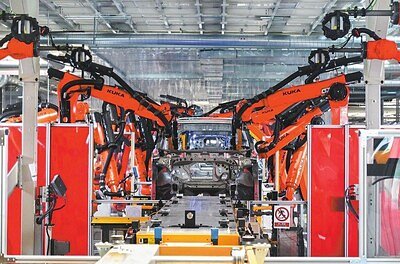
At the heart of Anhui's economic miracle is its dominance in advanced manufacturing, particularly in the electric vehicle (EV) and robotics sectors. The province has become China's undisputed automotive champion, producing 3.69 million vehicles in 2025, including 1.79 million new energy vehicles (NEVs)—both figures ranking first in the nation.
In 2025, Anhui exported over 1.2 million complete vehicles, the highest volume of any provincial-level region. This success is powered by a comprehensive industrial chain that includes homegrown giants like Chery Group and JAC Motors, EV innovator NIO, and major players like BYD and Volkswagen. The automotive sector is now the first single industry in Anhui to surpass 100 billion yuan in annual export value.
Simultaneously, the province has become a leader in intelligent manufacturing. Anhui's industrial robot exports ranked second in the country last year, supported by a burgeoning robotics cluster in the city of Wuhu. The province's ambitious "Action Plan for the Development of Anhui Province's Intelligent Robot Industry" aims to build a 100-billion-yuan industry chain by 2027 and establish a globally influential advanced manufacturing cluster for smart robots by 2030.
Forging Pathways to the World
Perhaps the most impressive aspect of Anhui's rise is how it has overcome its landlocked geography. The province has turned its extensive river systems into commercial superhighways. The monumental Yangtze-Huaihe Grand Canal, a 95 billion RMB ($12.5 billion) project that became fully navigable in late 2023, is a testament to this strategy.
The canal connects China's two most important rivers, the Yangtze and the Huaihe, effectively creating a new artery for trade. It has slashed water transportation distances by up to 600 kilometers for goods moving through the region, making logistics cheaper, faster, and more environmentally friendly. This investment in infrastructure has cemented Anhui's status as the national leader in waterway freight volume for years running, allowing its factories to seamlessly ship goods to the port of Shanghai and onto the rest of the world.
This logistical prowess is critical, enabling the province to import over 330 billion yuan worth of advanced technology, equipment, and resources in 2025 while exporting its own high-value products, from EVs and industrial robots to memory chips and display modules.
A Hub for Global Innovation
Anhui's allure extends beyond manufacturing muscle to cutting-edge research and development. Volkswagen Group's decision to establish its largest R&D center outside of Germany in Hefei, Anhui's capital, is a powerful endorsement of the province's innovation ecosystem. The Volkswagen China Technology Company (VCTC), which became fully operational in 2024, is the centerpiece of the automaker's "in China, for China" strategy.
The state-of-the-art facility integrates software development, hardware testing, and full-vehicle validation, with the goal of slashing vehicle development cycles by 30%. It is focused on creating intelligent, connected vehicles tailored specifically for the Chinese market, collaborating with local tech partners like XPENG. This deep integration signifies a shift in global R&D, with foreign giants choosing Anhui not just as a production base, but as a co-creator of future technology.
As Anhui embarks on its 15th Five-Year Plan (2026-30), its trajectory serves as a potent model for other inland regions. By combining strategic opening-up policies, massive infrastructure investment, and a relentless focus on high-tech industries, the province has rewritten the rules of economic geography. Its journey from an agricultural province to a global high-tech hub demonstrates a new path to prosperity, one that will be watched closely both within China and around the world.