
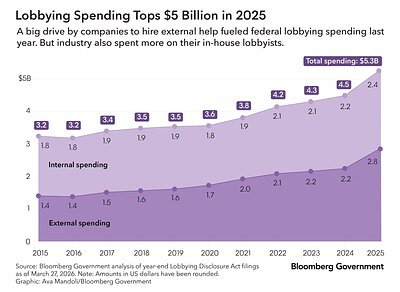
- $5.3 billion: Record federal lobbying spending in 2025, an 18% increase from 2024.
- 42% surge: Lobbying on trade issues saw the most dramatic increase.
- 350% growth: Ballard Partners, a Trump-aligned firm, saw revenue surge to $88 million in 2025.
Experts agree that the record-breaking lobbying spending reflects heightened corporate efforts to shape policy amid political uncertainty, particularly in areas like trade, taxation, and emerging technologies like AI.
K Street's $5.3B Boom: Lobbying Spending Hits Record High in 2025
ARLINGTON, Va. – April 15, 2026 – Federal lobbying spending surged to an unprecedented $5.3 billion in 2025, shattering previous records as corporations and special interests intensified their efforts to shape policy amid a volatile political and economic landscape. The new figures, detailed in an annual report by Bloomberg Government, reveal a nearly 18% increase from the $4.5 billion spent in 2024, highlighting a dramatic escalation in the battle for influence in Washington.
A Record-Breaking Surge in Influence
The report, based on an analysis of Lobbying Disclosure Act filings, paints a picture of a booming industry. The $5.3 billion figure represents the highest total ever recorded for federal lobbying, underscoring a period of intense activity on K Street. The analysis reviewed 360 firms that each generated over $1.3 million in revenue, designating 80 of them as "standout" organizations based on metrics like revenue growth and client retention.
This spending surge reflects a new reality in the capital, where uncertainty over major policy initiatives has prompted a flood of investment in advocacy. The jump of approximately $800 million in a single year is a stark indicator of the high stakes involved.
"The lobbying landscape is evolving rapidly, and our latest report captures the pulse of this $5.3 billion industry," said Cesca Antonelli, editor in chief at Bloomberg Industry Group, in the press release accompanying the report. "By tracking shifts in agency focus and surging issues like trade and taxation, we deliver the critical intelligence government affairs professionals need to stay ahead of policy changes, maximize their influence, and drive meaningful impact."
The New Battlegrounds: Trade, Taxes, and Tech
The report highlights specific policy areas that have become focal points for this intensified lobbying. Filings related to domestic and foreign trade saw the most dramatic increase, skyrocketing by 42% from 2024 to 2025. This reflects widespread corporate anxiety and strategic positioning around potential new tariffs, ongoing supply chain realignments, and shifting global trade alliances.
Taxation also proved to be a major driver, with lobbying on tax issues and the Internal Revenue Code rising by 20%. With key provisions of the 2017 Tax Cuts and Jobs Act (TCJA) set to expire, corporate interests are heavily invested in shaping the future of federal tax policy. Major spenders on this front include powerful industry groups like the U.S. Chamber of Commerce alongside individual corporate giants.
Simultaneously, a new and powerful force has emerged: artificial intelligence. The rapid development and deployment of AI technologies have sparked a "K Street spree," with tech firms dramatically increasing their lobbying budgets. OpenAI's federal lobbying spending reportedly climbed by nearly 70% to almost $3 million, while rival Anthropic’s spending surged over 330% to $3.1 million in 2025. This rush to influence reflects the industry's desire to shape nascent regulations on everything from technology governance and data privacy to national security applications. Lobbying on manufacturing and defense also saw significant upticks, at 18% and 14% respectively.
The Trump Effect: A Political Realignment on K Street
Perhaps the most significant shift in the lobbying landscape is the dramatic rise of firms with close ties to former President Donald Trump. The report's findings, corroborated by other industry analyses, show that so-called "Trump-aligned" firms are not just participating in the boom—they are leading it. This political realignment has disrupted the traditional hierarchy of K Street, as clients seek access and insight into a potentially new administration.
Ballard Partners, founded by longtime Trump fundraiser and ally Brian Ballard, emerged as a dominant force, reportedly hauling in over $88 million in 2025—a staggering increase of more than 350% from the previous year. The firm attracted over 130 new clients after the 2024 election, including blue-chip corporations like JPMorgan Chase, Chevron, Palantir, and Netflix, all seeking to navigate the changing political winds.
Other firms with strong Republican and Trump connections have also seen explosive growth. Miller Strategies, led by top Trump adviser Jeff Miller, reported $35.6 million through the third quarter of 2025, a 180% increase over its 2024 total. Newer firms like Continental Strategy and Checkmate Government Relations have also posted multi-million dollar revenue streams, capitalizing on their connections to the ascendant political power structure. This trend indicates that for many corporations, perceived political access has become the most valuable commodity in Washington.
Shifting Targets and Growing Concerns
Alongside the surge in spending, lobbyists are also changing who they are trying to influence. For the first time, the Bloomberg Government report analyzed which specific agencies were being targeted, revealing a strategic shift toward the executive branch. The largest increases in lobbying filings were directed at the Office of the U.S. Trade Representative (USTR), the Office of the Vice President, and the National Economic Council (NEC). This suggests a concerted effort to shape policy at its point of origin, before it even reaches the legislative process in Congress.
This multi-billion-dollar influence ecosystem continues to raise alarms among government watchdogs and transparency advocates. Critics argue that the sheer scale of spending creates a system where financial power can drown out the public interest. With an estimated 13,000 lobbyists in Washington—roughly 24 for every member of Congress—the pressure on policymakers is immense.
Concerns also persist around the "revolving door," where former government officials and congressional aides transition into lucrative lobbying roles, leveraging their connections and inside knowledge. This dynamic, combined with the rise of politically-aligned firms, paints a picture of an influence industry that is becoming more powerful, more expensive, and more deeply intertwined with the partisan mechanics of Washington than ever before. As policy debates over trade, technology, and the economy intensify, the battle for influence on K Street shows no signs of slowing down.