
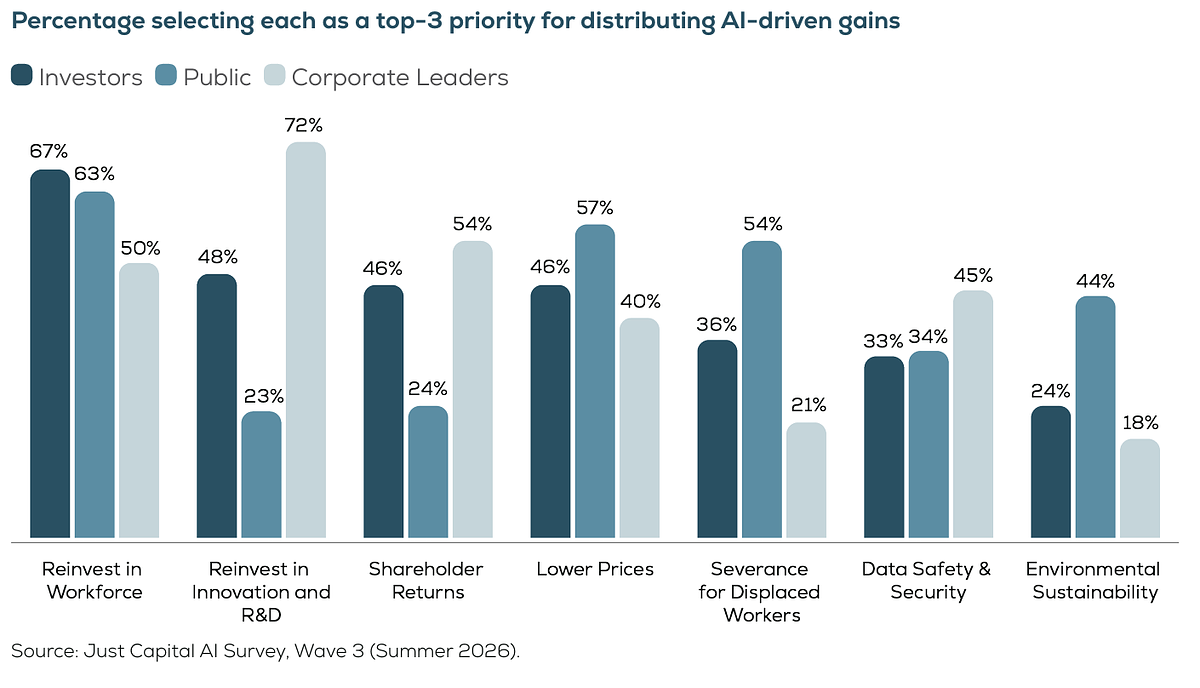
- 63% of the public and 67% of investors believe AI profits should benefit the workforce, while 72% of executives prioritize R&D and 54% focus on shareholder returns.
- Public optimism about AI's economic impact rose 12 points (47% to 59%) in under a year, but 22% of executives now expect significant job losses due to AI.
- Only 20% of top 100 companies disclose AI training programs, despite growing investor and public demand for workforce reinvestment.
Experts agree that the widening gap between corporate AI profit strategies and stakeholder expectations poses a critical risk to long-term trust, operational resilience, and market leadership.
AI's Profit Paradox: A Widening Chasm in Corporate Strategy & Public Trust
NEW YORK, NY – June 16, 2026 – As artificial intelligence transitions from a futuristic concept to a core driver of corporate profitability, a fundamental and potentially damaging disconnect is emerging. New research reveals a stark chasm between how corporate leaders plan to spend AI-driven gains and what their most critical stakeholders—the public and their own investors—expect. While executives are focused on funding the next wave of innovation, the very people whose trust they need are asking a simple, powerful question: “What’s in it for us?”
According to the latest quarterly survey from JUST Capital, an organization tracking corporate behavior, the battle lines are clearly drawn. A significant majority of the American public (63%) and institutional investors (67%) believe that the financial windfalls generated by AI should be primarily reinvested in the workforce through training, wage increases, and support for displaced employees. Corporate leaders, however, have a starkly different agenda. An overwhelming 72% prioritize funneling those profits back into Research & Development, while 54% are focused on delivering returns to shareholders.
This isn't just a minor disagreement over accounting; it's a strategic collision course with profound implications for corporate reputation, long-term value creation, and the social license to operate in an increasingly automated world.
The Great Disconnect: A Crisis of Trust
The divergence in priorities highlights a growing trust gap that savvy business leaders cannot afford to ignore. “Our research suggests some sizeable gaps exist between how corporate leaders think about AI deployment and what the public and investors would like to see,” said Just Capital CEO Martin Whittaker in the report. “The public understands the economic upside AI helps to create – but they need convincing that they stand to benefit from the gains.”
Whittaker’s point is critical. Companies that fail to build this bridge of trust risk more than just public sentiment; they risk their long-term viability. As he notes, “Companies that are able to do that will be rewarded with greater trust and a stronger overall license to operate. As the impacts of the AI transition continue to take shape, this will be extremely valuable.”
This isn't merely a public relations challenge. The data reveals a deep-seated anxiety coexisting with a surprising degree of optimism. While public optimism about AI’s positive effect on overall economic growth has climbed an impressive 12 points in less than a year (from 47% in Fall 2025 to 59% today), this high-level confidence is undermined by persistent, personal fears about job security. The concern is that AI will create a world of prosperity for a select few while leaving the broader workforce behind.
Beyond the Balance Sheet: Navigating Anxiety and Opportunity
Fears of large-scale job loss are not unfounded, and alarmingly, corporate leaders are beginning to share this concern more openly. The share of executives expecting significant AI-driven job losses within their industries in the next 2–3 years has nearly doubled in just six months, jumping from 13% to 22%. This internal acknowledgment validates the public’s anxiety and raises the stakes for how companies manage the transition.
This dynamic—optimism for the macro-economy paired with fear for individual livelihoods—is the central paradox leaders must navigate. Broader economic analyses from institutions like the World Economic Forum and McKinsey Global Institute have long suggested that AI is more likely to reshape and augment jobs rather than eliminate them entirely. However, this nuanced reality is lost if the public only sees profits being channeled to R&D and shareholders while their roles are being automated or fundamentally altered without a clear path forward.
There are nascent signs that some leaders are beginning to respond. The JUST Capital survey notes that the share of corporations willing to dedicate more than 5% of their AI investment to support displaced workers has more than doubled, albeit from a low base, from 9% in late 2025 to 17% today. While a step in the right direction, it pales in comparison to the scale of the challenge and the expectations of the public and investors.
The Strategic Imperative: Reinvesting in People
Viewing workforce investment as a cost center in the age of AI is a strategic miscalculation. The most forward-thinking companies understand that reinvesting in their people is the surest way to unlock the very productivity gains they seek. An adaptable, skilled, and motivated workforce is not a liability in the face of automation; it is the ultimate competitive advantage.
Analysis from JUST Capital’s “Most Just Companies” rankings shows a correlation between leadership in AI and a commitment to worker training. Companies across diverse sectors, from Salesforce and Visa to Boston Scientific and Constellation Energy, are being recognized for their proactive AI talent development initiatives. Yet, they remain the exception. Of the top 100 companies analyzed, only 20% explicitly disclose their AI training programs, highlighting a vast opportunity for others to lead.
For business strategists and C-suite executives, the message is clear: the most effective way to de-risk the AI transition and maximize its upside is to bring employees along. This involves transparent communication about AI strategy, robust investment in reskilling and upskilling programs, and reimagining roles to fuse human ingenuity with machine efficiency. This isn't corporate charity; it's a direct investment in operational resilience and future growth.
The Investor's View: A Surprising Alliance for a Human-Centric Future
Perhaps the most compelling finding from the research is the surprising alignment between the public and institutional investors. The traditional narrative often pits shareholder interests against those of workers and society. Yet, with 67% of investors demanding that AI gains be reinvested in the workforce, that paradigm is being turned on its head.
This signals a sophisticated evolution in how capital markets define value. Investors, particularly those with a long-term horizon and a focus on ESG (Environmental, Social, and Governance) factors, recognize that a company's success is inextricably linked to its human capital and its standing in the community. A company that automates its way to short-term profits at the expense of its workforce and public trust is building on a foundation of sand. Such a strategy invites regulatory scrutiny, brand damage, and an inability to attract and retain the high-level talent needed to manage an AI-driven enterprise.
This investor-public alliance presents corporate boards with a powerful mandate. The pressure to adopt a more equitable and human-centric approach to AI is no longer coming just from advocacy groups; it is coming from the very owners of the company. Leaders who heed this call will not only be building a more just and resilient enterprise but will likely find themselves leading the market in the years to come.