
- 26% of UK workers using AI tools report increased work pressure
- 36% of white-collar professionals fear AI could make their job obsolete
- 35% of professionals doubt AI productivity gains will benefit staff wellbeing
Experts argue that the AI productivity paradox stems more from implementation failures than technological limitations, emphasizing the need for human-centric strategies to manage AI integration in workplaces.
AI's Hidden Cost: UK Workers Face More Pressure, Not More Productivity
LONDON, UK – March 12, 2026 – A new wave of artificial intelligence intended to usher in an era of unprecedented productivity is instead creating a paradox in UK workplaces, where employees report rising pressure, increased workloads, and a growing fear for their job security. A landmark study reveals a significant disconnect between the promise of AI efficiency and the reality for many workers, particularly in white-collar professions.
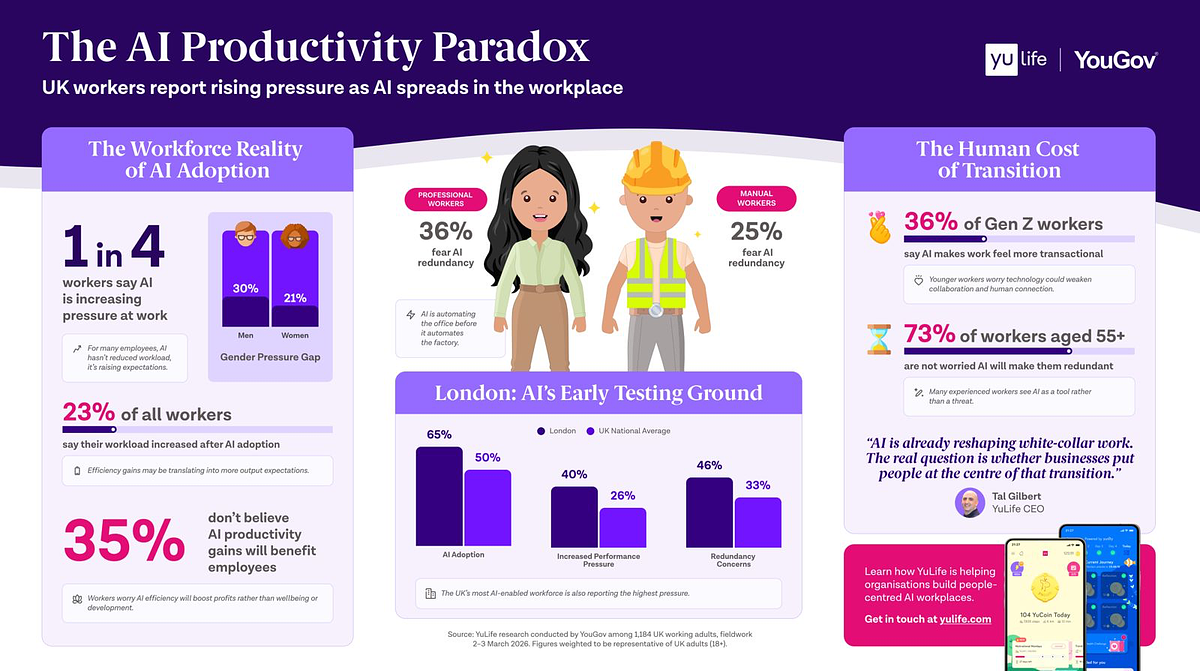
New research from insurtech firm YuLife, conducted by YouGov, paints a concerning picture. One in four UK workers (26%) who use AI tools say the technology is actively increasing pressure at work. More alarmingly, over one in five (23%) report that their workload has actually grown since AI was introduced, challenging the core assumption that these tools are designed to lighten the load. This "AI productivity paradox" suggests that the benefits of automation are not being felt on the front lines, creating a tense and uncertain environment for employees.
A White-Collar Reckoning
Historically, automation has been a threat primarily associated with manual labour and blue-collar jobs. However, the new data suggests a dramatic reversal. The study found that professionals in higher social grades (ABC1) are significantly more anxious about AI-driven redundancy than their counterparts in skilled and unskilled manual roles (C2DE). A striking 36% of these white-collar professionals who use AI fear it could make their job obsolete, compared to 25% of C2DE workers.
This shift indicates that AI's disruptive potential is now squarely aimed at knowledge workers, affecting roles that rely on analysis, communication, and administration. The very tasks that define many professional careers—drafting emails, summarizing reports, and analyzing data—are now being performed by AI, raising fundamental questions about the future value of these human skills.
Interestingly, this anxiety is not uniform across all demographics. Older workers appear more sanguine about the technological shift. Among AI-using employees aged 55 and over, a confident 73% state they are not concerned that AI will make their role redundant within the next five years. Despite this confidence, adoption is still notable in this group, with 22% using AI tools for writing and editing tasks.
The Widening Trust Gap
Beyond job security, the research uncovers a profound "trust gap" between employees and their employers regarding the dividends of AI-driven productivity. A significant portion of the workforce remains skeptical that they will share in the benefits. One-third of professionals (35%) who use AI tools do not believe that any resulting productivity gains will be reinvested into staff wellbeing, training, or development.
This sentiment points to a workforce that feels the squeeze of AI-driven expectations without seeing a corresponding investment in their own growth or welfare. Global data supports this concern, with studies showing that companies are often more likely to reinvest AI savings back into technology rather than into their people, or simply increase workloads to fill the time saved.
"We are navigating a generational shift in how people work," noted Tal Gilbert, CEO of YuLife, in the press release accompanying the study. "The real question isn't whether AI will reshape white-collar roles because that is already happening. The challenge is whether we shape that transition deliberately, with people at the centre, or allow short-term efficiency economics to dictate the terms."
This leadership challenge is becoming critical. Experts in organizational change argue that the paradox is less a failure of technology and more a failure of implementation and training. Without a clear strategy for integrating AI into workflows and redesigning jobs to complement the technology, companies risk creating an environment of "rework," where employees spend a significant portion of their time correcting, clarifying, and rewriting low-quality AI output, negating any potential time savings.
London: Canary in the AI Coal Mine
The data strongly suggests that London is serving as the UK's primary testing ground for the AI-integrated workplace, and the results are a cause for concern. The capital boasts a significantly higher AI adoption rate, with only 35% of London workers reporting they do not use AI, compared to 50% nationally.
This rapid integration, however, comes with intensified pressures. In London, 40% of workers using AI report increased performance pressure, a stark contrast to the 26% national average. The fear of redundancy is also far more acute, with 46% of the capital's AI users worried about their jobs in the next five years, compared to 34% across the UK. Furthermore, 39% of Londoners say their workload has increased since AI tools were introduced, far exceeding the national figure. This accelerated experience in the capital provides a potential glimpse into the future for other regions, highlighting the urgent need for proactive strategies to manage the human side of technological transition.
The Human Cost of Efficiency
The ripple effects of AI are also reshaping workplace dynamics and personal experiences. The study found that men are significantly more likely than women to report feeling increased performance pressure from AI (30% vs. 21%), suggesting the impact of this technological shift is not being felt equally.
Furthermore, the very nature of collaboration and connection at work may be under threat. Among younger workers, the Gen Z cohort (aged 18-28), 36% of those who use AI tools feel that the technology is making workplace interactions feel more transactional. This raises critical questions about the future of workplace culture, mentorship, and the informal learning that happens through human connection.
As companies continue to pour investment into artificial intelligence, the challenge is becoming clearer. The focus cannot solely be on algorithmic efficiency and bottom-line productivity. Without a parallel investment in human-centric design, employee wellbeing, and transparent communication, businesses risk fostering a workforce that is not empowered by technology, but exhausted and alienated by it. The ultimate success of the AI revolution in the workplace may depend not on the power of the code, but on the ability of leaders to bridge the growing divide between technological potential and human experience.