
- 55% faster: Developers using AI assistants complete tasks up to 55% faster.
- 3 projects delivered: A consultant in West Africa managed to deliver three separate, complex client projects in parallel using Verdent's platform.
- ICSE 2026 award: Verdent's SEAlign research earned a Distinguished Paper award at the ICSE 2026 conference.
Experts view Verdent's platform as a significant leap in AI-driven software development, enabling non-technical users to build complex applications while augmenting human engineers' productivity and redefining their roles.
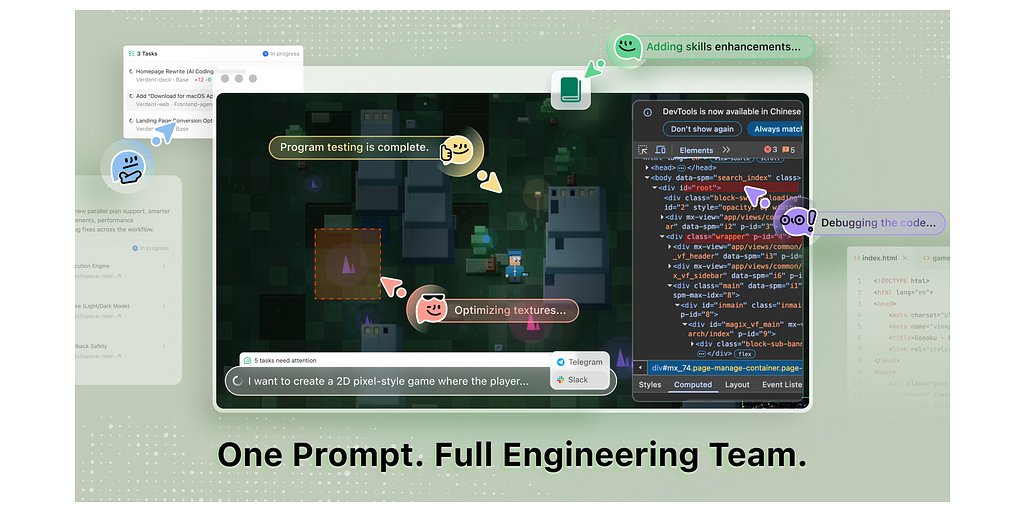
The AI Engineer is Here: Verdent's Platform Goes Beyond Code
SINGAPORE – April 20, 2026 – Verdent, an AI-native software company, has released a significant update to its platform, positioning it not merely as a coding assistant, but as the world's first 'AI engineering team.' The company announced that its platform now extends beyond simple code generation to manage the entire software development lifecycle—from planning and execution to validation and delivery—aiming to close the persistent gap between a great idea and a shipped product.
For decades, building software has been the exclusive domain of highly skilled engineers. Most ventures fail not from a lack of vision, but from the immense technical and financial hurdles required to assemble a team and build a functional product. Verdent's updated platform is designed to dismantle this barrier, offering a single, AI-driven solution that can take a rough concept and carry it through to a deployed application.
This move signals a pivotal shift in the role of artificial intelligence in software creation, moving from a helpful tool that assists developers to an autonomous partner that executes complex engineering work.
A Revolution for the Non-Technical Builder
The promise of democratizing software development has long been a holy grail in tech, with low-code and no-code platforms making significant strides. Verdent's approach, however, represents a new paradigm. Instead of providing visual building blocks, it offers an AI team that users collaborate with through a chat-first interface.
The company's press release highlights early users who embody this new class of builder. A photographer in Europe, with no prior engineering experience, successfully constructed a custom e-commerce site complete with a customer relationship management (CRM) system. In India, an equipment supplier built and deployed a multi-role workflow and billing application for their factory floor. Perhaps most impressively, a consultant in West Africa managed to deliver three separate, complex client projects in parallel: an education platform, a bank CRM, and a corporate intranet.
These examples illustrate the core mission: empowering founders, indie developers, and small businesses to build sophisticated systems without hiring a traditional engineering team. The platform retains context across sessions—remembering stack choices, previous decisions, and the existing codebase—so users can pick up where they left off. It can even continue working asynchronously via Slack or Telegram, pushing projects forward while the human user is offline.
Beyond Code Generation: An AI That Thinks Like an Engineer
What sets Verdent apart from a crowded field of AI coding assistants like GitHub Copilot and Cursor is its ambition to manage the entire engineering workflow. While other tools excel at generating code snippets or refactoring files, Verdent operates at a higher level of abstraction, focusing on project-wide intent and execution.
Its process begins not with code, but with planning. When given a goal, the AI enters a 'plan mode,' asking clarifying questions to understand the user's intent and generating a structured development plan. This initial dialogue helps map out logic and ensures the AI has a coherent strategy before writing a single line. One review noted the platform's ability to generate flowcharts and architecture diagrams during this phase, providing a crucial layer of visual validation for the user.
This sophisticated reasoning is grounded in serious academic research. The platform's architecture is directly shaped by Verdent's work on SEAlign, a research project focused on aligning AI with the complex decision-making of real-world software engineering. This research, which earned a Distinguished Paper award at the prestigious ICSE 2026 conference, addresses a critical flaw in many AI models: even powerful code generators often fail at engineering tasks because they make poor procedural decisions. SEAlign's approach trains the AI to better understand instructions, use tools correctly, and navigate the multi-step, often ambiguous, process of building software. The result is an AI that is less prone to error and more capable of handling complex, long-term projects.
Reshaping the Tech Workforce and the Future of Work
The emergence of autonomous AI engineering teams inevitably raises questions about the future of the software engineering profession. While fears of job displacement are common, the prevailing trend suggests a future of augmentation and evolution rather than outright replacement.
Studies have shown that developers using AI assistants can complete tasks up to 55% faster. This surge in productivity allows human engineers to offload repetitive and boilerplate work—such as routine bug fixes, testing, and initial scaffolding—to their AI counterparts. Verdent's platform, by its own design, automates this work at scale.
This shift forces a redefinition of the software engineer's role. The emphasis moves away from writing line-by-line code and toward higher-level strategic thinking. Future engineers will likely spend more time on system architecture, complex problem-solving, creative design, and, crucially, the oversight and management of AI systems. They will become the curators, reviewers, and integrators of AI-generated work, ensuring quality, security, and alignment with business goals. This human-AI partnership allows teams to tackle more ambitious projects and accelerate innovation.
However, this transition is not without challenges. Some industry analyses point to potential headwinds for junior developers, as many entry-level tasks become automated. One Stanford study noted a relative decline in employment for early-career engineers in roles highly exposed to AI. The long-term effect may be an increase in the overall demand for software—as it becomes cheaper to produce—but with a higher prerequisite skill level for the human professionals who build and manage it.