
- $14M raised: Autoscience secures $14 million in seed funding for its autonomous AI research lab.
- 3,300 teams: Autoscience's AI system secured a Silver Medal in the Kaggle Santa 2025 competition, competing against 3,300 teams.
- 2,000 papers weekly: The AI field produces over 2,000 machine learning papers every week, highlighting the need for automation.
Experts view Autoscience's autonomous AI research lab as a groundbreaking solution to the scalability challenges in AI development, with potential to accelerate innovation but requiring careful ethical and governance frameworks.
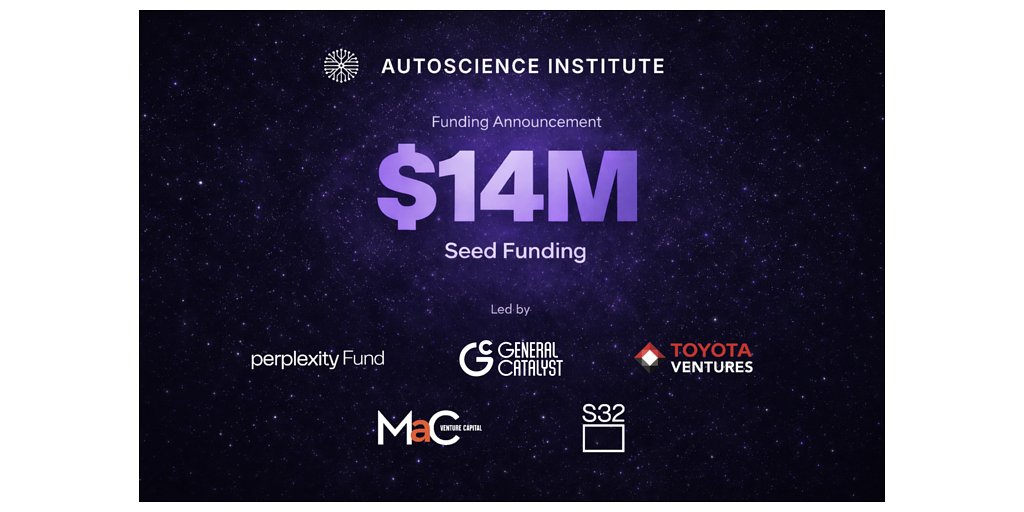
AI That Builds AI: Autoscience Raises $14M for Autonomous Research Lab
SAN MATEO, CA – March 18, 2026 – A San Mateo startup is pioneering a future where artificial intelligence not only performs tasks but also invents the very methods to improve itself. Autoscience announced today it has raised $14 million in seed funding to build what it calls the world’s first automated AI research lab, a system designed to automate the discovery and deployment of new machine learning models.
The funding round was led by venture capital giant General Catalyst, with notable participation from Toyota Ventures, Perplexity Fund, MaC Ventures, and S32. The investment signals a growing confidence in a new frontier for AI: automating the intellectual labor of research and development itself. Autoscience has developed a virtual laboratory staffed by non-human "AI Scientists" and "AI Engineers" that can ideate, validate, and ship state-of-the-art machine learning models without direct human intervention in the creative process.
The End of the Human Bottleneck?
The core problem Autoscience aims to solve is one of scale and speed. With the AI field advancing at a blistering pace—producing over 2,000 machine learning papers every week—human research teams are drowning in data and discoveries. It has become practically impossible for any single organization to effectively evaluate every breakthrough, let alone test and integrate them into their own systems. This has created a critical bottleneck where the limiting factor in AI development is no longer access to data or computing power, but the finite capacity of human researchers to generate and test new ideas.
Autoscience addresses this challenge with a two-part AI system. Its automated "scientists" are designed to consume vast quantities of research, formulate novel algorithmic hypotheses, and design experiments to test them. Once a new invention is validated, automated "engineers" take over, optimizing the model for real-world performance and deploying it into production.
“We’ve reached a point where human intuition is no longer enough to navigate the complexity of algorithmic discovery,” said Eliot Cowan, CEO of Autoscience, in a statement. “We’ve built a research organization where the researchers are AI systems. We aim to compress a decade of machine learning research into months, unlocking new AI capabilities for scientists and forming a competitive edge for our customers.”
From Kaggle Medals to Fortune 500 Clients
While the concept may sound like science fiction, Autoscience has already produced tangible results to back its ambitious vision. The company first gained recognition when its autonomous system became the first AI to produce a peer-reviewed scientific research paper, which was accepted at an ICLR 2025 workshop. This marked a significant milestone, demonstrating an AI's ability to contribute novel, verifiable knowledge to the scientific community.
Soon after, the system proved its practical prowess by securing a Silver Medal in the highly competitive Kaggle Santa 2025 machine learning competition. Placing so highly against 3,300 teams, many composed of the world's top data scientists, marked the first time a fully-autonomous system has achieved such a result in a live, featured Kaggle event. These achievements serve as powerful validation, demonstrating capability in both theoretical invention and practical, competitive application.
With this new $14 million in funding, Autoscience plans to scale its offering to a select group of Fortune 500 and large private companies. The company will deploy a managed service where hundreds of its automated AI researchers work continuously to improve a client's proprietary machine learning models. Initial target industries are high-stakes sectors like finance, manufacturing, and fraud detection, where even marginal improvements in model performance can yield substantial returns and mitigate significant risk.
A New Paradigm in AI Investment
The significant investment in Autoscience reflects a broader shift in venture capital strategy towards a category often called "AI for AI." Investors are increasingly betting on companies that don't just apply AI, but build tools to accelerate its fundamental development. Lead investor General Catalyst, for instance, has a "creation strategy" focused on building AI-native companies that can automate core business functions. Toyota Ventures has also shown a keen interest in startups applying AI to solve critical industrial problems.
“We believe Autoscience is tackling an increasingly important challenge in machine learning: the pace and scalability of experimentation,” noted Yuri Sagalov, Managing Director at General Catalyst. “As research output continues to grow, teams are looking for ways to more efficiently test, validate, and translate new ideas into production systems.”
This investment underscores a growing recognition that as AI models become more complex, the tools to build them must also evolve. Autoscience is part of a nascent but rapidly growing field of "autonomous labs" that use AI to reason about new hypotheses, effectively turning the scientific method into an automated, scalable process.
When Algorithms Become Scientists
The emergence of autonomous AI researchers like those developed by Autoscience opens up a host of profound questions about the future of science, work, and innovation. If an AI can invent new algorithms and author peer-reviewed papers, it challenges our traditional definitions of creativity and scientific discovery.
The most immediate impact will be on the roles of human AI researchers. The technology could either displace them or, more optimistically, augment their abilities. Human experts may transition from the painstaking work of model development to higher-level roles: defining strategic research goals, curating the problems fed to the AI labs, and interpreting the complex, often non-intuitive solutions the systems produce. This new paradigm could free human scientists to focus on more creative, cross-disciplinary problem-solving.
However, this future is not without its ethical hurdles. How do we ensure that autonomous research systems, trained on vast but potentially biased datasets, do not create and deploy models that perpetuate or even amplify societal inequities? Who is accountable when an AI-developed model deployed in a high-stakes financial or manufacturing system fails with unforeseen consequences? Establishing robust frameworks for safety, transparency, and governance will be critical as these systems become more powerful and autonomous. The development of AI that can conduct its own research promises to dramatically accelerate the pace of technological progress, but it also demands a parallel acceleration in our consideration of its societal and ethical implications.