
- 25% decrease in organic search traffic by 2026 (Gartner prediction).
- 45% of active AI users discovered a new brand via AI-generated answers.
- 58% of consumers perceive brands cited by AI as more trustworthy.
Experts agree that brands must urgently adapt to AI-driven content strategies to maintain visibility, credibility, and trust in an increasingly algorithm-mediated information landscape.
AI Is Your New Audience: Are You Speaking Its Language?
NEW YORK, NY – June 11, 2026 – For decades, the playbook for corporate visibility was clear: win over journalists, climb search engine rankings, and engage on social media. But a new, powerful gatekeeper has emerged, one that doesn't respond to press junkets or traditional SEO. It’s artificial intelligence. Answer engines like ChatGPT, Claude, and Google’s AI Overviews are rapidly becoming the primary lens through which customers, investors, and partners discover and evaluate brands. This tectonic shift is forcing communications and marketing teams to confront a new reality: their primary audience is now, in many ways, an algorithm.
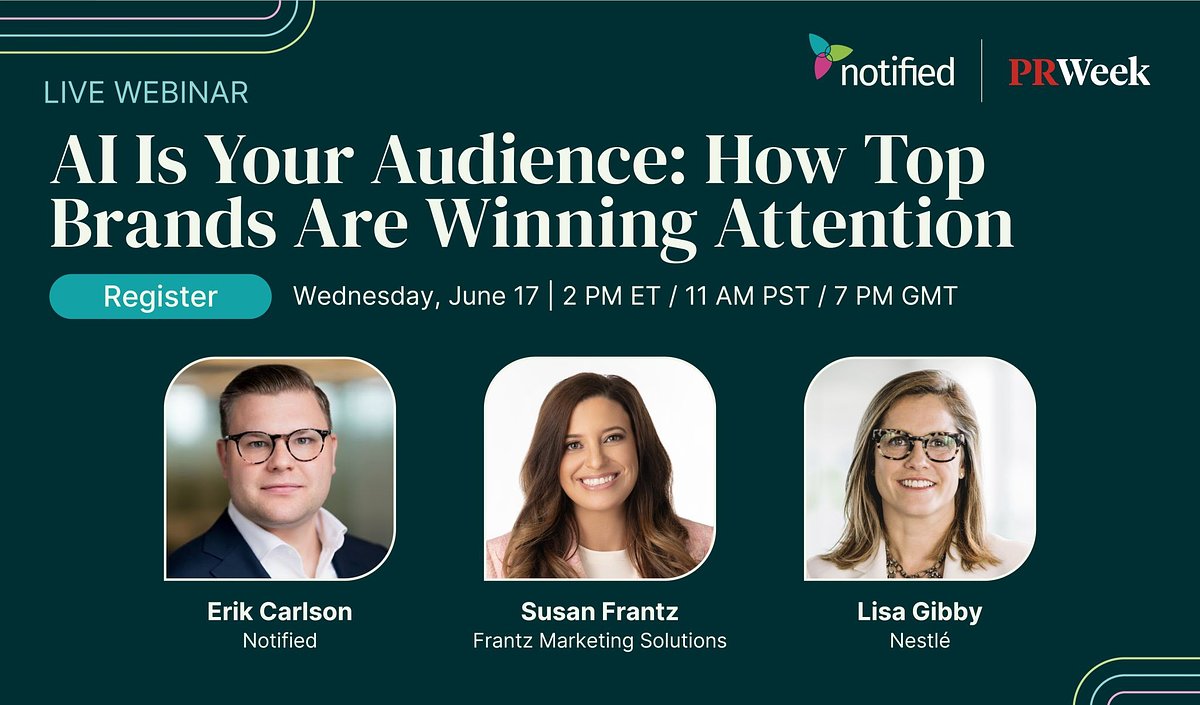
Recognizing this critical inflection point, PRWeek and the market engagement firm Notified are convening a panel of experts to dissect this new landscape. Their upcoming webinar, "AI Is Your Audience: How Top Brands Are Winning Attention," features a formidable lineup including Notified CEO Erik Carlson, Nestlé’s Chief Communications Officer Lisa Gibby, and Frantz Marketing Solutions Founder Susan Frantz. The discussion promises to move beyond theory, offering a practical guide for brands struggling to find their voice in a world where AI-generated answers are the new front page.
The Silent Gatekeepers: How AI Reshapes Brand Discovery
The transition from a search-based to an answer-based information ecosystem is not gradual; it's a fundamental rewiring of how knowledge is consumed. Previously, success was measured in clicks and traffic driven from a list of blue links. Today, that model is being upended. Gartner predicts that by 2026, organic search traffic will decrease by 25%, cannibalized by AI chatbots and other virtual assistants. This is the dawn of the "zero-click" era, where AI synthesizes information from countless sources and presents a single, consolidated answer, often making a visit to the original website unnecessary.
For brands, the implications are profound. Visibility is no longer about climbing a list; it’s about being the definitive source an AI model chooses to cite. These systems prioritize content that is clear, structured, and authoritative. They don't just scan for keywords; they use natural language processing to understand context, relationships, and credibility. Research shows that a typical AI response cites only a handful of domains. Failing to be one of them is the digital equivalent of being unlisted in the phone book—a swift path to invisibility.
"If your content is not easy for AI systems to understand and trust, your brand may be ignored," warns Erik Carlson, CEO of Notified. This isn't just about missing out on a few clicks; it's about being written out of the narrative presented to customers, journalists, and investors who increasingly turn to AI for a first take on any given topic.
Cracking the Code: A New Playbook for Content Strategy
Adapting to this new paradigm requires more than just tweaking existing SEO practices. It demands a wholesale rethinking of content strategy, a discipline now often referred to as "Answer Engine Optimization" (AEO). Companies at the vanguard are building their communications strategy around making their official content the most legible, credible, and citable information available to AI.
Notified, recently acquired by shareholder services leader Equiniti, is positioning itself at the forefront of this shift. The company has integrated AI-powered tools into its core platforms, Content OS™ and IR Hub™, to help clients adapt. Its AI Press Release Optimizer, for instance, analyzes and refines press releases to improve their structure and clarity for LLMs. This is based on the insight that AI models heavily weight press releases as direct, official sources of information. Similarly, its new AI-driven features for investor relations—from market intelligence tools to AI citation reporting—are designed to help companies control their narrative in an environment where algorithms are always listening.
Best practices for AEO are emerging across the industry. They include:
- Structured Content: Using clear headings, bullet points, and data tables makes it easier for AI to parse and extract key information.
- Authoritative Sources: Original research, expert commentary, and consistent messaging reinforce a brand's credibility. Earned media coverage on trusted third-party sites acts as a powerful validator.
- Technical Integrity: Clean sitemaps, comprehensive metadata, and schema markup provide a clear roadmap for AI crawlers.
- Off-Site Presence: A brand’s footprint on platforms like LinkedIn, Crunchbase, and industry directories serves as corroborating evidence of its identity and offerings, strengthening its overall authority.
The High Stakes of the Answer Engine Economy
The financial and reputational stakes are enormous. According to a recent survey, 45% of active AI users have already discovered a new brand or service through an AI-generated answer. The flip side is equally potent: another study found that 47% of consumers have taken significant action, such as avoiding a purchase or switching brands, based on an AI's recommendation.
Trust is the new currency. When a brand is cited as a source in an AI answer, 58% of consumers perceive it as more trustworthy. However, this trust is fragile. In instances where an AI's response conflicts with a brand's own messaging, consumer trust in the brand plummets to just 29%, with the majority seeking external validation. In this new landscape, silence isn't just an absence of communication—it's a liability. If a brand’s official narrative is missing, AI will fill the void, often with outdated, inaccurate, or third-party information that can erode brand equity overnight.
Beyond the Algorithm: Forging Trust in an AI-Driven World
This evolution is not merely a technical challenge for marketers; it’s a strategic imperative for the C-suite that touches the core of brand reputation and stakeholder engagement. The rollout of Google’s AI Overviews, which places AI-generated summaries at the very top of search results, is a clear signal that this change is permanent and accelerating. The rapid growth is staggering, with one report noting a 527% jump in AI-referred web sessions in the first half of 2025 alone.
The upcoming discussion, featuring leaders like Nestlé’s Chief Communications Officer Lisa Gibby, who navigates these challenges for a global enterprise, alongside Notified CEO Erik Carlson and strategic communications expert Susan Frantz, underscores the urgency of this topic. The central theme is that brands cannot afford to be passive. They must proactively manage their digital presence to ensure accuracy, build authority, and maintain trust in an ecosystem increasingly mediated by algorithms.
The question for every leader is no longer if they need an AI content strategy, but whether their current one is robust enough to secure their place in the answers of tomorrow.