
- 80% to 99% of clinical alarms are false or non-actionable, leading to alarm fatigue among staff.
- Continuous monitoring can reduce unplanned ICU transfers by 32% by enabling earlier intervention.
- Study involving 300+ high-risk patients across 11 hospitals demonstrated high accuracy in AI detection and classification.
Experts agree that integrating AI-powered wearables with continuous monitoring can significantly improve patient safety and clinical efficiency by reducing alarm fatigue and enabling earlier interventions.
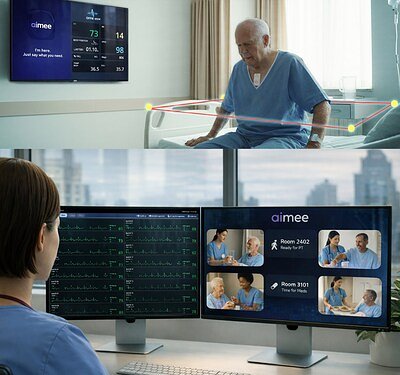
AI and Wearables Unite to Redefine Hospital Patient Monitoring
CHICAGO and BERKELEY, Calif. – February 25, 2026 – A strategic partnership announced today between Sibel Health and LookDeep Health is set to create a new standard for patient care by merging continuous, clinical-grade vital signs with real-time, AI-powered bedside analysis. The collaboration integrates Sibel Health's wearable sensors with LookDeep Health's vision-based AI to provide a comprehensive, contextual picture of a patient's condition, a move designed to enhance safety and efficiency in hospitals strained by operational challenges.
The partnership pairs Sibel's FDA-cleared ANNE® One monitoring platform, which uses advanced wearable sensors for continuous data collection, with LookDeep's aimee™ for hospitals. The aimee™ platform is a multimodal AI assistant that uses computer vision and audio understanding to interpret the environment at a patient's bedside. Together, they aim to translate a constant stream of physiological and environmental data into actionable insights for clinicians, supporting care from the emergency department through to recovery at home.
Addressing a Critical Gap in Patient Care
Outside the walls of the intensive care unit (ICU), most hospitalized patients are monitored intermittently, with nurses performing spot checks every few hours. This practice creates significant gaps during which a patient's condition can subtly but rapidly deteriorate. Compounding this issue is a global healthcare staffing crisis, leaving nurses and other clinicians stretched thin and responsible for more patients than ever before.
This high-pressure environment is also plagued by alarm fatigue. Industry data suggests that a staggering 80% to 99% of clinical alarms are false or non-actionable, leading to desensitization among staff who may inadvertently miss a critical alert. The combination of intermittent data, workforce shortages, and constant noise creates a precarious situation where early signs of decline can be easily overlooked.
This new integrated solution directly targets these vulnerabilities. By providing a continuous data stream from Sibel's wearables, it eliminates the blind spots between manual checks. Studies have shown that such continuous monitoring can reduce unplanned ICU transfers by as much as 32% by enabling earlier intervention. When combined with LookDeep's contextual AI, the system promises to filter out the noise, presenting clinicians with more meaningful, trend-based notifications instead of simple threshold-based alarms.
A New Paradigm: Combining Vitals with Visual Context
The core innovation of the Sibel-LookDeep partnership lies in its ability to add context to raw data. While Sibel's ANNE® platform provides the what—a constant flow of vital signs like heart rate, respiratory rate, and temperature—LookDeep's aimee™ provides the why. The AI observes the patient's behavior, movements, and interactions, giving clinicians a richer understanding of the numbers.
For example, a rising heart rate on its own is an ambiguous signal. But when paired with AI analysis showing the patient is agitated or attempting to get out of bed unaided, it becomes a clear and urgent call for intervention. Conversely, if the AI sees the patient is calm and talking with a family member, it can help de-prioritize a minor alert, reducing unnecessary interruptions.
The credibility of this AI is bolstered by rigorous validation. LookDeep Health recently published a peer-reviewed paper in Frontiers in Imaging detailing its model architecture and real-world deployment. A study involving over 300 high-risk patients across 11 hospitals demonstrated the platform's high accuracy in detecting objects, classifying patient roles, and identifying when a patient is alone.
"Better health data for all means making continuous sensing reliable and usable across the full continuum - from the ED to the inpatient setting and into recovery at home," said Steve Xu, MD, CEO & Co-Founder of Sibel Health. "The breakthrough comes when those signals are paired with real-time context and turned into timely, actionable insight. By partnering with LookDeep, we're connecting clinical-grade wearable vitals with bedside understanding and engagement so teams can recognize meaningful change earlier."
Narinder Singh, CEO & Co-Founder of LookDeep Health, added, "The future isn't inside of any app; it is a unified, always-on patient experience. By bringing together Sibel's vision of Better Health Data for All® and LookDeep's vision of being Ever Present for Every Patient, we can help hospitals extend the level of attention found in the most critical settings to every care setting - without overwhelming staff or the hospital's financial model."
Championing an 'Open by Design' Future
A significant aspect of the partnership is its commitment to an 'Open by Design' philosophy, a direct challenge to the issue of vendor lock-in that has long hindered technological progress in healthcare. Hospitals often find themselves trapped in proprietary ecosystems, making it difficult and expensive to adopt new innovations or integrate systems from different manufacturers.
The Sibel-LookDeep integration is engineered to prevent this. Sibel Health's sensors are compliant with the IEEE 11073 SDC (Service-oriented Device Connectivity) family of standards, a communication protocol designed specifically to ensure manufacturer-independent interoperability for medical devices. This foundation allows the combined platform to work alongside existing hospital information systems, such as electronic health records (EHRs), and other devices without requiring a complete overhaul of a hospital's IT infrastructure. This approach empowers health systems to adopt the new capabilities for immediate impact while preserving the flexibility to evolve their technology stack in the future.
Operationalizing Innovation from Bedside to Home
Turning advanced technology into a practical clinical tool requires more than just software and hardware; it demands a thoughtful approach to workflow integration and change management. This is where Nexus Bedside, a healthcare technology company founded by veteran hospital executive Dr. Akram Boutros, enters the collaboration.
Dr. Boutros, whose experience as a cancer patient highlighted systemic gaps in care, founded Nexus Bedside to help hospitals deploy remote monitoring technologies effectively. The company will assist health systems in operationalizing the Sibel-LookDeep solution, redesigning clinical workflows to leverage its capabilities for virtual nursing, remote rounding, and seamless transitions from hospital to home. By enabling off-site nurses to monitor multiple patients continuously, the system allows on-site staff to focus on direct, hands-on care where they are needed most.
The combined platform is designed to support clinicians in detecting early warning signs, reducing alarm fatigue, enabling clinician-directed vigilance where teams can instruct the AI on what to watch for, and improving discharge readiness to reduce costly readmissions.
The integration is now available and will be introduced first to a select group of health systems through coordinated deployments before a broader rollout is planned. This phased approach will allow for fine-tuning the system in real-world clinical environments, ensuring it delivers on its promise to create a safer, more efficient, and more connected future for patient care.