
- 100,000 people are on the national organ transplant waiting list, with 95,000 waiting for a kidney.
- NYU Langone's Transplant Institute has a 100% one-year organ and patient survival rate for living donor transplants.
- Elias was able to receive a transplant before needing dialysis, avoiding the burden of long-term treatment.
Medical experts emphasize that living donor transplants significantly improve patient outcomes, offering longer-lasting kidneys and immediate functionality, while highlighting the critical role of public awareness and altruistic donors in addressing the national organ shortage.
A Stranger's Gift: How a News Story United Two Families in a Fight for Life
NEW YORK, NY – April 10, 2026 – It started with a local news segment. For 13-year-old Elias Manolis of Franklin Square, Long Island, it was a desperate public plea for a new kidney. For Tim Fitzpatrick, a 44-year-old father from a neighboring town, it was a moment that would change his life, and Elias's, forever.
Fitzpatrick was at home when he saw the story of a boy his own children's age facing Stage 4 kidney failure. The family's search for a donor had come up empty. The story lingered with Fitzpatrick long after the broadcast ended. Within days, driven by a powerful sense of empathy, he contacted the NYU Langone Transplant Institute to be tested as a living donor. He was a match.
On March 23, 2026, in a meticulously coordinated effort between the Transplant Institute and Hassenfeld Children's Hospital at NYU Langone, Fitzpatrick gave one of his kidneys to a boy he had never met. It was an act of extraordinary altruism that highlights a growing solution to a national crisis and forges a profound bond between two families.
A Father's Call to Action
For Tim Fitzpatrick, the decision felt less like a choice and more like a calling. As a father whose own 11-year-old son, Logan, receives ongoing care at Hassenfeld Children's Hospital for a chronic disease, he intimately understood the helplessness and hope that define a parent's hospital vigil.
"I couldn't stop thinking about him," Fitzpatrick said. "You see a kid like that, and you think about your own. If my son were in that position, I'd be hoping someone would step up." The thought was persistent, a quiet but firm question that echoed in his mind: Why not me?
This question spurred him from passive sympathy to active compassion. Fitzpatrick, a regular blood donor, saw this as a natural, albeit larger, extension of his desire to help. The initial spark, ignited by an ABC7NY report in February, grew into a determined resolve. He navigated the comprehensive evaluation process, a series of physical and psychological tests designed to ensure the safety and well-being of any potential living donor. When the call came confirming he was a match for Elias, his path was set.
A Race Against Time
While Fitzpatrick was beginning his journey as a donor, the Manolis family was nearing the end of their options. Elias was born with ureterovesical junction (UVJ) obstruction, a rare congenital condition where a blockage prevents urine from properly draining from the kidneys into the bladder. Over his young life, this constant backup of fluid had caused progressive, irreversible damage to his kidneys.
By the time he was 13, his kidney function had plummeted, and he was facing the daunting prospect of dialysis. This intensive treatment, which filters waste from the blood, would have drastically altered his childhood, tethering him to a machine for hours several times a week and sidelining him from school, sports, and the simple joys of being a teenager.
His parents, Margaret and Nikos Manolis, launched a heartfelt campaign, sharing Elias's story on a "Kidney4Elias" Facebook page and through local media outlets. Their plea reached thousands, but a compatible donor remained elusive. The family needed someone with a B or O blood type willing to undergo major surgery for their son. More than 100,000 people are on the national organ transplant waiting list, with about 95,000 of them waiting for a kidney. The wait for a deceased donor organ can take years, a timeline Elias could not afford.
A Coordinated Medical Triumph
The successful transplant was a testament to both human generosity and medical excellence. NYU Langone's Transplant Institute is ranked No. 2 in the nation and is the largest and highest-quality program in New York State, boasting a 100% one-year organ and patient survival rate for living donor transplants. This expertise was critical.
The procedure on March 23rd involved two surgical teams working in concert. In one operating room, Dr. Bruce E. Gelb, a transplant surgeon at the Transplant Institute, used a minimally invasive technique to remove Fitzpatrick's left kidney. "Tim's willingness to step forward for someone he didn't know is extraordinary," said Dr. Gelb, acknowledging the profound impact of such a choice.
Simultaneously, in an adjacent operating room at Hassenfeld Children's Hospital, Dr. Jonathan C. Berger, surgical director of the Pediatric Kidney Transplant Program, prepared to receive the precious gift. He performed the delicate transplant for Elias. The timing was crucial. "Because of Tim's decision, Elias was able to receive a transplant before needing dialysis," explained Dr. Berger. "That changes everything for a child. It means a smoother recovery, better long-term health, and a chance to move forward without that added burden." Kidneys from living donors typically last twice as long as those from deceased donors and begin functioning immediately, a vital factor in a patient's recovery.
Two Families Become One
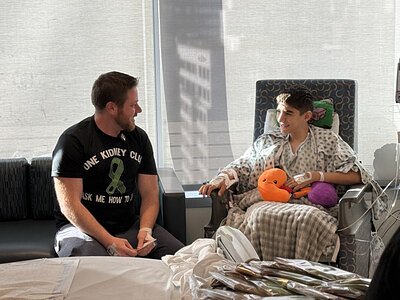
The day after the surgery, the human connection behind the medical marvel was realized. Tim and his wife, Stephanie, walked into Elias's room in the Pediatric ICU. It was the first time the families had met, the first time Elias and his parents could put a face to the name of their anonymous hero.
The moment was filled with emotion and warmth. The Fitzpatricks came bearing gifts: homemade cookies shaped like kidneys and a drawing from their son Logan, which they split in half for each family to keep. Tim wore a "One Kidney Club" T-shirt, a humorous nod to his new status. Elias, surrounded by kidney-shaped stuffed animals, gave his donor a heartfelt, handwritten letter.
"It was overwhelming in the best way," said Margaret Manolis. "He was a stranger who stepped in to help our son—and now he and his family will always be part of our lives." The meeting solidified a bond that had begun with a selfless act and was now cemented in shared gratitude and relief.
Elias was discharged just five days later, returning home in time to celebrate Easter. He has since named his new kidney "Mr. Penguin" and is already looking forward to life's simple pleasures, especially eating a steak, which had been off-limits due to his condition. The two families have remained in constant contact, already planning a summer barbecue. For Elias and Fitzpatrick, a story that began with a television screen has become a shared journey of compassion, connection, and a second chance at a full life.