
- $240 annual subscription: The cost of accessing Zoonova's Alpha AI platform.
- 150+ financial features: The number of data points analyzed by the platform's machine learning models.
- 23 guided follow-up prompts: The depth of analysis offered beyond basic trade signals.
Experts would likely conclude that while Alpha AI democratizes access to sophisticated financial tools, its success hinges on whether it can effectively educate users to interpret complex data without introducing new risks through misinterpretation or over-reliance on AI predictions.
Zoonova's Alpha AI: Quant Power for the People or a New Risk?
SALT LAKE CITY, UT – April 13, 2026 – In the ever-escalating arms race to equip retail investors with institutional-grade tools, Utah-based fintech firm Zoonova AI has fired its latest shot. The company today launched Alpha AI, a new investment analysis platform that promises to put the power of quantitative machine learning, sentiment analysis, and predictive forecasting into the hands of the everyday investor, all accessible through a conversational AI interface.
The platform, available for an annual subscription of $240, aims to level the playing field between Wall Street and Main Street. By translating complex data into plain-English insights, Alpha AI seeks to empower individual investors to move beyond simple stock picking and engage with sophisticated market intelligence. But as the lines blur between professional and retail toolkits, the launch raises a critical question: does democratizing complex financial analytics truly empower the average user, or does it introduce a new layer of risk and potential for misunderstanding?
The Engine Under the Hood
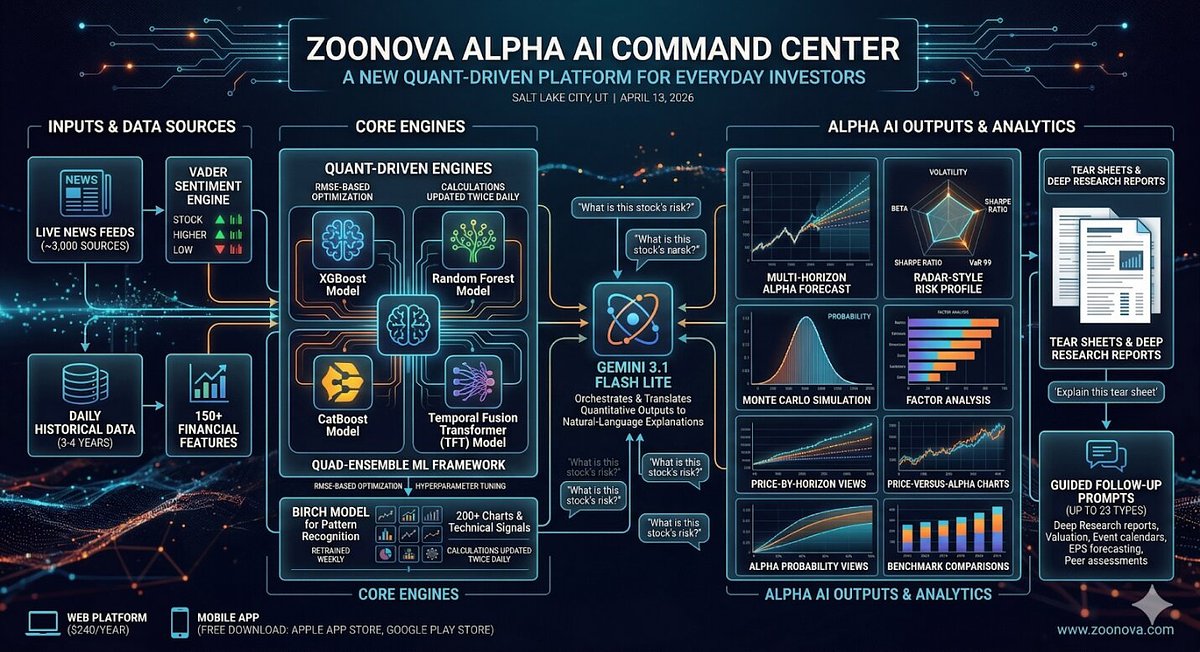
At the heart of Alpha AI lies a sophisticated architecture that Zoonova AI calls its "Quad-Ensemble machine learning framework." This isn't a single algorithm but a team of four distinct models working in concert: XGBoost, Random Forest, CatBoost, and a Temporal Fusion Transformer (TFT). While the first three are well-regarded workhorses in predictive analytics, the inclusion of a TFT model is notable. TFTs are specifically designed for forecasting time-series data across multiple future horizons, a complex task that is central to financial market prediction.
This core engine crunches over 150 financial features from approximately four years of daily historical data for each stock. To maintain relevance in volatile markets, the models are retrained weekly, with core calculations updated twice a day.
The platform's intelligence doesn't stop at raw numbers. Alpha AI layers on additional models to build a more holistic market view. A Birch clustering model sifts through over 200 chart patterns and technical signals to identify recurring market behaviors. Simultaneously, a sentiment engine based on the VADER framework scans roughly 3,000 live news feeds, distilling the constant flood of information into a stock-level sentiment score.
The final, and perhaps most crucial, piece of the puzzle is the platform's conversational layer, powered by Gemini 3.1 Flash Lite. This large language model acts as an interpreter, translating the dense quantitative outputs from the ensemble models into natural-language explanations. Through its "AI Command Center," users can ask questions like, "What is the forecast for this stock over the next quarter?" and receive not just a number, but a guided analysis, complete with Monte Carlo simulations, factor analysis, and stress tests.
“Alpha AI was built to combine a quantitative engine with an interface people can actually use,” said Blaise F. Labriola, Managing Partner of Zoonova AI, in the official announcement. “The goal is to give investors access to deeper forecasting, risk analysis, and market intelligence in a format that is faster to interpret and easier to use.”
A Crowded Field of AI Co-Pilots
Zoonova AI enters a fintech market that is already buzzing with AI-powered investment assistants. Platforms like Magnifi and AInvest have pioneered the conversational AI approach, while social trading giant eToro recently launched "Agent Portfolios" that allow users to deploy AI for automated trading. Other competitors, such as Danelfin, offer "explainable AI" with clear stock scoring systems, and Prospero provides hedge-fund-grade analytics on a free mobile app.
Alpha AI aims to differentiate itself through the sheer breadth and depth of its integrated toolkit. While some platforms focus on trade signals and others on portfolio management, Zoonova's offering is positioned as a comprehensive market intelligence hub. The platform doesn't just provide a "buy" or "sell" signal; it offers up to 23 guided follow-up prompts, encouraging users to dive deeper into valuation analysis, risk registers, peer assessments, and EPS forecasting. Features like the "Explain this tear sheet" workflow are designed specifically to demystify professional-grade reports for a retail audience.
This focus on deep, explorable intelligence rather than simple execution signals could be its key differentiator. However, at a price point of $240 per year, it competes directly with established players like Danelfin, whose Plus Plan costs $264 annually. The availability of "core features" on a free companion mobile app may serve as a crucial funnel to attract users who are hesitant to commit to the full subscription fee upfront.
Bridging the Gap or Widening the Divide?
The central promise of Alpha AI is accessibility. By wrapping complex tools like Monte Carlo simulations—a method used to model the probability of different outcomes in a process that cannot easily be predicted—in a user-friendly, conversational interface, Zoonova is betting that it can bridge the knowledge gap for individual investors. The platform's visual analytics layer, featuring radar-style risk profiles and benchmark comparisons, is another attempt to make dense data immediately digestible.
Yet, this very accessibility raises concerns. Can an "everyday investor" with limited financial training effectively interpret a factor analysis report or a stress test, even when explained by an AI? While the platform includes in-line glossaries and explainability features, there is a risk that users might misinterpret the outputs or place undue faith in the AI's predictions without fully understanding the underlying assumptions and limitations. The disclaimer that accompanies all such platforms—that this is not financial advice and all investments carry risk—takes on new weight when the tools being offered are this powerful.
The success of Alpha AI will likely depend not just on the accuracy of its models, but on its ability to genuinely educate its users and foster a healthy sense of skepticism. It must walk a fine line between empowering investors with data and overwhelming them with tools they are not equipped to handle, potentially leading to poor, data-driven decisions.
The Lean Startup Behind the Big Brain
Behind the sophisticated technology is Zoonova AI, a firm that has been operating in the fintech space since 2012. Founded by Blaise Labriola and Jared Stoddard, the Utah-based company operates as a subsidiary of Altaira, LLC. Publicly available data suggests Zoonova is a remarkably lean operation for a company launching such an ambitious product. As of early 2026, the company is listed as "unfunded," indicating it has not taken on venture capital in a market where competitors are often heavily backed.
This bootstrapped approach could be seen as a sign of efficient, focused development, but it also raises questions about the company's ability to scale and compete on marketing and customer support against larger, better-funded rivals in the long run. The company has prior experience in the space, having launched earlier versions of a free AI-powered analysis app that integrated ChatGPT-4 Turbo, suggesting a long-term commitment to making advanced analytics accessible. Alpha AI represents the culmination of this effort, moving from a free tool to a premium subscription service, a critical test for any startup's business model. The transition will test whether users who have grown accustomed to free fintech tools are willing to pay for a higher tier of intelligence and analysis.