
- Payment failure rates range from 5% to over 15%, representing billions in lost revenue annually. - Yuno's AI agent autonomously optimizes payment routing, potentially saving merchants thousands of dollars monthly. - The system monitors real-time approval rate drops, transaction rejections, and payment provider outages.
Experts view Yuno's AI agent as a transformative leap in payment operations, shifting from reactive human intervention to proactive, autonomous optimization that enhances efficiency and revenue.
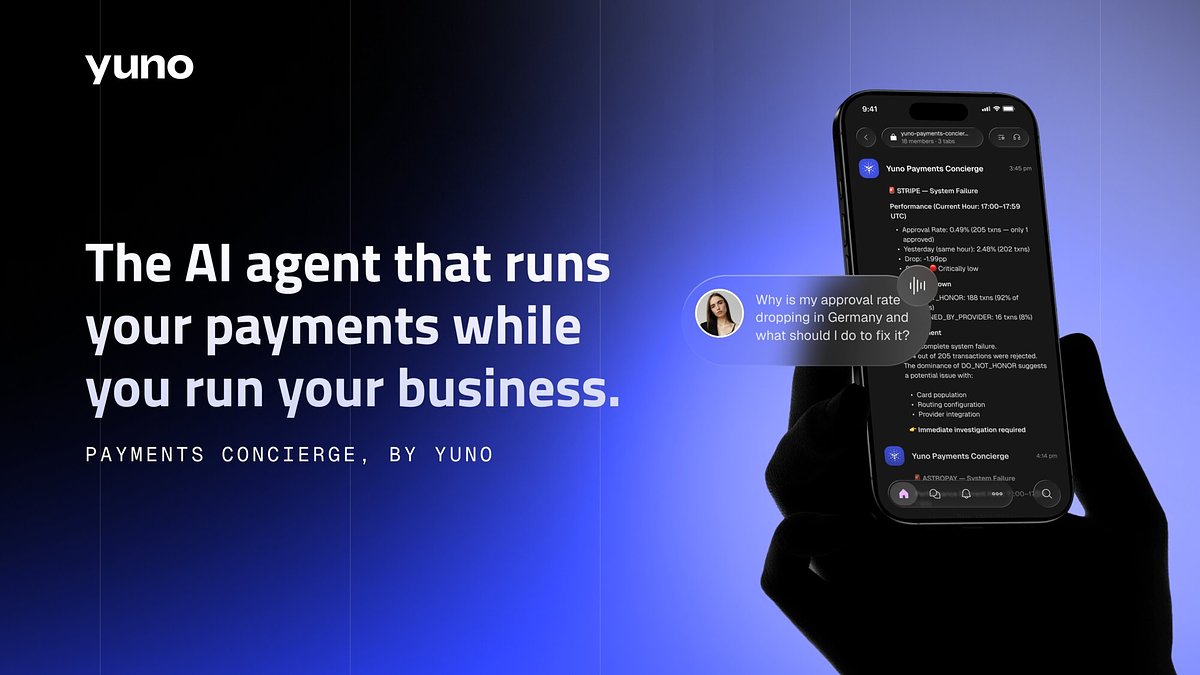
Yuno's AI Agent Aims to Revolutionize Global Payment Operations
SAN FRANCISCO, CA – April 06, 2026 – Global financial infrastructure platform Yuno today unveiled Payments Concierge, an autonomous AI agent designed to fundamentally reshape how enterprise merchants manage their complex payment ecosystems. Announced at the HumanX conference, the new offering moves beyond traditional analytics dashboards and alert systems, introducing an always-on agent that not only monitors a company's payment stack but independently acts to optimize it for performance, cost, and conversion.
For global businesses, the complexity of online payments is a source of constant friction and hidden revenue loss. Yuno's launch promises a shift from the current reactive model—where human teams scramble to fix problems after they occur—to a proactive, autonomous paradigm where an AI agent anticipates and resolves issues in real time.
The Shift to 'Agentic AI' in Finance
The technology underpinning Payments Concierge is part of a growing trend known as 'agentic AI.' Unlike traditional automation, which follows rigid, predefined rules, agentic AI is characterized by its autonomy. It can perceive its environment, set goals, and execute multi-step tasks with minimal human intervention. While basic automation is like cruise control, following a set path until an obstacle appears, agentic AI is more akin to a self-driving system, capable of navigating dynamic conditions and making intelligent, real-time decisions.
In the context of payments, this means creating systems that don't just report data but understand strategic objectives. Yuno's Payments Concierge is designed to embody this principle. It continuously ingests data across a merchant's entire payment infrastructure, understands the goals for approval rates and costs, and takes independent action within pre-configured permissions. This represents a significant leap from the current industry standard of payment orchestration platforms, which, while powerful, often rely heavily on human operators to interpret data and implement changes.
“Payment operations today are mostly reactive with teams finding out something broke after the revenue is already lost,” said Juan Pablo Ortega, CEO and co-founder of Yuno, in a statement. “Payments Concierge is a fundamentally different approach. It’s not a smarter dashboard or a better alert. It’s an autonomous agent that understands a merchant’s entire payment strategy and continuously acts on it. It catches issues humans can’t see, optimizes costs humans can’t track, and executes changes in real-time.”
Solving the Silent Killers of E-Commerce Revenue
For large-scale merchants, small payment issues compound into significant financial losses. A subtle change in a single card issuer's approval patterns can lead to thousands of 'silent declines'—failed transactions that occur without a clear reason for the customer—before a human team can even identify the trend. Industry data has consistently shown payment failure rates ranging from 5% to over 15%, representing billions in lost revenue and potential customer churn.
Payments Concierge is engineered to combat these silent killers. Its core capabilities target the most common and costly pain points in payment operations:
Real-Time Anomaly Detection: The agent monitors for sudden approval rate drops, spikes in transaction rejections, and payment provider outages. Its ability to analyze patterns at a granular level—such as identifying a specific bank identification number (BIN) from a particular issuer that is suddenly failing—allows it to detect problems that are nearly impossible to catch manually.
Autonomous Optimization: Crucially, detection is immediately followed by action. If a specific payment gateway shows degraded performance, the AI can autonomously adjust routing rules to send transactions through a better-performing alternative. It can also reorder the payment methods displayed at checkout, pre-selecting the option with the highest probability of success for a given customer, thereby improving conversion before a payment is even attempted.
Cost-Level Transparency: The platform also surfaces interchange and scheme fees at the individual transaction level. This allows the AI to make more sophisticated routing decisions, balancing the need for high approval rates with the goal of minimizing transaction costs. For a large merchant, this dual optimization can translate into thousands of dollars in monthly savings without sacrificing revenue.
Navigating a Crowded and Complex Landscape
Yuno enters a competitive field populated by established Payment Service Providers (PSPs) like Adyen and Stripe, as well as specialized Payment Orchestration Platforms (POPs) such as Spreedly and Primer. These platforms have already helped merchants simplify the management of multiple payment providers through unified APIs and smart routing rules.
The key differentiator Yuno is betting on with Payments Concierge is the move from smart to autonomous. While existing platforms provide the tools and data for a payment manager to make informed decisions, Yuno's agent is designed to make many of those decisions itself. This reduces the cognitive load and manual work required from human teams, promising a new level of efficiency.
Further setting it apart is its accessibility. Instead of forcing teams into another dashboard, the AI agent can be accessed through common communication channels like Slack, WhatsApp, and Telegram. This allows a payment lead to query the system for a complex performance report or a C-level executive to request a high-level summary, with the agent delivering the information instantly in the appropriate format.
The New Human-AI Partnership in Payments
The introduction of a truly autonomous agent into a critical business function like payments naturally raises questions about the future of human roles. However, the vision presented by Yuno and other proponents of agentic AI is not one of replacement, but of collaboration and role elevation.
By automating the tedious and reactive tasks of monitoring, troubleshooting, and data compilation, Payments Concierge aims to free up human payment professionals to focus on more strategic work. Instead of spending hours pulling data to understand why last Tuesday's approval rate dipped, a payment manager can focus on negotiating better terms with providers, exploring new markets, or designing more sophisticated fraud prevention strategies. The AI becomes a tireless digital co-worker that handles the minute-to-minute operations, allowing its human counterparts to concentrate on long-term growth and complex problem-solving that requires creativity and business acumen.
The Underlying Questions of Trust and Security
Handing over the keys to a core part of the revenue engine to an AI is a significant step, and it comes with profound security and regulatory considerations. An autonomous agent that can alter payment routing and access sensitive transactional data must operate within an ironclad framework of security and compliance.
Any such system must adhere to the highest industry standards, including PCI DSS for handling cardholder data and privacy regulations like GDPR and CCPA. The processes for data encryption, access control, and secure API integration must be flawless. Furthermore, the decisions made by the AI must be auditable and, to a degree, explainable to satisfy regulatory scrutiny and internal governance.
Challenges related to accountability, liability in case of error, and potential for algorithmic bias must be rigorously addressed. Building trust in these autonomous systems will require not only technological prowess but also a deep commitment to transparency and robust oversight, ensuring that while the agent acts independently, it always remains under the strategic control and ethical guidance of its human operators.