
- 34% of customers on the Intelligent Octopus Flux (IOF) tariff paid less for imported energy than they earned from exporting (June 2024–May 2025).
- Some households made over £300 in pure profit during this period.
- The average payback period for a solar and battery system in the UK is now around seven years.
Experts agree that this AI-driven integration marks a significant step toward energy independence, enabling homeowners to profitably participate in the grid while accelerating the UK's transition to decentralized, renewable energy.
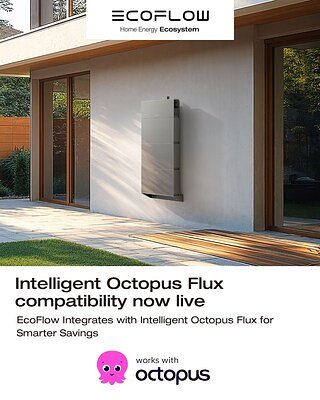
Your Home is Now a Power Plant: The AI Fueling Energy Independence
BIRMINGHAM, England – December 16, 2025 – For years, the relationship between a household and its energy provider has been a one-way street: consume and pay. Now, a pivotal integration between home energy leader EcoFlow and UK energy-tech pioneer Octopus Energy is flipping that model on its head, empowering homeowners to become active, profitable participants in the nation's grid.
EcoFlow has announced full compatibility for its PowerOcean home battery systems with Octopus Energy's groundbreaking Intelligent Octopus Flux (IOF) tariff. This move goes beyond simple connectivity; it hands the complex task of energy arbitrage—buying low and selling high—over to a sophisticated AI. For the growing number of UK households with solar panels, this partnership promises not just lower bills, but a new level of energy autonomy and a tangible return on their green investment.
From Passive Consumer to Active Producer
The financial pressure of volatile energy prices has left many UK families searching for a foothold. The combination of solar panels and home batteries has long been a beacon of hope, but maximizing their value has often required manual intervention and a deep understanding of fluctuating tariffs. This new integration automates that process, aiming to make significant savings accessible to everyone.
The financial mechanics are compelling. The Intelligent Octopus Flux tariff is designed to treat the grid like a giant, efficient battery for the homeowner. It offers matching import and export rates, eliminating the long-standing penalty where users sell their power for far less than they buy it. By integrating with EcoFlow's PowerOcean battery, the system can automatically charge the battery with cheap, off-peak electricity overnight. Then, during the lucrative 4 pm to 7 pm peak window, it can sell stored solar energy back to the grid at the highest rates.
According to Octopus Energy's own data, the results are transformative. Between June 2024 and May 2025, over a third of customers on the IOF tariff paid less for their imported energy than they earned from exporting, with some making over £300 in pure profit. This shifts the homeowner's identity from a mere bill-payer to a micro-generator contributing to the grid and their own bottom line. With independent analysis suggesting the payback period for a solar and battery system in the UK now averages around seven years, this level of automated optimization could shorten that timeline considerably, making the initial investment less daunting for families weighing the cost.
The Brains Behind the Battery: Automation Takes Control
At the heart of this partnership is the intersection of robust hardware and intelligent software. EcoFlow's PowerOcean system provides the physical foundation, utilizing safe and long-lasting Lithium Iron Phosphate (LFP) battery chemistry, backed by a 15-year warranty and a multi-layered safety system that includes a dedicated fire prevention module. This focus on durability and safety is crucial for building the trust required to install a high-capacity energy device in one's home.
But the true game-changer is the AI. Octopus Energy's proprietary Kraken platform is the brain of the operation. Once a homeowner links their EcoFlow system via the Octopus app, Kraken takes direct, automated control. It analyzes real-time wholesale energy prices, weather forecasts for solar generation, and the household's unique consumption patterns. This creates a completely hands-free experience that continuously optimizes for the lowest cost and highest return.
"Customers have been asking for EcoFlow to integrate with Intelligent Octopus Flux, and we're thrilled to deliver it," said Craig Bilboe, EcoFlow's Country Manager UK, IE, & ANZ. "EcoFlow already supported Agile and Flux within our app, but adding Intelligent Flux brings a new level of automation, safety-led optimisation, and financial benefit to UK households."
This shift represents a profound evolution in the smart home. It moves beyond convenience—like automated lighting or thermostats—into the realm of automated financial management. It asks the user to place their trust not just in the hardware, but in an algorithm's ability to manage a key aspect of their household finances and utility.
Building a Resilient and Greener National Grid
While the benefits for individual homeowners are clear, the collective impact of thousands of homes adopting this technology is where the true societal transformation lies. The UK's energy grid is in the midst of a historic transition toward decentralization, aiming to source 30% of its electricity from decentralized sources by 2030. Each home with a smart-controlled battery becomes a small but vital node in this new energy web.
Collectively, these systems function as a Virtual Power Plant (VPP). When the national grid is under strain during peak demand, instead of firing up expensive and carbon-intensive gas power plants, it can draw on the stored energy from thousands of home batteries. Conversely, on a windy and sunny day when renewable generation is high, these batteries can absorb the excess energy, preventing it from being wasted.
This demand-side flexibility is critical for stabilizing the grid and accelerating the adoption of renewables. It helps solve the intermittency problem—the fact that the sun doesn't always shine and the wind doesn't always blow—by creating a distributed storage network. By participating, homeowners are not just saving money; they are actively helping to build a more resilient, efficient, and greener national infrastructure, reducing the UK's reliance on fossil fuels one household at a time.
The Human Layer: Trust, Adoption, and the Path Forward
For this vision to be fully realized, significant human-centered challenges must be addressed. The primary barrier remains the upfront investment. While the ROI is increasingly attractive, the initial cost of a solar and battery system is substantial. However, by making the financial returns more predictable and automated, integrations like this strengthen the investment case and may encourage more accessible financing options in the future.
Furthermore, the system requires a smart meter capable of half-hourly readings and a reliable communications network, highlighting the foundational digital infrastructure needed to support this energy revolution. Trust is another crucial component. Homeowners must feel confident handing over control of their expensive battery system to an external AI. This is where the reputation of both EcoFlow, with its emphasis on safety and warranty, and Octopus Energy, a Which? recommended provider known for customer service, becomes paramount.
The user experience must remain simple and transparent, allowing users to see what the system is doing and why, even if they don't need to intervene. As this technology moves from early adopters to the mainstream, its success will depend on its ability to deliver on its promise of 'install and forget' savings, empowering people without overwhelming them with complexity. This partnership is a powerful step in that direction, demonstrating how technology, when thoughtfully applied, can empower individuals and collectively build a more sustainable and equitable energy future.