
- $350,000 in Google Cloud credits: Meet-Ting receives up to this amount as part of Google's AI startup program.
- 50% month-on-month growth: The company reports this growth rate for six consecutive months.
- 20 meetings per month: Power users booked this many meetings autonomously via the agent during a six-month beta.
Experts would likely conclude that while Meet-Ting's AI agent represents a significant leap in autonomous scheduling, its long-term success hinges on overcoming trust, privacy, and reliability challenges in a rapidly evolving competitive landscape.
Your Calendar Now Has a Brain: The Rise of Autonomous AI Agents
LONDON, UK – January 29, 2026 – In a significant move that blurs the line between digital assistant and autonomous colleague, UK startup Meet-Ting has launched an AI “availability agent” designed not just to follow instructions, but to observe, learn, and independently manage a user’s calendar. Backed by Google's AI startup program and working closely with OpenAI, the company is betting that the future of productivity involves delegating our most valuable asset—our time—to intelligent agents that can operate on our behalf.
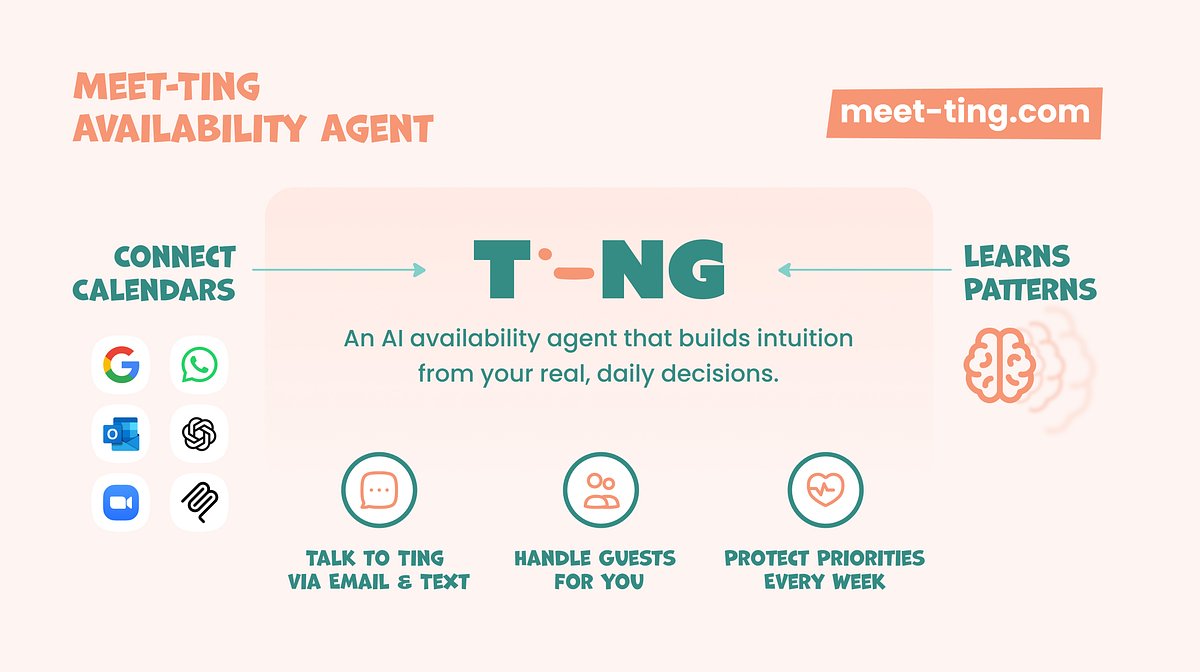
Unlike scheduling assistants that rely on booking links or explicit commands, Meet-Ting’s agent, nicknamed Ting, operates natively within email and WhatsApp. By being CC'd into a conversation, the AI begins a process of autonomous coordination, signaling a broader shift in how people may soon interact with AI across work and life. The launch comes as the AI scheduling category accelerates, with tech giants and venture-backed startups all racing to build the definitive tool for automated coordination.
“We're seeing the same pattern as other agent companies... people don't want to manage the agent, they want it to just handle things,” said Dan, co-founder of Meet-Ting. “Once Ting understands your priorities and relationships, people stop managing their calendars themselves. That's delegation.”
Beyond Booking Links: A New Paradigm for Scheduling
The primary innovation offered by Meet-Ting is its departure from the rigid, link-based systems popularized by tools like Calendly. Instead of forcing participants into a separate dashboard or web form, Ting integrates directly into the conversational flow where scheduling naturally occurs. This “inbox-native” approach aims to eliminate tool fatigue and streamline coordination by having the AI handle the back-and-forth negotiations of finding a suitable time.
By operating inside email and WhatsApp threads, the agent gains access to a rich layer of contextual information that static calendars miss. It analyzes the conversational nuances—tone, professional hierarchy, stated urgency, and the implicit relationships between participants—to build what the company calls a “privacy-first, proprietary model.” This decision dataset becomes the foundation for its autonomous capabilities. Rather than asking a user to configure a complex set of rules upfront, the AI learns by observing the thousands of micro-decisions a person makes about their time.
For instance, it learns which meetings are consistently prioritized, which are postponed, and the subtle trade-offs made when managing competing requests. During a six-month beta, the company reported that power users were booking up to 20 meetings per month via the agent, including for high-stakes scenarios like investor introductions and job interviews, demonstrating a growing willingness to entrust the AI with critical outcomes.
The Trust Equation: Delegating Judgment to an Algorithm
The prospect of an AI making judgment calls based on the perceived tone and hierarchy of an email thread raises immediate and critical questions about trust, privacy, and algorithmic bias. Meet-Ting’s entire model hinges on users' willingness to delegate not just a task, but their personal judgment. The company addresses this by emphasizing its “privacy-first” approach, stating that the behavioral data collected is used to train a model specific to each user, ensuring that personal context remains private.
However, the collection of such sensitive behavioral data places a heavy burden on the company to ensure robust security and ethical stewardship. While early adopters, including executives from Nike and Disney, have embraced the technology, broader enterprise adoption will likely demand more transparent documentation on data security protocols, such as SOC2 compliance and detailed data processing agreements, which were not yet publicly available during its early access phase. The challenge lies in balancing the deep personalization that makes the agent effective with the rigorous privacy standards users and regulators expect.
Furthermore, the reliance on AI, even advanced models like Google's Gemini which Ting is built on, is not without risk. While reportedly uncommon, early reviews have noted minor instances of AI “hallucination,” where the agent might misinterpret context, posing a potential risk to user confidence. As AI agents become more autonomous, ensuring their reliability and accountability becomes paramount to fostering the trust necessary for true delegation.
The Race to Build AI Infrastructure
Meet-Ting’s strategy extends far beyond simply booking meetings. The company is positioning itself as foundational infrastructure for a future “agent-to-agent” world, where much of the digital coordination happens between autonomous systems operating on behalf of individuals and companies. This vision is heavily supported by its strategic alliances. As a member of Google's AI startup program, it receives up to $350,000 in credits for Google Cloud and Gemini infrastructure. Simultaneously, as an early app developer with OpenAI, it is preparing its product to operate natively inside ChatGPT.
“Our bet is that in the future, more work happens inside large language models,” Dan explained in the company's announcement. “Scheduling shouldn't require leaving that environment. Availability agents need to work where conversations happen - whether that's email, WhatsApp, ChatGPT, or agent-to-agent APIs.”
This positions the startup in a fiercely competitive landscape. Google, Perplexity, and a host of startups backed by prominent venture capital firms like Y Combinator and Sequoia Capital have all recently launched or invested in calendar AI. The race is not just to build a better scheduling tool, but to own the coordination layer of the emerging AI-native workflow.
From Beta to Global Rollout
Meet-Ting's strategic positioning is backed by significant momentum. The company has reported 50% month-on-month growth for six consecutive months, with thousands of users signing up. This growth is attributed to a founding team that combines expertise in viral product growth and deep AI engineering. Co-founder Dan Bulteel previously led social media globally for ByteDance and TikTok, while co-founder Mariana Prazeres has been researching and building AI systems since 2017.
Following successful launches in the UK, US, and Brazil, Ting is now expanding its service to France, Germany, Italy, and Spain. The core question, as the technology becomes more widespread, is shifting from whether AI can book meetings to whether people will let it. The startup's early success suggests that the appetite for delegation is strong, provided the technology proves itself reliable and intuitive.
As Dan noted, “What we've learned is that delegation happens when the technology understands what you value.” In a world saturated with information and commitments, the promise of an intelligent agent that truly understands and protects your time may be the ultimate value proposition.