
- $10.3 billion: Global robotics funding in 2025
- 6 seconds: Time for Z1 to autonomously swap tools
- 100Hz: Speed of Z1's 'Fast System' for real-time motor control
Experts view XGSynBot's Z1 as a strategic pivot toward industrial-grade AI, emphasizing durability and modularity over bipedal agility, though its success will hinge on proving reliability at scale.
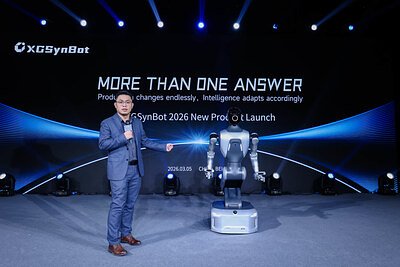
XGSynBot's Z1 Robot: A 'Blue-Collar' Bet on Industrial AI's Future
BEIJING and SAN FRANCISCO – March 10, 2026 – In a dual-city launch event stretching from Silicon Valley to Beijing, embodied AI pioneer XGSynBot has thrown down the gauntlet, not with another flashy prototype, but with a machine designed for the grit and grime of the factory floor. The company debuted its Z1 wheeled humanoid robot on March 5, a machine it bills as a 'blue-collar worker' ready to tackle the 'last mile' of industrial automation and solve what it calls the industry's 'automation paradox'.
The launch, which has already generated tens of millions in potential orders, signals a strategic shift in the race for embodied AI dominance. While competitors focus on increasingly agile bipedal robots, XGSynBot is betting that durability, modularity, and an open ecosystem are the keys to finally bridging the gap between laboratory demos and reliable, 24/7 industrial production.
A Robot Built for the Production Line
For years, the manufacturing sector has been caught in a bind: investing in high-cost automation that often lacks the flexibility to adapt to changing production needs. The recent wave of humanoid robots promised a solution, but many have proven too fragile for the demanding reality of industrial environments.
"We've built the world's most flexible robots over the past three years, yet they remain trapped in the world's most rigid processes," said the CEO of XGSynBot in a statement. "The Z1 isn't a 'mascot' build for the lab; it's a 'blue-collar worker' designed for the real world from the first day."
At the heart of this philosophy are several key engineering decisions. The Z1 features what XGSynBot claims is the world's first Modular-End-Effector Quick Change System. This allows the robot to autonomously swap tools—from grippers to welders to suction cups—in under six seconds. This capability transforms the Z1 from a single-task machine into a versatile worker that can move between different workstations, a critical factor for boosting ROI in dynamic manufacturing settings. While modularity is a growing trend, with competitors like Deep Robotics also featuring quick-release designs, the Z1's speed and integration into a wheeled humanoid platform are notable.
Further reinforcing its industrial credentials are the proprietary XG-High-Performance Joint Modules. By integrating motors, reducers, and sensors into single, compact units, the design aims to enhance precision and stability while minimizing the signal latency that can plague more distributed systems. This integrated architecture is crucial for withstanding the constant vibrations and operational stresses of a factory.
The Z1's brain is a 'Dual-System' architecture inspired by human cognition. A 'Slow System' handles high-level reasoning, allowing it to understand complex natural language commands. Simultaneously, a 'Fast System' operates at 100Hz, managing real-time motor control and reflexes. This allows the robot to process a command like "move those boxes to the next station" while maintaining the millisecond-level stability required to safely navigate a busy assembly line.
Navigating a Crowded Field of Humanoids
The Z1 enters an arena buzzing with activity and nine-figure investments. The year 2026 is widely seen as a pivotal moment for embodied AI, as the industry attempts to transition from research to mass production. Global robotics funding surpassed $10.3 billion in 2025, and the humanoid robotics market alone is projected to grow at a staggering pace.
XGSynBot's wheeled design sets it apart in a field dominated by bipedal competitors. Boston Dynamics' highly anticipated Electric Atlas, with its 56 degrees of freedom, is set for deployment in Hyundai factories. Agility Robotics' Digit is already being trialed by major logistics firms and manufacturers like Toyota to fill labor gaps. Meanwhile, Tesla's Optimus Gen 2 and Apptronik's Apollo are also vying for a foothold in industrial settings.
While bipedal robots are designed to navigate environments built for humans, wheeled platforms can offer advantages in stability, speed, and energy efficiency on the flat, structured surfaces of most factory and warehouse floors. XGSynBot is wagering that for many industrial tasks, emulating human walking is less important than achieving maximum uptime and reliability. The success of this approach will depend on whether the Z1's versatility can outweigh the potential mobility limitations compared to its two-legged rivals.
Beyond the Bot: The STARFIRE Ecosystem Strategy
Perhaps the most forward-looking aspect of XGSynBot's announcement is not the robot itself, but the strategy surrounding it. Project STARFIRE is an ambitious initiative to build an open, global ecosystem to accelerate embodied AI's adoption.
The strategy rests on three pillars. First, Scenario Co-Innovation will involve deploying large-scale solutions with partners in key sectors like 3C electronics, automotive, and renewable energy. Second, Product Synergy aims to create a 'Plug-and-Play' environment by opening hardware interfaces to third-party tool and component manufacturers. This could foster a rich ecosystem of specialized end-effectors and sensors, expanding the Z1's capabilities far beyond what XGSynBot could develop alone.
Finally, and most significantly, the company plans to incrementally open-source its proprietary datasets, simulation models, and SDKs. This approach mirrors the success of platforms like the Robot Operating System (ROS), which democratized robotics development and fostered a global community of innovators. By inviting collaboration from academic and industry developers, XGSynBot hopes to rapidly improve its AI models and accelerate the development of new applications.
This open strategy stands in contrast to the more closed, proprietary approaches of some competitors and could be a powerful differentiator. If successful, STARFIRE could create a network effect, making the Z1 platform more valuable as more partners and developers join.
From Prototype to Production: The Real Hurdle
Despite the excitement, the entire embodied AI industry faces a formidable challenge: proving commercial viability at scale. The path from a compelling demo to a fleet of robots operating reliably 24/7 is fraught with obstacles, including integration with existing factory systems, ensuring human-robot safety, and demonstrating a clear return on investment.
Experts note that the true test for humanoid robots is not just performing a task once, but performing it thousands of times flawlessly in an unpredictable environment. This requires a level of robustness and reliability that has so far eluded many prototypes.
By focusing on a ruggedized design, practical modularity, and a collaborative ecosystem, XGSynBot is tackling these deployment hurdles head-on. The company is betting that the next wave of innovation will be defined less by acrobatic feats and more by the quiet competence of machines that can survive the realities of manufacturing. The Z1's journey from launch stage to factory floor will be a critical test of this philosophy and a key indicator of the entire industry's maturation.