
- 71% of employees feel protected at work, yet 36% have witnessed incivility or disrespect, and 33% have experienced it firsthand.
- 62% of employees believe misconduct is more likely to be overlooked when perpetrated by leaders or top performers.
- 77% of employees would consider leaving their job if they didn't feel protected, costing U.S. businesses an estimated $223 billion over the last five years due to turnover.
Experts agree that unchecked workplace misconduct, particularly by leaders, erodes trust, fuels turnover, and poses significant financial and legal risks to organizations.
Workplace Misconduct Ignored for Leaders, Fueling Fear and Turnover
SAN FRANCISCO, CA – January 21, 2026 – A striking paradox is unfolding in American workplaces: while a majority of employees report feeling protected, their day-to-day experiences are rife with disrespect, exclusion, and retaliation. A new survey from employee training platform TalentLMS reveals a deep chasm between perceived safety and the reality of unchecked misconduct, particularly when perpetrated by leadership and top performers. The findings paint a picture of a workforce silenced by fear and disillusioned by a two-tiered system of justice, creating a significant retention crisis that experts say is costing businesses billions.
The survey of 1,000 U.S. employees found that while 71% say they feel protected at work, this confidence is undermined by pervasive misbehavior. More than a third of employees (36%) have witnessed incivility or disrespect, with 33% experiencing it firsthand. Nearly one in three has witnessed professional or social exclusion, and a quarter has seen retaliation against someone for speaking up. The consequences are stark: a staggering 77% of employees say they would consider leaving their job if they didn't feel protected, directly tying psychological safety to a company's ability to retain talent.
The Leadership Blind Spot
At the heart of this disconnect is a crisis of accountability that starts at the top. The survey data points to a widespread belief that power and performance provide a shield against consequences. Nearly two-thirds of employees (62%) agree that misconduct is more likely to be overlooked when the person involved is a leader or a top performer. This perception is not unfounded, as 45% of respondents have seen colleagues promoted even after mistreating others.
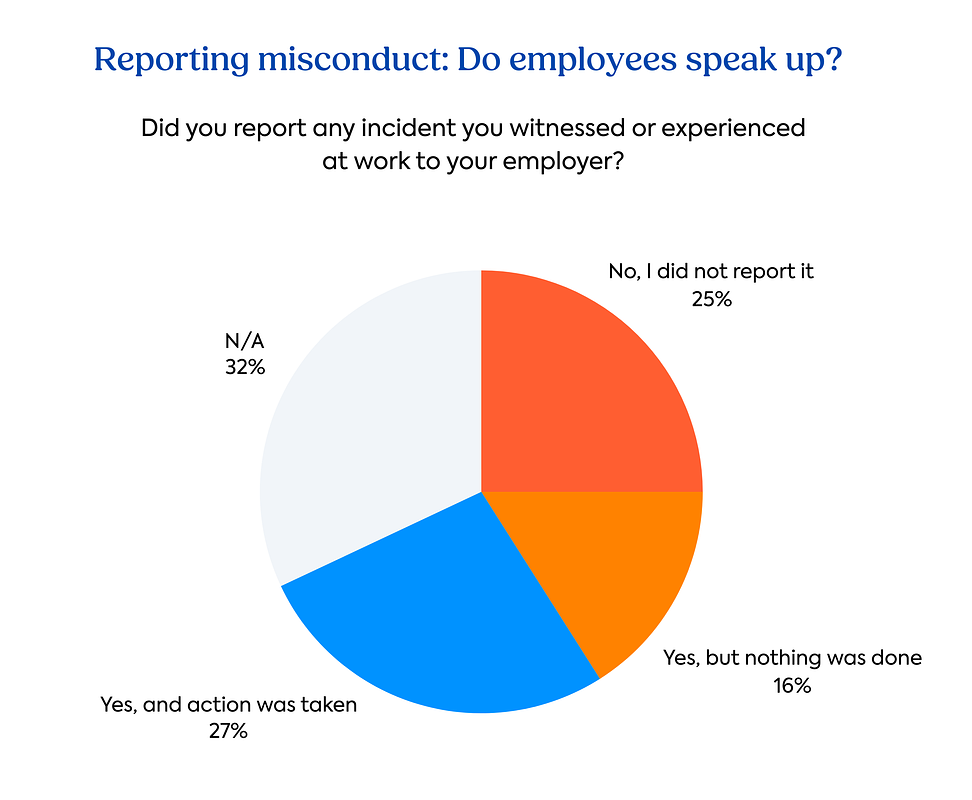
This leadership blind spot fosters a culture of silence and fear. The survey reveals that managers are often part of the problem, not the solution. Nearly half of employees (47%) say their managers actively discourage them from escalating harassment or discrimination complaints. Compounding this, 42% of workers worry that speaking up will get them labeled as “difficult,” a fear that leads many to suffer in silence. Consequently, a quarter of employees who witnessed or experienced misconduct never reported it. Of those who stayed silent, the majority (56%) believed reporting would make no difference, while 36% cited a direct fear of retaliation.
Broader industry research confirms this trend, highlighting that leadership behavior is the primary driver of workplace culture. Studies show that a lack of psychological safety - the belief that one can speak up without fear of punishment or humiliation - is a leading cause of disengagement and turnover. When employees see a different set of rules for those in power, trust erodes, and the entire ethical foundation of the organization is threatened.
The Staggering Cost of Inaction
While a culture of fear is damaging to morale, its impact on a company's bottom line is catastrophic. The 77% of employees willing to walk away from a job where they feel unprotected represent a massive financial risk. Independent research quantifies this threat, with one recent analysis estimating that employee turnover driven by toxic work environments has cost U.S. businesses as much as $223 billion over the last five years. Experts note that a toxic culture is ten times more predictive of turnover than compensation.
The costs of replacing an employee are substantial, often estimated at one-half to two times their annual salary. These expenses include direct costs like recruitment and training as well as indirect costs like lost productivity, decreased team morale, and the burden on remaining staff. When nearly half of employees who witness misconduct end up leaving their roles, as some studies suggest, the failure to address these issues becomes a significant and recurring financial drain.
This “invisible exodus” is fueled by the very issues highlighted in the TalentLMS survey. When employees feel their concerns are ignored or, worse, that they will be punished for voicing them, their loyalty evaporates. The result is a revolving door of talent that hampers innovation, disrupts operations, and damages a company's reputation as an employer.
Training That Misses the Mark
Organizations often turn to compliance training as a primary defense against misconduct, and employees see its potential. According to the survey, 60% believe such training has improved behavior in their workplace. However, its effectiveness is severely limited when it fails to reflect the complex realities employees face. A significant 45% of workers find that compliance training is disconnected from real-world situations, rendering it a “check-the-box” exercise rather than a practical tool for change.
“When compliance training reflects real workplace scenarios, it helps people recognize misconduct, understand what steps they can take, and feel more comfortable speaking up,” said Theoni Velkou, Compliance Manager & Data Protection Officer at Epignosis, TalentLMS's parent company. Velkou emphasizes that practical training is essential for building trust across an organization.
This gap is widened by uneven access to training and a pullback in related initiatives. One in five employees received no compliance training in the past year, and only a third received training on Diversity, Equity, and Inclusion (DEI). Notably, 31% of employees report feeling less protected as their companies have scaled back DEI initiatives, suggesting these programs play a crucial role in fostering a sense of safety and belonging.
A Shifting Legal Landscape Demands Action
Companies that fail to address these systemic issues are not only risking their talent and financial health but are also exposing themselves to growing legal peril. The regulatory environment is evolving to offer greater protections for employees and place a higher burden of proof on employers. In April 2024, the U.S. Equal Employment Opportunity Commission (EEOC) finalized new harassment guidelines that expand protections to cover remote work, social media, and issues related to sexual orientation and gender identity.
Furthermore, state laws are becoming more stringent. For example, California’s SB 497, which took effect in 2024, creates a “rebuttable presumption” of retaliation if an employer takes adverse action against an employee within 90 days of them reporting misconduct. This shifts the legal burden, making it easier for employees to prove retaliation and harder for companies to defend their actions. With retaliation remaining the most common charge filed with the EEOC, such laws signal a broader legislative trend toward holding employers accountable.
As legal frameworks tighten and employee expectations for a safe and equitable workplace rise, the tolerance for a two-tiered system of justice is diminishing. The findings from the TalentLMS survey serve as a clear warning: inaction is no longer a viable option, and organizations that fail to foster a culture of genuine safety and equal accountability will be left behind.