
- 100 hours/month saved on A/R operations by early adopter Spectrio
- 90% of finance teams predicted to deploy AI by 2026 (Gartner)
- SOC 2 Type II compliance for data security
Experts agree that Woodrow AI addresses critical trust barriers in finance automation with its specialized, auditable, and secure approach, positioning it as a viable solution for high-stakes financial operations.
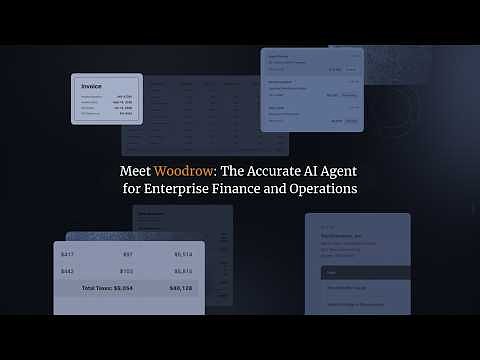
Woodrow AI Debuts Finance Agent, Vying for Trust in a Cautious Sector
SAN FRANCISCO, CA – March 18, 2026 – Woodrow AI announced its public launch today, introducing an AI agent built specifically for the exacting world of enterprise finance and operations. While artificial intelligence has become a standard tool in sales and engineering departments, finance has remained a cautious holdout, largely due to its non-negotiable demands for accuracy, security, and auditable processes. Woodrow aims to bridge that gap, promising a “finance-grade” solution designed to automate high-volume, repetitive work with the transparency and human oversight the sector requires.
The company enters a market where the term 'AI' is ubiquitous but true, autonomous adoption in core financial processes is still nascent. Woodrow's agent is designed to tackle tasks like accounts payable and receivable (AP/AR), reconciliations, and payroll validation—work that is often manual, tedious, and spans multiple disconnected software systems.
"Finance teams are running detailed, manual processes at growing volume and constantly hiring to keep pace," said Sidharth Kakkar, Founder of Woodrow, in the company’s announcement. "The tasks are repetitive, cross-system, and relentless. Woodrow takes that work off your team's plate with the audit trails and controls that make delegation safe."
The Challenge of ‘Finance-Grade’ AI
The slow adoption of AI in finance is not due to a lack of interest but a deficit of trust. In a field where a 95% accuracy rate can still signify a 100% failure on a critical report, the probabilistic nature of many general AI models has been a non-starter. The core challenge has been to build a system that is not only intelligent but also impeccably reliable, secure, and transparent.
Woodrow claims to have addressed this by building its agent with expert-level finance and accounting knowledge at its core. The system is designed to log into a company's existing tools, pull data, reconcile information, and execute workflows from start to finish. Crucially, every action is logged, creating a complete audit trail that explains the reasoning behind each step. This end-to-end auditability is a key feature aimed at winning over skeptical finance leaders.
Security is another cornerstone of the offering. The company highlights its SOC 2 Type II compliance, a rigorous standard for managing customer data, and assures that personally identifiable information (PII) is never used to train underlying AI models. Access to connected systems is scoped narrowly per workflow, minimizing the security footprint.
Early results from design partners seem to validate the approach. Spectrio, a digital signage company, deployed Woodrow for its accounts receivable inbox automation. "Accuracy is non-negotiable in finance, and Woodrow is built accordingly," said Jonathan Ehrhart, Chief Financial Officer at Spectrio. "We were live on our first workflow within weeks and have saved 100 hours/month on A/R operations."
A Specialized Player in an Evolving Field
Woodrow is not entering an empty arena. The market for financial automation is populated by established giants and nimble startups alike. Major players like UiPath, Workday, and BlackLine have been integrating AI into their platforms for years, steadily moving from rule-based robotic process automation (RPA) to more intelligent, agentic systems. Workday has embedded AI across its financial management suite, while BlackLine's “Verity AI” focuses on automating the financial close process with an emphasis on accuracy and control.
However, Woodrow is positioning itself differently. Instead of offering a broad platform or an add-on to an existing ERP, it provides a purpose-built, standalone agent designed to function like a specialized team member. This focus is its primary differentiator. While a general platform might require extensive configuration and internal expertise to manage, Woodrow is pitched as a solution that understands accounting principles out of the box.
This specialization reflects a broader trend in the AI industry. As the underlying technology from large language models matures, the value is shifting from the models themselves to their application in specific, high-stakes domains. By focusing exclusively on finance operations, Woodrow is betting that a deep, narrow expertise will triumph over a shallow, broad capability.
Investor Confidence and Market Readiness
The launch is backed by a notable roster of venture capital firms, including First Round Capital, Pelion Venture Partners, and Kapor Capital, signaling strong investor confidence in this specialized strategy. Investors believe the timing is right, as both the technology and the market have reached a critical inflection point.
"Finance leaders have been waiting for AI that meets their standards," commented Todd Jackson, Partner at First Round. "Until now, the underlying models weren't strong enough to build trustworthy agents for high-volume work across systems...but that's changed. Today's models can reason through workflows, handle more context, and reliably call the right tools."
This sentiment is echoed by industry data. Recent surveys show that AI adoption in finance is accelerating, with Gartner predicting that 90% of finance teams will deploy at least one AI-enabled solution by 2026. However, significant barriers remain, including concerns over data quality, a shortage of technical talent, and navigating complex regulatory landscapes. Woodrow's focus on auditable, secure, and controlled automation is a direct response to these very concerns.
Tyler Hogge, Partner at Pelion, noted the underserved nature of the market. "Too often, finance teams are last to get the tools they deserve," he stated. The investment thesis appears clear: a massive market opportunity exists for an AI solution that can finally meet the rigorous demands of the CFO's office.
Reshaping the Finance Workforce, Not Replacing It
The introduction of capable AI agents inevitably raises questions about the future of the finance workforce. Woodrow’s mission to automate “high-volume repetitive work” directly targets tasks that currently occupy a significant portion of junior and mid-level finance professionals' time.
However, the consensus among industry analysts is that such tools will lead to a transformation of roles rather than outright replacement. By delegating manual reconciliations and data entry to AI agents, human professionals are freed to focus on higher-value activities. These include strategic analysis, interpreting AI-driven insights, managing exceptions, and overseeing AI governance to ensure compliance and ethical use.
The 'human oversight' component of Woodrow's platform is central to this vision. The system is designed to escalate exceptions and request human guidance when it encounters a novel situation, placing the human professional in the role of a manager and strategist, not a data entry clerk.
This shift will necessitate a change in skill sets. Proficiency in data interpretation, workflow automation, and AI governance will become increasingly critical. New roles, such as 'AI auditor' or 'agentic AI manager,' are expected to emerge, bridging the gap between finance and technology. For the modern finance department, embracing tools like Woodrow may not be about reducing headcount, but about empowering their existing team to drive greater strategic value for the business.