
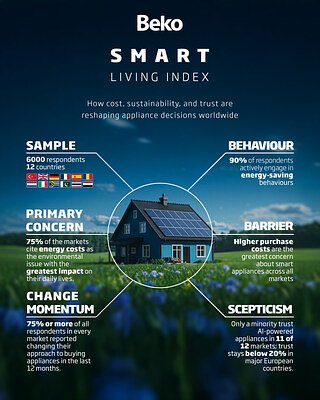
- 6,000 consumers surveyed across 12 markets in the Smart Living Index (SLI) - 8 of 12 countries cited rising energy costs as the top environmental concern - 86% of Pakistanis, 81% of Thais, and 80% of Turks highly value smart home innovations, vs. <20% in Western markets
Experts would likely conclude that financial pressures are now the primary driver for sustainable home living, reshaping consumer behavior and industry strategies globally, with significant regional differences in smart technology adoption.
The Price of Green: Financial Pressure Drives Sustainable Homes
ISTANBUL, Turkey – January 22, 2026 – A landmark global study has revealed a fundamental shift in what motivates people to live more sustainably at home, with soaring household expenses, particularly energy bills, now eclipsing environmental altruism as the primary driver. The findings come from the inaugural Smart Living Index (SLI), a comprehensive survey released today by global home appliance giant Beko.
The study, one of the largest of its kind, surveyed 6,000 consumers across 12 diverse markets, from the UK and Germany to Pakistan and Thailand. It paints a complex picture of a world where economic necessity is forcing a re-evaluation of energy consumption, creating surprising trends in technology adoption and a clear demand for government support.
Cost Becomes the Catalyst for Change
For years, the narrative around sustainable living has been dominated by environmental consciousness. However, Beko's research indicates that the most immediate and acutely felt climate challenge for most households is the impact on their wallets. In a striking confirmation of this trend, consumers in eight of the twelve countries surveyed cited rising energy costs as the environmental issue with the greatest impact on their daily lives.
This economic pressure is fundamentally altering purchasing habits. Across all markets, consumers reported that long-term affordability and sustainability have grown in importance when choosing new appliances over the last year. The focus has moved from a simple upfront cost to a more sophisticated calculation of an appliance's total cost of ownership, including its running costs. This shift suggests that "eco-friendly" is becoming synonymous with "economical" in the minds of consumers, a powerful motivator that is reshaping the home appliance industry. The study highlights that markets where consumers actively track these running costs show a higher adoption of smart, energy-saving features, demonstrating a direct link between financial awareness and tech engagement.
A Global Divide in Smart Home Adoption
While the pressure to save money is a universal theme, the solutions consumers are embracing reveal a stark geographical and cultural divide. The Smart Living Index uncovers a significant "trust gap" in technology, particularly between established Western markets and rapidly growing emerging economies.
In key European markets like France, Spain, the UK, and Germany, fewer than 20% of consumers trust AI-powered appliances, even while acknowledging their potential environmental benefits. This skepticism is reflected in lower enthusiasm for future smart innovations, with only 40% of UK consumers and 39% of Germans placing a high value on them. Instead, a significant portion of the public in these regions is turning to "analogue" or behavior-based energy-saving methods. For example, in many of these countries, approximately two-thirds of respondents still prefer to dry laundry on a traditional washing line to save electricity.
In stark contrast, consumers in the Global South are eagerly embracing the potential of smart technology. Enthusiasm for even smarter appliances is exceptionally high in Pakistan (86%), Thailand (81%), and Turkey (80%). These markets are not just open to smart features; they are excited by future-forward innovations like self-cleaning or even energy-generating appliances. This disparity presents a complex challenge for global manufacturers, who must work to build trust in mature markets while simultaneously meeting the demand for cutting-edge technology in growth regions.
The Age Paradox and a Unified Call for Government Action
The study also challenges conventional wisdom about environmental engagement, revealing an "age vs. income paradox." Contrary to the popular image of the young, eco-conscious activist, the research shows that energy-saving behavior actually increases with age. The over-54 demographic consistently leads in all energy-saving activities, from turning off lights to using energy-efficient appliance cycles. Conversely, engagement in these behaviors tends to decrease as household income rises, suggesting that those with less financial pressure are also less motivated to conserve.
Despite these differing behaviors, one sentiment unites consumers across the globe: the transition to a sustainable future cannot be shouldered by individuals alone. An overwhelming majority—more than 50% of respondents in every single market—agreed that government policy should support consumers in switching to more resource-efficient home appliances. This widespread demand for intervention signals a public belief that structural support, such as subsidies, tax incentives, or clearer energy-efficiency standards, is essential to make sustainable choices accessible and affordable for everyone.
As households continue to navigate economic uncertainty, the industry is taking note of this evolving landscape. Hakan Bulgurlu, CEO of Beko, commented on the findings, stating, "The Smart Living Index highlights the urgent need to bridge the trust gap in smart technology and its benefits to unlock its full potential for smarter, more sustainable living in every household." He emphasized that small, individual changes can create significant collective impact when adopted at scale.
Bulgurlu added, "At Beko, we believe that consumers should have access to options designed to reduce environmental impact, regardless of financial pressures. By understanding global energy-saving trends and perceptions of smart appliances, we are even more equipped to meet the needs of our customers and support the shift toward more sustainable living." The findings from the Smart Living Index provide a clear roadmap for how industry and policymakers can collaborate to address consumer needs, building a future where both the planet and the household budget can thrive.
Topics & Related
Generative AI
Machine Learning
ESG
Decarbonization
Automation
Revenue
EBITDA
AI & Machine Learning
Related Company Pulse