
- 4,000-meter drill program at the historic Starratt-Olsen Mine, targeting untapped potential after 70 years of dormancy.
- 164,000 ounces of gold historically produced from Starratt-Olsen, averaging 6.17 grams per tonne (g/t).
- 1.1 kilometers away from the flagship Madsen Mine, leveraging existing mill capacity for cost-efficient expansion.
Experts would likely conclude that West Red Lake Gold's strategic, phased approach to exploration and production—focusing on historically proven, low-risk targets—positions the company for sustainable growth in one of the world's premier gold districts.
West Red Lake Gold Drills into History to Fuel Its Next Growth Phase
RED LAKE, ONTARIO – June 16, 2026 – In the world of mineral exploration, the most promising path forward can often be found by looking back. West Red Lake Gold Mines Ltd. (TSXV: WRLG) is putting that axiom to the test, announcing the commencement of a significant surface drilling program at the Starratt-Olsen Mine, a historic gold producer that has lain dormant for over 70 years. This move is far more than a simple exploration play; it is a clear and calculated growth signal from a company methodically executing a strategy to transform itself from a single-asset operator into a multi-faceted production hub in one of the world's most legendary gold districts.
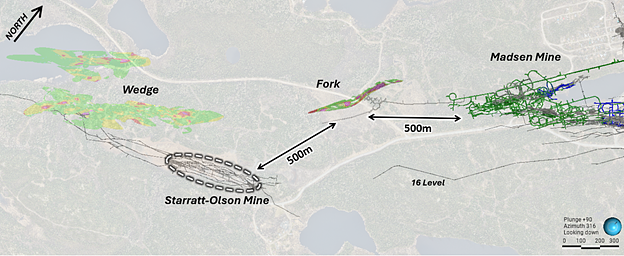
Just months after achieving commercial production at its flagship Madsen Mine, WRLG is now deploying capital and equipment just 1.1 kilometers away to probe the untapped potential of a site that last saw active mining in the 1950s. The fully funded, 4,000-meter drill program represents a pivotal step in the company’s ambition to systematically unlock value across its expansive 47 km² Madsen property, validating a long-term vision that investors and analysts are watching closely.
A Strategy of Sequential Growth
The timing of the Starratt-Olsen program is the key to understanding its strategic importance. West Red Lake Gold is not just collecting disparate assets; it is building a pipeline. The first major milestone was achieved in January 2026 when the company declared commercial production at the Madsen Mine, establishing a vital processing hub with available mill capacity. This foundation is now being used to leverage a sequence of satellite deposits.
The next step, already in motion, is the development of the Fork deposit. With underground work underway, Fork is on track to be integrated into the Madsen production profile in the first half of 2027. This move is designed to increase ore sources, enhance operational flexibility, and drive down unit costs. Now, with the drills turning at Starratt, WRLG is initiating the next phase of resource definition, looking to add another cog to its expanding production machine.
This methodical, step-by-step expansion was articulated by the company’s Vice President of Exploration, Will Robinson. “Following a highly successful drilling season at Rowan and Fork, we are maintaining our momentum by moving the surface drill to the past-producing Starratt-Olsen Mine,” he commented. “Given that underground development is now underway at Fork and the deposit is advancing toward inclusion in the Madsen production profile in 2027, it is logical to continue defining new resources along this main southwestern structural corridor. Starratt represents our next major stepping stone along this prospective trend as we systematically unlock the full value and exploration scale across the Madsen property.”
This statement decodes the company’s momentum. The signal is one of disciplined capital allocation and operational sequencing. Rather than pursuing scattered, high-risk greenfield targets, WRLG is focusing on a known mineralized trend, de-risking its growth by targeting areas with a proven history of gold endowment, all within trucking distance of its central mill.
Unearthing a Red Lake Legacy
The allure of Starratt-Olsen lies in its rich history. Between 1948 and 1956, the mine produced approximately 164,000 ounces of gold from ore grading an average of 6.17 grams per tonne (g/t). These are not insignificant figures; Starratt was historically the second-largest producer on the entire Madsen property. Yet, since the mine gates closed over seven decades ago, the main historic mining footprint has remained virtually untouched by modern exploration drilling.
Exploration in the 1950s was limited by the technology and geological understanding of the time. Today, with advanced geophysical techniques, oriented diamond drilling, and a more sophisticated understanding of the structural controls on gold mineralization, companies can effectively “see” what previous generations of miners may have missed. The current program at Starratt is specifically designed to do just that, targeting the up- and down-plunge extensions of the very panels that were profitably mined in the past. It will also test for new, sub-parallel mineralized lenses that may lie adjacent to the historic workings—a common occurrence in the complex geology of the Red Lake district.
For investors, this represents a compelling value proposition. The project is not a wildcat exploration venture but a brownfield redevelopment opportunity. The presence of historical workings and established gold production significantly reduces geological risk. Success here would not require building a new mine from scratch but could potentially lead to a relatively low-cost, bolt-on source of ore for the nearby Madsen mill.
The Geological Blueprint for Success
The decision to focus on Starratt is grounded in sound geological science. The Red Lake Mining District is an Archean greenstone belt, a geological environment famous for hosting high-grade, structurally controlled gold deposits that have yielded over 30 million ounces of gold. The mineralization at Starratt-Olsen is hosted within the same volcanic rock package and is controlled by similar structural features—notably the Austin Shear Zone—as the world-class Madsen deposit.
This geological continuity is the crux of WRLG’s district-scale strategy. The company is essentially following a well-defined geological blueprint that has already proven to be incredibly lucrative. The drill program will use oriented core, which allows geologists to precisely measure the orientation of veins and structures, providing critical data for building an accurate 3D model of the deposit. By targeting the “plunge extensions,” they are following the likely orientation of the ore shoots above and below the areas that were previously mined out. This is a highly effective and targeted method for expanding a known mineralized system.
The 4,000-meter program, expected to conclude by mid-August 2026, will serve as the first modern test of this thesis. The assay results, which will be released as they become available, will be a critical catalyst and a major signal of the project's potential to contribute to the company's long-term production profile.
Positioning in a Prolific District
West Red Lake Gold’s systematic expansion is taking place in a competitive and highly active region. The Red Lake district is home to major operators like Evolution Mining, and it continually attracts junior explorers drawn by the potential for bonanza-grade discoveries. In this context, WRLG’s strategy of consolidating a large, contiguous land package with a central, operating mill is a significant competitive advantage.
By controlling the Madsen infrastructure, the company holds the key to unlocking value not just from its flagship mine but from a portfolio of surrounding deposits. This hub-and-spoke model provides a clear and scalable path to increasing production, enhancing operational flexibility, and ultimately improving margins. The exploration at Starratt-Olsen is a tangible demonstration of this strategy in action, signaling a mature and disciplined approach to growth that sets the company apart.