
- 44 to 46 aircraft: Volotea's fleet size to receive network-wide narrowband connectivity.
- 12-month trial: Duration of the high-speed LEO satellite internet trial starting Q4 2026.
- 430+ routes: Volotea's network where the digital transformation will be implemented.
Experts would likely conclude that this partnership sets a new industry standard for budget airlines, demonstrating a commercially viable path to full digital transformation through layered connectivity and data-driven retail solutions.
Volotea and Immfly to Redefine Budget Air Travel with LEO Connectivity
HAMBURG, Germany – April 15, 2026 – Spanish low-cost carrier Volotea and onboard digital solutions provider Immfly are set to redefine the passenger experience in the budget airline sector, announcing a major expansion of their decade-long partnership. The initiative will introduce a multi-tiered connectivity solution, including a trial of high-speed Low Earth Orbit (LEO) satellite internet, and a fully integrated, data-driven onboard retail program across Volotea’s entire fleet.
The ambitious project, unveiled today, represents a significant leap forward in digital services for the low-cost carrier (LCC) market, a segment that has traditionally lagged behind full-service airlines in adopting in-flight connectivity due to high costs and complex installations. By combining cutting-edge LEO technology with a fleet-wide narrowband solution and an intelligent retail platform, Volotea and Immfly are creating a comprehensive digital blueprint that could set a new industry standard.
A New Digital Blueprint for Budget Airlines
For years, the promise of reliable in-flight Wi-Fi on budget airlines has been more of an exception than the rule. The economics of installing and maintaining traditional satellite systems on high-utilization, narrowbody aircraft often proved prohibitive. This new program from Immfly and Volotea aims to shatter that paradigm.
The initiative is explicitly designed to serve as a reference model for the LCC and ultra-low-cost carrier (ULCC) industries. It demonstrates a commercially viable path to full digital transformation by layering different connectivity options and leveraging them to unlock new revenue streams and operational efficiencies.
"This partnership milestone reflects the shared ambition between Immfly and Volotea to redefine what passengers can expect onboard," said Pablo Linz, CEO and Co-founder of Immfly. "By combining narrowband and high‑speed LEO connectivity, next‑generation retail, and a full hardware upgrade, we’re enabling a step‑change in digital performance across the fleet."
For Volotea, an airline known for connecting small and medium-sized European cities and holding a four-star Skytrax rating, this move is a calculated investment in passenger experience. It aims to enhance its competitive edge by offering a seamless digital journey that complements its reputation for customer satisfaction, providing amenities typically associated with more expensive carriers.
The Multi-Tiered Connectivity Approach
At the heart of the transformation is a sophisticated, two-pronged connectivity strategy designed to provide flexibility and reliability across the airline's network of over 430 routes.
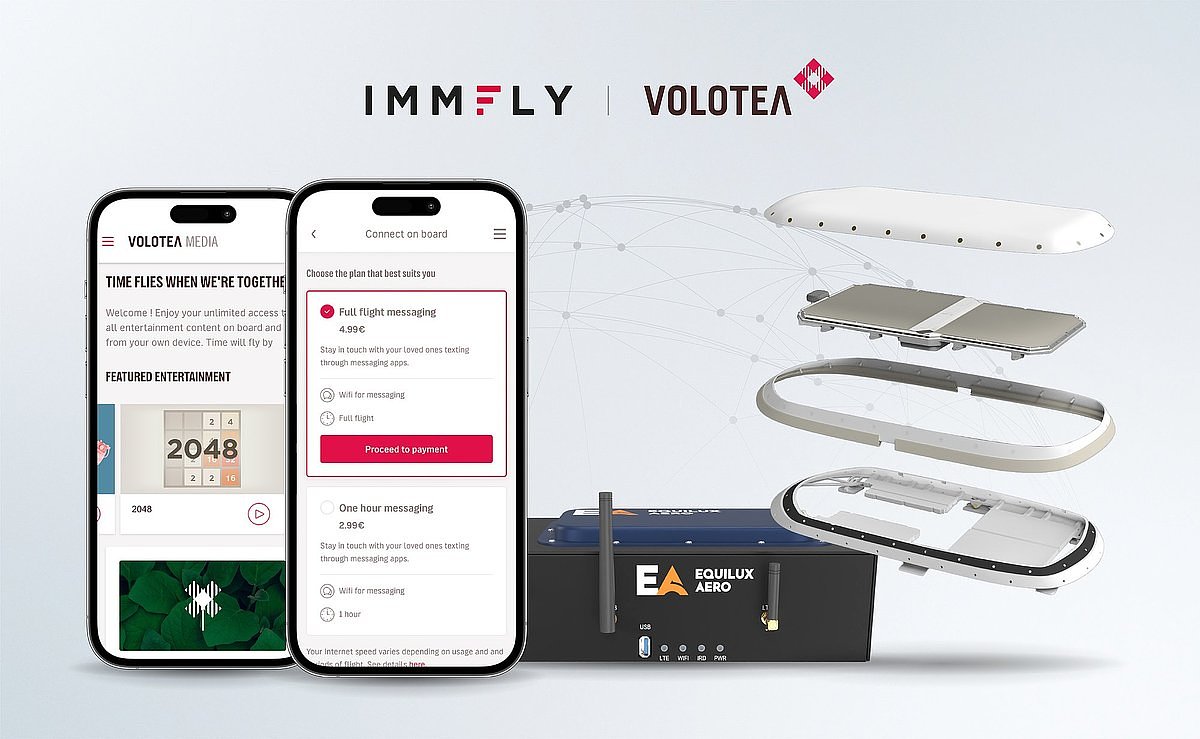
The flagship component is a 12-month trial of Immfly’s next-generation high-speed connectivity, scheduled to begin in the final quarter of 2026. The trial will be conducted on an Airbus A320 already equipped with Immfly’s Equilux onboard server. The upgrade will integrate a Gogo Electronically Steered Antenna (ESA) to connect with the Eutelsat OneWeb LEO satellite constellation. This combination promises to deliver low-latency, high-bandwidth internet, enabling passengers to stream video, browse the web, and use cloud applications as they would on the ground. The trial is designed to validate both the operational performance and the commercial benefits of high-speed services in a live airline environment.
Running in parallel, and ensuring a baseline of digital service across the entire fleet, is a network-wide rollout of Immfly’s Iridium-based narrowband solution. Set to begin in the third quarter of 2026, this system will be installed across Volotea’s full fleet of 44 to 46 Airbus A319 and A320 aircraft. This narrowband capability will support essential passenger messaging services, including WhatsApp, and provide a reliable data link for critical operational communications, ensuring continuity regardless of which aircraft is flying a particular route.
Revolutionizing Onboard Retail with Data
The introduction of fleet-wide connectivity serves as the foundation for the program's most commercially significant element: a complete overhaul of the onboard retail experience. Starting in the second half of 2026, Immfly and Volotea will deploy a fully integrated retail platform designed to maximize ancillary revenue and streamline cabin operations.
This new system moves far beyond traditional trolley service. It includes a modern crew Electronic Point of Sale (EPOS) solution, a powerful new back-office system, and passenger-facing features like pre-flight ordering and in-seat ordering via personal devices.
Crucially, the intelligence behind this platform is powered by capabilities gained from Immfly’s 2025 acquisition of the UK-based firm Data Clarity. This integration allows the system to leverage AI-driven analytics for demand forecasting, inventory management, and hyper-personalization. By analyzing passenger data and real-time sales trends, the platform can optimize what is loaded onto each flight, significantly reducing waste while ensuring popular items are always in stock. This data-driven approach promises to create a more efficient, profitable, and sustainable retail operation.
"This next phase allows us to bring greater consistency and quality to the journey, with enhanced connectivity and more intuitive retail services," noted Alex de Jesús, Chief Experience Officer at Volotea. "It’s about making every interaction onboard simpler, more connected and more enjoyable for our passengers."
A Crowded Sky: The LEO Connectivity Race
The decision to use the Eutelsat OneWeb constellation places Volotea and Immfly at the forefront of a rapidly evolving in-flight connectivity market. While SpaceX's Starlink has garnered significant attention, the solution chosen here is specifically tailored for the narrowbody aviation market. The Gogo ESA is a low-profile, lightweight antenna designed for minimal drag and rapid installation, reducing the aircraft downtime that is so costly for LCCs.
This strategic choice pits the Eutelsat OneWeb solution against other major players, including Viasat, which is integrating LEO capacity into its offerings, and SES with its MEO system. However, Immfly's focus on creating a complete, end-to-end ecosystem—from the antenna to the server to the data analytics and retail interface—provides a unique selling proposition. It offers airlines a single, unified platform for a full digital transformation, rather than a piecemeal collection of services.
The partnership, which first began in 2015 with the installation of a wireless in-flight entertainment platform, has steadily evolved. This latest phase marks Volotea's transition to a full "360° customer" of Immfly, entrusting the company with its entire onboard digital ecosystem. It is a testament to a decade of collaboration and a shared vision for the future of air travel, where connectivity is not just an amenity, but the backbone of a smarter, more efficient, and more passenger-focused flying experience.