
- Verdent AI introduces the world's first 'AI engineering team' to manage the entire software development lifecycle.
- Early case studies show non-technical users building custom e-commerce and CRM systems.
- Verdent's SEAlign research received a Distinguished Paper Award at ICSE 2026.
Experts view Verdent's platform as a significant step toward AI-driven software development, democratizing creation while transforming the role of human engineers into strategic overseers of autonomous AI teams.
Verdent's AI Engineering Team Aims to Build Software, Not Just Code
SINGAPORE – April 20, 2026 – In a move that signals a significant shift in the landscape of software creation, Verdent AI today announced a major update to its platform, positioning it as the world's first "AI engineering team." Led by Zhijie Chen, a former Head of Algorithms at ByteDance, the Singapore-based company is moving beyond the now-familiar concept of AI copilots that assist with coding. Instead, Verdent offers an autonomous system designed to manage the entire software development lifecycle, from high-level planning and execution to final validation and delivery, aiming to close the persistent gap between a great idea and a shipped product.
For years, the promise of AI in software development has focused on augmenting the work of human coders. Verdent’s announcement suggests a new phase is beginning—one where AI transitions from an assistant to a comprehensive project manager and executor. This technology could dramatically lower the barrier to entry for entrepreneurs and small teams, but it also raises fundamental questions about the future role of human engineers in a world of increasingly autonomous AI agents.
Beyond the Copilot: A New Paradigm for Building Software
The central problem Verdent aims to solve is not the difficulty of writing code, but the complexity of shipping a finished product. "Code generation is abundant," said Zhijie Chen, founder and CEO of Verdent, in the company's announcement. "What remains scarce is completion—software that is planned, executed, verified, and shipped."
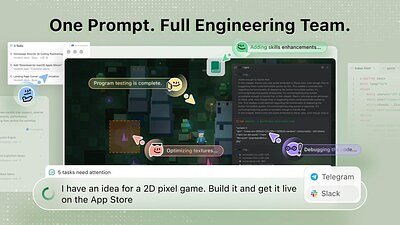
This philosophy marks a clear departure from first-generation AI coding tools. While copilots excel at generating code snippets and answering isolated prompts, they still require a human developer to orchestrate the larger process: deciding what to build, integrating new code, running tests, and managing deployment. Verdent is designed to take on this entire workflow. Users describe their goal in natural language—be it a customer relationship management (CRM) tool, an internal dashboard, or a complete e-commerce platform—and the AI team gets to work.
The platform breaks the goal into a coherent plan, breaks that plan into discrete tasks, writes and modifies the necessary code, and runs tests to verify its work. The output is not a code snippet, but a working, reviewable product increment. Early case studies provided by the company paint a compelling picture of this new reality: a European photographer with no engineering background reportedly built a custom e-commerce and CRM system from scratch, while an equipment supplier in India deployed a factory floor workflow application. These examples underscore the platform's focus on empowering builders who are constrained not by ideas, but by the traditional need for a technical team.
The Technology of an Autonomous Team
Verdent's claim to be an "AI engineering team" is underpinned by technology designed for autonomy and continuity. Unlike tools that treat each prompt as a cold start, the platform retains context across projects, remembering architectural decisions, coding conventions, and user preferences. This allows work to progress with a consistency that mimics a human team's shared knowledge.
This continuity extends to its operational model. The system can work asynchronously through integrated tools like Slack and Telegram, allowing a founder to kick off a complex task, step away for customer meetings, and receive updates as the AI team makes progress. This asynchronous capability is what makes the "team" metaphor more than just marketing; it suggests a system that carries the workload forward even when the user is focused elsewhere.
This ambitious approach is grounded in serious academic research. The company's work on SEAlign, which focuses on aligning AI systems with the complex decision-making demands of real-world engineering, received a Distinguished Paper Award at ICSE 2026, a top conference in software engineering. This research moves beyond optimizing for code generation in isolation. "Agent success is not just about stronger models," noted Huangzhao Zhang in the announcement. "It is about making better decisions across the plan-code-verify cycle." This academic validation suggests Verdent's platform is built on a foundation that attempts to teach AI the nuanced art of engineering judgment, not just the science of syntax.
Democratizing Creation or Disrupting Careers?
The immediate promise of a platform like Verdent is the profound democratization of software creation. For decades, building sophisticated digital products required significant capital, access to technical talent, or both. By offering an "AI engineering team" on demand, Verdent and similar emerging platforms could unlock a wave of innovation from indie developers, small businesses, and non-technical founders who were previously sidelined.
However, this technological leap inevitably casts a long shadow over the software development profession. If an AI can manage the entire development lifecycle, what becomes of the human engineer? Industry analysts predict not an outright replacement, but a radical transformation of the role. According to recent reports from firms like Gartner and Forrester, the future of software development lies in smaller, AI-augmented teams. In this model, human engineers transition from writing every line of code to becoming architects, reviewers, and directors of AI teams. Their focus shifts from implementation details to high-level strategy, creative problem-solving, and ensuring the final product aligns with business goals.
The demand will likely shift toward professionals who can effectively prompt, guide, and validate the work of autonomous AI systems. The skills required will be less about mastering a specific programming language and more about systems thinking, product vision, and the ability to conduct a symphony of specialized AI agents. Verdent’s emphasis on providing "working output teams can review and ship" aligns perfectly with this vision of human-AI collaboration.
Navigating a Crowded Field of AI Agents
Verdent's claim to be the "first" AI engineering team is bold, particularly in a market that is rapidly moving toward more autonomous systems. The concept of "agentic engineering," where AI agents can reason, plan, and execute complex tasks, is the industry's new frontier. Companies from garage startups to tech giants are racing to build AI that can do more than just suggest code.
Where Verdent appears to differentiate itself is in its cohesive, end-to-end vision and its explicit focus on empowering builders, not just developers. While some tools offer powerful agentic capabilities for specific tasks or require deep technical expertise to operate, Verdent has packaged the entire process into a unified platform aimed at delivering a complete outcome. Its success will likely depend on how reliably it can deliver on this promise of a seamless idea-to-product journey.
The introduction of Verdent's platform is a landmark moment, crystallizing a trend that has been building for years. The era of AI as a mere assistant is giving way to an era of AI as a partner, a collaborator, and now, an entire team. For creators and entrepreneurs, this represents an unprecedented opportunity to build the future. For the technology industry itself, it signals a fundamental and irreversible evolution in how software is made.