
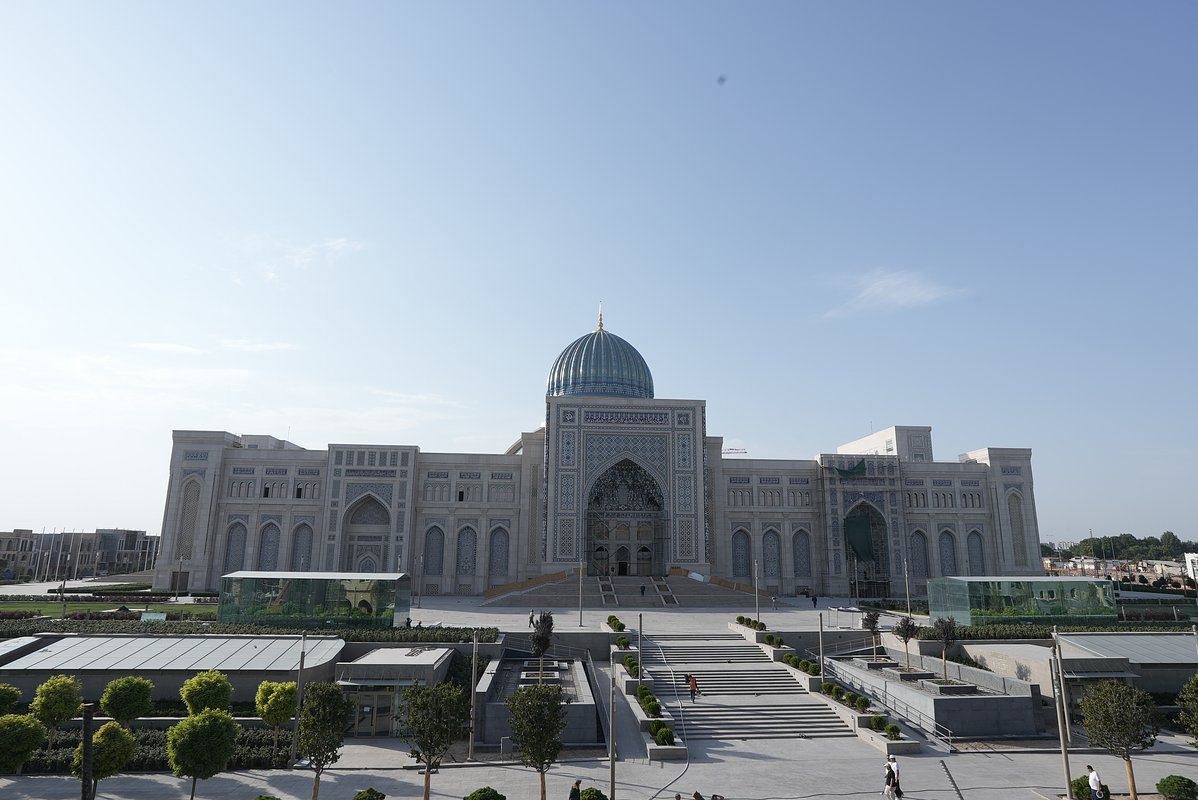
- 65-meter central dome: The architectural marvel at the heart of the Center for Islamic Civilization.
- 200,000+ unique publications: The library's collection housed within the Center.
- 500+ international experts: Collaborating from around 100 countries on the project.
Experts view Uzbekistan's Center for Islamic Civilization as a groundbreaking model for cultural preservation and intellectual exchange, blending historical heritage with modern innovation to position the country as a global hub for scientific and diplomatic collaboration.
Uzbekistan’s New Heritage Hub Wins Global Acclaim Before Opening
TASHKENT, UZBEKISTAN – December 04, 2025 – In a move that has captured the attention of cultural and scientific communities worldwide, Uzbekistan's ambitious new Islamic Civilization Center has been awarded the prestigious international Prix Avicenne 2025. The recognition, bestowed by the French scientific community at the National Academy of Medicine of France, comes more than a year before the center’s scheduled public opening in March 2026, signaling a powerful endorsement of a project that blends national ambition with global scholarly innovation.
This isn't merely an award for a beautiful building; it's an acknowledgment of a profound strategic shift. Under the leadership of President Shavkat Mirziyoyev, Uzbekistan is masterfully leveraging its deep historical legacy as a cornerstone of its 21st-century identity and foreign policy. The Center for Islamic Civilization is the flagship of this vision—a multi-faceted megaproject designed not just to preserve the past, but to position Uzbekistan as a vital, forward-looking hub for intellectual exchange, cultural diplomacy, and scientific research.
A National Vision for Cultural Renaissance
The creation of the Center for Islamic Civilization is a key pillar in President Mirziyoyev's broader strategy to redefine Uzbekistan's role on the world stage. Moving beyond its post-Soviet identity, the nation is re-engaging with its history as a cradle of civilization—a historical crossroads that produced some of the world's greatest thinkers. The President's initiative aims to reframe the narrative around Islamic heritage, emphasizing its contributions to science, peace, and tolerance.
"This award is further vivid evidence of international recognition of the large-scale activities of our President Shavkat Mirziyoyev, who initiated and inspired the creation of Islamic Civilization Center," said Firdavs Abdukhalikov, the Center's Director. He described the project as one designed to "return to the world the true intellectual heritage of the great thinkers of the East."
This initiative is part of a wider push to transform Uzbekistan into a regional hub for education and innovation. By investing heavily in cultural infrastructure, the government is making a calculated bet that soft power and intellectual leadership can yield significant diplomatic and economic dividends. The Center is intended to be a beacon for international scholars, a destination for cultural tourism, and a powerful symbol of a nation confidently building its future by embracing its past.
Reviving the Golden Age of Science
At the heart of the Center's mission is the revival and popularization of the scientific breakthroughs of the Islamic Golden Age, a period when Central Asia was a global epicenter of knowledge. The award's namesake, Ibn Sina (known in the West as Avicenna), is a prime example. Born near Bukhara in modern-day Uzbekistan, Avicenna was a polymath whose work revolutionized medicine. His encyclopedia, The Canon of Medicine, was a standard medical text in Europe for over 600 years and introduced concepts like contagious disease and clinical trials.
But Avicenna was not alone. The region also produced luminaries like Al-Biruni, a master of physics who calculated the Earth's radius with remarkable accuracy in the 11th century, and Al-Farabi, the great philosopher and music theorist known as the "Second Master" after Aristotle. The Center is dedicated to bringing their monumental contributions out of esoteric academic circles and into the public consciousness.
Interactive exhibitions will showcase these breakthroughs in algebra, astronomy, and medicine. Furthermore, the Center is actively engaged in the reconstruction of medical treatises and is organizing international conferences to stimulate new research. It aims to become the leading global platform for the study of Avicenna's heritage, transforming Tashkent into a nexus for historians of science and medicine.
A New Blueprint for Heritage Innovation
Beyond its cultural mission, the Center for Islamic Civilization represents an innovative model for heritage management. The facility itself is an architectural marvel, with a 65-meter central dome, but its true innovation lies within. It houses a research center, advanced digitization and restoration laboratories, and a library containing over 200,000 unique publications.
This integrated approach sets a new international benchmark for how cultural institutions can function as dynamic ecosystems of research, preservation, and public engagement. The decision by the Prix Avicenne jury highlighted that Uzbekistan is not just preserving its past but is "forming and initiating new large-scale projects, standards for research, restoration, cataloguing and popularization of the Islamic intellectual heritage."
Nowhere is this more evident than in its handling of its most prized artifact: the Quran of Uthman. One of the oldest Qur'anic manuscripts in existence and listed on UNESCO's Memory of the World Register, this artifact is a cornerstone of the Center's collection. Its ongoing conservation involves leading international experts, blending centuries-old heritage with cutting-edge preservation science. This fusion of ancient artifacts with modern technology is a recurring theme, ensuring that the Center is not a static museum but a living institution.
The Power of Global Collaboration
From its inception, the Center was envisioned as a global project. Its development has involved nearly 500 experts from around 100 countries working alongside more than 1,000 Uzbek researchers. Of the 800 projects planned for the institution, over half are being implemented with foreign partners, underscoring a deep commitment to international cooperation.
This collaborative spirit is already bearing fruit. The Center is set to house the regional ICESCO Manuscripts Center and has signed cooperation agreements with institutions like the UAE-based "Manara" Center to jointly promote tolerance and combat extremism. High-level diplomatic visits from the United States and neighboring Central Asian leaders further underscore its growing geopolitical significance. International experts involved in the project have expressed enthusiasm, with some describing it as a "truly grand project" that is vital for preserving shared human civilization.
As Uzbekistan prepares to open the Center's doors, the Prix Avicenne award serves as a powerful confirmation of its strategy. By investing in its unique cultural assets and fostering global partnerships, the nation is demonstrating that the wisdom of the past, when harnessed with modern innovation, can be a powerful engine for future progress and a bridge between cultures.