
- $2.2 million: Initial pre-seed funding for XRDNA in 2023
- 33%: Projected growth in Utah tech occupations by 2034
- 2026: Year of the landmark partnership announcement
Experts view this partnership as a pivotal step toward advancing executable systems, with potential to revolutionize sectors like aerospace and defense, though they caution about security and ethical challenges in deploying such autonomous technologies.
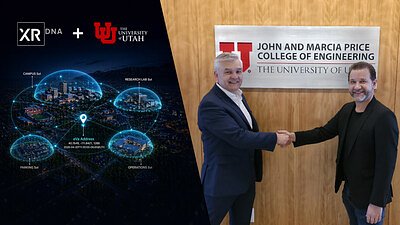
Utah Partnership Aims to Build the 'Internet of Actions'
SALT LAKE CITY, UT – May 13, 2026 – In the heart of Utah's booming "Silicon Slopes," a landmark partnership is underway to build the next evolution of the internet—one where digital systems don't just connect and share information, but actively coordinate and execute tasks in the physical world. Spatial computing firm XRDNA and the University of Utah's John and Marcia Price College of Engineering have announced a multi-year strategic collaboration aimed at creating what they call "executable systems."
This initiative seeks to move beyond the familiar Internet of Things (IoT), where devices passively report data, to an "Internet of Actions" where infrastructure, sensors, and digital environments operate as a single, living ecosystem. The partnership establishes a formal framework for joint research and development, leveraging XRDNA's cutting-edge technology to transform academic breakthroughs into operational systems for critical sectors like aerospace, defense, and national infrastructure.
From Connected to Executable: A New Digital Fabric
At the core of this ambitious vision is XRDNA's proprietary technology stack, designed to serve as a new foundational layer for real-time coordination. The centerpiece, Mission Fabric™, is described as a real-time orchestration layer that unifies identity, security, and infrastructure into a continuously coordinated system. It's the digital nervous system intended to make physical assets intelligent and actionable.
Unlike traditional siloed systems, Mission Fabric™—supported by Elastic Vector Addressing (eVa) for locating any object in space and time, and Spheres of Influence (SoI) for managing trust and security—is designed to weave disparate elements together. A university laboratory, a city's power grid, a fleet of drones, or a constellation of satellites could all be integrated into a single, executable environment. This transforms them from a collection of disconnected assets into a cohesive system that can sense, decide, and act in unison.
"This partnership represents a fundamental shift in how innovation happens," said Charles Adelman, Founder and CEO of XRDNA, in the announcement. "Mission Fabric™ is the orchestration layer that turns infrastructure into executable systems. By partnering with the University of Utah, we're creating a living R&D environment where research, operations, and real-world deployment can function as one continuously coordinated system."
A Legacy of Innovation in the Silicon Slopes
The choice of the University of Utah is deeply symbolic. As one of the original four nodes of the ARPANET, the precursor to the modern internet, the university helped lay the groundwork for our connected world. This new partnership aims to build on that legacy, pioneering the shift from a web of information to a web of action.
The collaboration also reinforces Utah's meteoric rise as a national technology hub. The state, which projects a staggering 33% growth in tech occupations by 2034, has cultivated a vibrant ecosystem that supports deep-tech innovation. The presence of major tech players like Qualtrics, Pluralsight, and Domo has created a fertile ground for startups like XRDNA, which was founded in 2023 with over a decade of patented IP and an initial $2.2 million in pre-seed funding.
"We are living through a period of rapid technological disruption, and engineering colleges have a responsibility to help shape that future rather than simply respond to it," stated Charles Musgrave, Dean of the John and Marcia Price College of Engineering. "Our partnership with XRDNA gives our faculty and students an excellent opportunity to collaborate with an industry partner with pioneering technology on complex systems-level challenges... Our goal is to create an environment where research, education, and real-world problem solving reinforce one another—and where promising ideas can move more quickly from the lab into practical use."
Forging the Tools of National Security and Industry
The practical applications of this technology are far-reaching, with an initial focus on high-stakes domains. Key areas of collaboration include defense and space systems, multimodal sensor networks, materials innovation, and digital twins for critical infrastructure.
In aerospace and defense, the partnership aims to build adaptive, coordinated mission networks. For example, Mission Fabric™ could be used to vectorize Space Domain Awareness, uniting ground-based sensors, satellite catalogs, and analytics into a secure, interoperable mesh. This would allow operators to visualize the orbital environment in real-time, with AI predicting potential satellite conjunctions and enabling automated responses. It promises to transform disparate intelligence, surveillance, and reconnaissance (ISR) assets into a unified, intelligent network.
In the civilian sector, the technology will be applied to building real-time, spatially aware digital twins of physical systems. This aligns with work already being done in the state, such as the Utah Department of Transportation's efforts to create a digital twin of its transportation system. By integrating live sensor data into a virtual model of a city's power grid or water system, operators can run simulations, predict failures, and optimize performance in real-time, enhancing resilience and efficiency.
The Promise and Perils of an Executable World
The vision of a world of executable systems is one of unprecedented efficiency and capability, but it is not without significant challenges. Concentrating control over critical physical infrastructure into a single digital layer creates an incredibly high-value target for cyberattacks. A breach in such a system could have cascading real-world consequences far beyond a typical data leak.
Anticipating this, XRDNA has built its security model, Spheres of Influence (SoI), on a "Zero Trust Native" architecture. The principle is that no user or device is trusted by default, and every interaction must be continuously authenticated, authorized, and audited. This granular approach to security is designed to contain threats and prevent unauthorized actions within the executable environment.
Beyond security, the rise of autonomous-capable systems, particularly in defense, raises profound ethical questions. As machines are given more authority to act—potentially in lethal situations—clear lines of accountability and robust human oversight become paramount. The partnership's focus on creating "adaptive, coordinated mission networks" will inevitably intersect with the global debate on lethal autonomous weapons systems (LAWS) and the role of AI in warfare.
Furthermore, the spatial computing technologies that underpin this vision rely on collecting vast amounts of data about the physical world, raising privacy concerns. As these systems become more pervasive, ensuring transparency, user control, and ethical data handling will be crucial for public trust. This collaboration between industry and academia represents not just a technological testbed, but also a social and ethical one, as they navigate the complex landscape of building a truly executable world.